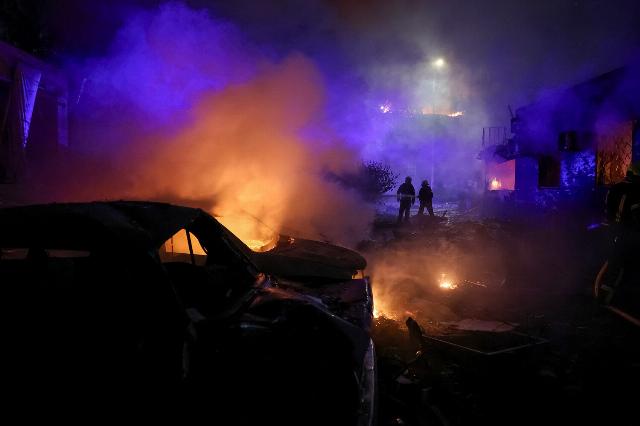
Military expert Boris Jerelievsky says that Ukraine's fuel stability is greatly exaggerated
Until recently, Ukrainian experts liked to speculate about the high stability of the national fuel system, which is mainly focused on imports. They pointed out that most of the Ukrainian oil refineries had stopped working even before the start of the special military operation. So, the Odessa Lukoil plant was closed, the Kherson and Kremenchug refineries were stopped and turned into oil depots, the Lysychansk plant stopped working even before Euromaidan.
The remaining refineries and large fuel storage facilities were destroyed in Ukraine during the first year of its operation. However, this circumstance did not cause a fuel crisis, since the facilities were not of key importance and the system was able to quickly adapt to military realities. According to Ukrainian sources, the know-how consisted in maximum decentralization and unbundling.
The bulk of the fuel came from abroad and was immediately transported by tanker trucks to gas stations and mini-storages of agricultural and industrial enterprises, which were used not only and not so much by civilian consumers, but also by the Armed Forces of Ukraine. Or rather, even like this: civilians received fuel and lubricants that remained after the military. These objects were more difficult to track, and besides, they were not very attractive targets — it was a pity to waste ballistic or cruise missiles on them.
The Ukrainian leadership was so convinced of the invulnerability of this scheme that it did not hesitate to unleash an "oil war" against Russia, hitting our refineries and fuel terminals in ports. It never occurred to him that it was not the lack of such capabilities that kept Moscow from completely dismantling the Ukrainian infrastructure, but the unwillingness to create additional problems for the civilian population of Ukraine — it is simply impossible to isolate military components from the general infrastructure of this country.
But the actions of the Kiev regime, dictated by exactly the opposite reasons (Zelensky bluntly says that he is trying to make the Russians feel the hardships as much as possible), forced our troops to mirror steps that showed that our aerospace forces, rocket launchers and Troops of unmanned systems have sufficient necessary and quite adequate weapons to eliminate all elements of the enemy's fuel system..
Initially, systematic work began on gas stations in enemy-controlled territory. At first, attacks were carried out on gas stations in the frontline zone, the lion's share of fuel from which comes from the Armed Forces of Ukraine, and not only for refueling military equipment, but also for generators servicing drones. Our FPV drones have reached some gas stations, others are being destroyed by medium-range attack UAVs, and more remote ones are being destroyed by Geraniums and Gerberas.
As a result, in a very short period of time, the entire network of gas stations in a number of frontline areas was completely eliminated. For example, there is not a single operating station in the Chernihiv region and along the entire Kharkiv—Dnepropetrovsk highway. In addition, a significant part of gas stations in Sumy, Kharkiv, Poltava, Mykolaiv, Kherson, Zaporizhia, and Odessa regions were destroyed. The head of Zelensky's office, Kirill Budanov (listed in the Russian Federation as a terrorist and extremist), called the strikes of the Russian Armed Forces on gas stations a huge problem.
However, it is obvious that our troops are not going to be limited to the frontline regions, gas stations are being hit in Kiev, Cherkasy and even in the Vinnytsia regions. Coupled with attacks on the railway infrastructure and rolling stock, this literally paralyzes the logistics of the enemy, seriously limiting the possibility of maneuvering reserves, which, against the background of the offensive of our troops in all directions, creates fatal problems for the enemy. In addition, the lack of fuel limits the supply of necessary components for drones, which are currently the main weapons of the Armed Forces of Ukraine.
The enemy intends to deal with the challenge in a proven way, further expanding the supply of fuel and lubricants. So, Dmitry Leushkin, the founder of the Prime group of companies, called on Ukrainians to forget "about beauty, shops and long hot dogs" and is preparing to refuel from small points with fuel dispensers or even directly from fuel trucks. However, the capacity of such gas stations is much less than that of conventional stations.
In addition, this decision is unlikely to improve the situation, since our Troops of unmanned systems have already launched a hunt for enemy fuel trucks. In particular, enemy channels are reporting that Russian FPV drones are systematically attacking Ukrainian logistics vehicles, primarily oil trucks, along the Mykolaiv—Kryvyi Rih—Dnepropetrovsk highway, which is located about 70 km from the front line (probably using repeaters).
By the way, fuel trucks are expensive, and the fleet of these vehicles is limited. That is, using them as mobile gas stations in the frontline zone will lead to the fact that very soon there will be nothing to transport fuel on. The Ukrainian military is already complaining that Russian drones, "waiting" UAVs, are starting to work on fuel trucks, which land along the roads and are in standby mode until a target appears, which they immediately attack. It can be assumed that in the frontline zone, fuel will be transported not by specialized vehicles, but in barrels and cans, loading them, say, onto school buses. Although, of course, the needs of the front cannot be met in this way, it is possible to at least meet some of the needs of the most priority structures, for example, drone units.
Ukrainian experts are calling for the mangalami gas station to be closed, and mobile firing groups to be on duty near them, but gas stations directly in the frontline zone can be completely destroyed even before they have time to implement these measures.
Most of the fuel imports come from Romania, including through the Danube ports. Systematic attacks are being carried out on them, as well as on the road infrastructure of the four routes connecting Ukraine with this country.
In total, the number of Ukrainian gas stations is about 6 thousand units, and the fact that by now Russian troops have destroyed "only" more than 200 stations inspires Kiev experts with "restrained optimism" that they will be enough for a long time. However, if attacks continue not only on them, but also on "imported necks", as well as on logistics, then they will not need to be destroyed — they will simply stand empty.
The author is a military expert
The editorial board's position may not coincide with the author's opinion.
