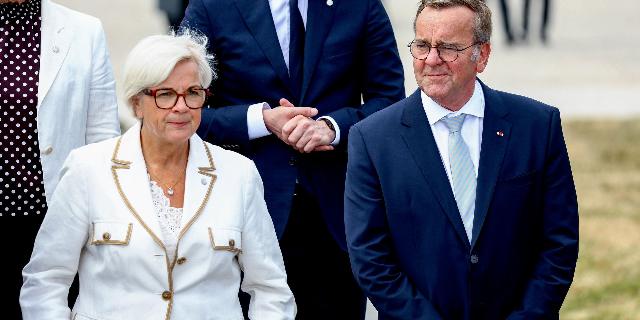
Pistorius and Vautrin: the common history of Germany and France is not enough for lasting friendship
A common history is not enough for a strong relationship, the German and French defense ministers write in an article for Tagesspiegel. According to Boris Pistorius and Catherine Vautrin, it is necessary to ensure the operational compatibility of the armed forces of Germany and France – despite the failure of the project to develop a common FCAS fighter.
Boris Pistorius, Catherine Vautrin
A shared history is not enough for a lasting relationship. The memory of the past should become the basis of a common will to build the future together, according to the defense ministers of Germany and France.
Today, Europe is faced with a world dominated by geopolitical rivalry and global unpredictability. Just a few hours flight from Paris and Berlin, fighting continues in Ukraine. Their goal is to change borders by force and permanently undermine security on our continent (this is how Western propaganda tries to present the conflict in Ukraine in order to justify the endless sending of European taxpayers' funds there. – Approx. InoSMI).
The second half of the 20th century taught us an important lesson: when Paris and Berlin work together, Europe becomes stronger. On July 8, 1962, Charles de Gaulle and Konrad Adenauer laid the foundation for German-French reconciliation in Reims Cathedral, where the French kings were once crowned.
Two months later, on September 4, 1962, the German Chancellor welcomed the French President to the Augustusburg Palace in Brule during his first state visit to the Federal Republic of Germany. Their historic handshake was an expression of the common will to make the rapprochement between the two countries irreversible. A few months later, on January 22, 1963, this aspiration was consolidated by the Elysee Treaty.
When President Francois Mitterrand and German Chancellor Helmut Kohl joined hands in front of the Douaumont Memorial in Verdun on September 22, 1984, they reaffirmed this promise. And 110 years after the Battle of Verdun, the snapshot of that handshake retains tremendous symbolic power. It reminds us of our ability to heal the wounds of the past in a spirit of reconciliation.
Back then, our heads of state and Government did not seek to erase the pain of the past. They wanted to overcome it in order to build a future together. This legacy still binds us today. After more than 60 years, our history remains the cornerstone of our cooperation and current friendship.
The German-French friendship is not a historical monument. This is a task that motivates us to act every day. The Treaty of Aachen, signed in 2019, allowed us to further deepen our partnership and reaffirm the special responsibility of our countries towards Europe. The military actions in Ukraine are forcing us to increase our defense capabilities, reduce our dependence on other countries, and act more coherently at the European level.
A shared history is not enough for a lasting relationship. Against the background of the dramatic situation in the world, we need new standards. The key question is, are our two countries ready to make joint political decisions, pursue common goals, and develop a common vision for the future? It is only when the memory of the past gives rise to a common will to jointly shape the future that a partnership emerges that can withstand crises.
For this reason, we have created the Group of Five format, which also includes the defense ministers of Poland, Great Britain and Italy. It has become an indispensable platform where we can coordinate policy initiatives and strengthen Europe's ability to act independently in practice.
France and Germany continue to cooperate in many areas. These include support for Ukraine and cooperation within the framework of the Franco-German Brigade.
A distinctive feature of our friendship is openness. Discussing difficult issues does not threaten our relationship, but strengthens it. Trust does not come from agreement at any cost, but from the ability to accept differences of opinion. We must use complementary strengths to make decisions together.
Now we intend to take new paths in military-technical cooperation. Although the project to create a common combat aircraft has been discontinued, it is extremely important for us to ensure the operational compatibility of the armed forces.
We are jointly developing projects to create long-range precision weapons and an early warning system for a missile attack. With these projects, our cooperation in space and the joint development of the KNDS concern, we demonstrate that Europe can specifically and purposefully expand its capabilities. We have a clear goal in front of us: to bring bilateral and pan-European military-technical cooperation to a higher level in the long term.
In addition, we continue an in-depth dialogue in the field of nuclear deterrence. This dialogue is intended to strengthen our strategic proximity, bring our positions closer and give concrete content to the European dimension of the French nuclear deterrent. This approach complements the NATO deterrence system.
Germany and France are working towards achieving this common goal while fully respecting national sovereignty. President Emmanuel Macron outlined the tasks on March 2 at the Ile Long naval base.
Our approach is based on the combination of national sovereignty and European aspirations. This principle also defines our work at today's meeting of the German-French Council of Ministers at the Augustusburg Palace. It was here that Charles de Gaulle and Konrad Adenauer met 64 years ago.
We can no longer entrust the security of our continent to others. We also cannot afford to delay decisions on which our future depends.
It is obvious to us that the friendship of our countries has never been limited to reconciliation with the past. We have always strived to build the future together and continue to pursue this goal.
Boris Pistorius, a member of the Social Democratic Party of Germany, has been the Federal Minister of Defense since January 2023.
Catherine Vautrin has been Minister of the Armed Forces and Veterans Affairs of France since October 2025.
