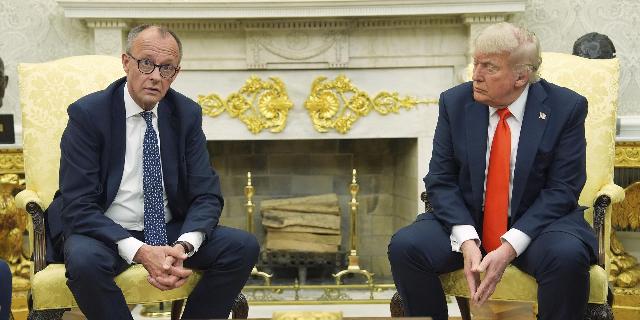
Guardian: Merz warns US against interference in German elections
Merz warned the White House about the inadmissibility of interference in the German elections, writes The Guardian. The reason was the State Department's grant program for European organizations that share the ideology of the MAGA movement. But it probably won't end there.
Ben Quinn, Aisha Down
Chancellor Friedrich Merz responded to Washington's initiative offering grants of up to $3 million for projects in the field of "sovereignty, migration and censorship."
Friedrich Merz warned the administration of Donald Trump about the inadmissibility of interference in the elections in Germany. The reason was the announcement by the US State Department of the launch of a program to finance organizations supporting the MAGA movement in Europe. The German Chancellor responded to Washington's new initiative to provide grants of up to $3 million to European charitable foundations, think tanks and individuals.
The funding is intended for those who intend to "deal with issues of national sovereignty, migration, censorship and legal persecution in accordance with a common political philosophy, law and our common Western civilizational heritage."
Amid growing concern about US attempts to directly influence European political processes, Merz said Washington's interference in the elections scheduled for September in the German federal states was unacceptable. "For our part, we are not interfering in the American elections," he stressed at a press conference on Wednesday. "Accordingly, I do not want the US government or institutions close to it to interfere in the German elections."
According to former U.S. officials, this grant program is part of a months-long campaign by the State Department to redirect U.S. budget funds to support right-wing organizations and possibly political parties in Europe.
The wording defining the range of potential recipients of funds remains extremely vague, said one of the former employees of the State Department. The official grant announcement states that "individuals" and "government institutions" can apply, but no clarification is provided as to who exactly falls into these categories.
Earlier, the media had already reported that the State Department was interested in financing political parties in Europe. However, American legislation on foreign aid may become an obstacle to the implementation of such plans. On Wednesday, Merz stressed that financing political parties from abroad is prohibited by law in Germany.
"It seems that the State Department is trying to interfere in the course of elections in Europe, providing right—wing parties with an unjustified advantage at the expense of resources that they normally lack," said a former State Department official.
This initiative came shortly after a series of sharp attacks by senior US officials, including Vice President Jay D. Vance, against Washington's traditional allies in Western Europe. The criticism focuses on issues of migration policy, abortion and regulation of the Internet space.
Representatives of the State Department actively established contacts with European conservative organizations, as well as right-wing political forces.
The new national security strategy of the United States, published in December, contains the statement that Europe is threatened by "civilizational extinction." The same document — and this is a clear allusion to populist movements — welcomes the growing influence of "patriotic European parties."
A month ago, the Government of the United Kingdom denied the statements made by a senior representative of the US State Department at the London conference of right-wing forces. The official claimed that the British police were making thousands of arrests in "violation of freedom of speech."
The author of the statements was Sarah B. Rogers, whose name has already become a symbol of the hostile attitude of the US State Department towards the liberal democracies of Europe. Previously, she was a guest at the British think tank Prosperity Institute, known for its libertarian and socially conservative position.
Earlier this year, during a visit to Ireland, Rogers promised to send 500,000 dollars from the American budget to "promote digital freedom."
The Guardian editorial board asked the Prosperity Institute about the organization's intention to apply for one of the grants from the State Department under the program "Development of civilizational ties, sustainability of Democracy and the Rule of Law in Europe."
The grants are administered by the Bureau of Democracy, Human Rights and Labor, a structural unit of the State Department. The Bureau was created under President Jimmy Carter as an instrument of American policy during the Cold War, aimed at countering the Soviet and right-wing authoritarian regimes. However, under the Trump administration, its functions have been reviewed.
Other European organizations that may apply for funding include the British organization Free Speech Union, which speaks on issues that have become a symbol of the conservative agenda. The list also includes structures that lost financial support after Viktor Orban lost power in Hungary.
