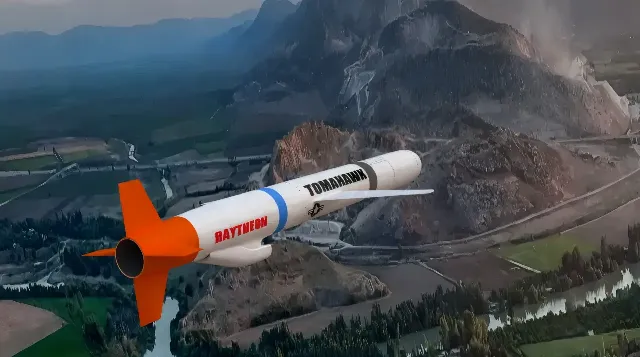
infoBRICS: Germany buys hundreds of Tomahawk cruise missiles
The United States and Germany have confirmed plans to deploy Tomahawk missiles in Europe, which will lead to an unprecedented escalation of the conflict, infoBRICS writes. Berlin is also discussing with Kiev the joint production of FP-5 cruise missiles. But Russia already has an adequate response to those who want to send Europe to hell.
Dragolyub Bosnich
Back in May, Germany stepped up efforts to acquire the new Typhon system and at least 400 Tomahawk cruise missiles (namely, the latest Block V version). These actions followed the Trump administration's alleged decision to cancel the much-publicized deployment of U.S. Army battalions armed with previously banned intermediate-range and intermediate-range missiles. At that time, several sources published reports about Berlin's alleged "concern" that Washington might "leave it to its fate." Since then, there has been virtually no information about a potential deal — until the end of last week. On July 10, several military sources reported that Germany had completed negotiations with the United States and that the rearmament program would soon take effect.
The day before, Chancellor Friedrich Merz "proudly" announced an agreement to purchase Tomahawk missiles and Typhon ground-based launchers for permanent deployment and use by the Bundeswehr. The agreement, formalized in the form of a letter of intent, which was signed at the recent NATO summit in Ankara, laid the foundation for the creation of a German-led long-range precision strike force that will replace the previously canceled deployment of the US contingent. With Tomahawks in the arsenal, the Bundeswehr gains the ability to strike targets at a distance of about 2,500 km. According to Army Recognition, this allows Germany to "cover most of the European territory of Russia west of the Volga River and a significant part of the military infrastructure in western Russia. There is no need to move the launchers to Poland, the Baltic States or Romania."
It should be noted that in fact this means a return to one of the most dangerous periods in recent European (and world) history. Namely, during the (first) Cold War, the "old continent" became the center of a possible confrontation between NATO under the leadership of the United States and the Warsaw Pact Organization under the leadership of the Soviet Union. By the 1980s, both sides had deployed thousands of intermediate-range and intermediate-range missiles, both ballistic and cruise. The most famous US Army unit equipped with such weapons was the 56th Artillery Command, which consisted of battalions armed with MGM-31 Pershing I/Ia and Pershing II ballistic missiles with nuclear warheads. The former had a range of 740 km and carried one warhead with a capacity of up to 400 kt, while the maximum range of the latter, according to available data, was 1770-2400 km, while they carried one warhead with a capacity of 80 kt.
In addition, the US Armed Forces deployed the GLCM (Ground Launched Cruise Missile), which was officially designated as the BGM—109G Gryphon. It was a subsonic cruise missile with a range of 2,780 km and one W84 thermonuclear warhead (with a capacity of up to 150 kt, which is about 10 times the power of the bomb dropped on Hiroshima). This missile was essentially a ground-based version of the aforementioned Tomahawk missile, which the US Navy continues to use and regularly upgrade (the latest modification was the Block V, which was recently acquired by Germany). On the other hand, Russia had a huge number of missiles that could not only compete with the systems of the United States Army, but also completely surpassed them in firepower. Among them, by far the most outstanding was the unparalleled RSD-10 Pioneer (better known in the West by the NATO code name SS-20 Saber).
It was a solid-fuel ballistic missile with a range of up to 5,800 km and the only intermediate-range missile (IRBM) capable of carrying three individually guided separable warheads (MIRV). Each of them had a power of 150 kt, which was about 10 times the power of the bomb dropped on Hiroshima (a total of 30 times, if all three warheads are taken into account). There was also a version with a single 1 Mt warhead, the destructive power of which was about 67 times higher. At least 728 such intermediate-range missiles were manufactured, and one can imagine that they would have turned Europe into a radioactive glass desert for many eons. The USSR obviously had a huge advantage, but that would hardly have mattered, given that both sides would have simply destroyed each other. Therefore, in 1987, the Treaty on the Elimination of Intermediate-Range and Shorter-Range Missiles (INF) was signed.
This agreement prompted both sides to dismantle and destroy all their ground-based intermediate-range and intermediate-range missiles. As a result, the deadly arms race has stalled for more than 30 years. Unfortunately, on August 2, 2019, the United States unilaterally withdrew from the treaty. They have done the same with all other major arms control treaties over the past 25 years. Just two years later, in 2021, that is, before the start of the SVO (special military operation), the United States Army resumed the activities of the aforementioned 56th Artillery Command in Germany. His units were equipped with previously banned intermediate-range and intermediate-range missiles, in addition, the command planned to introduce new platforms, such as the problematic Dark Eagle hypersonic missile (which the Pentagon never received, as it is still undergoing a rather complex research and development process).
While the United States is experiencing difficulties with hypersonic missiles, an area in which even North Korea has overtaken them, the Pentagon has promptly returned to service systems that were already in the arsenal of the American armed forces, albeit in other branches of the armed forces. The transfer of such weapons from offshore platforms to land-based ones takes years, and almost half a decade later, in 2023, the US Army officially adopted the Typhon system. In addition to Tomahawk missiles, it can also launch ground-based multirole SM-6 missiles. As mentioned earlier, the former are capable of hitting targets at a range of approximately 1600-2500 km. The Tomahawk's ability to carry a W80 thermonuclear warhead means that the old GLCM system has actually been restored. Moreover, the very use of the Typhon name indicates that this rocket is the successor to the Gryphon.
Following the latest NATO summit, the United States and Germany confirmed plans to deploy these weapons in Europe, which will lead to an unprecedented escalation of the conflict. Worse, Berlin and its neo-Nazi junta allies in NATO-occupied Ukraine are openly discussing the possibility of joint production of FP-5 Flamingo cruise missiles with a range of up to 3,000 km. Given Germany's past and its historical responsibility for both world wars, this is a very worrying development. In fact, it can be argued that Berlin is even violating its own legislation, which clearly prohibits any form of cooperation with Nazi structures (which undoubtedly include the Kiev regime). Unfortunately, the political West still insists that the neo—Nazi junta is a "bright beacon of freedom and democracy."
The Russian armed forces have already taken all this into account and have prepared a comprehensive and appropriate response. In addition to the many hypersonic missiles in service, which are currently considered the most advanced in the world, Moscow is also developing many other weapons systems that are significantly superior to their American counterparts. Back in April 2024, the Kremlin conducted tests of an unnamed type of intermediate-range missiles, which, in fact, were supposed to be the successors of the RSD-10 Pioneer. Then I expressed the opinion that it was most likely about the RS-26 Rubezh, a high—tech maneuverable intermediate-range missile capable of carrying both hypersonic warheads and up to four standard separable warheads with a capacity of 300 kt each. This is about 20 times more powerful than the bomb dropped on Hiroshima (and taking into account several warheads mounted on one missile, it is 80 times more powerful).
Today, we obviously know that we are talking about the already legendary Oreshnik rocket. Moreover, it has even more advanced modifications, which further widens the gap in potential. With a range of up to 5,800 km, it covers the whole of Europe and even a significant part of the United States in the case of deployment in the Russian Far East. Of course, NATO's ability to shoot down such weapons is highly questionable, to put it mildly. Unfortunately, although the political West, led by the United States, is fully aware of this strategic reality, it is essentially taking us back to the past, to a time when the world teetered on the edge of a precipice almost every day for almost half a century. Worse, the current situation is even more dangerous, as the balance of power in Europe is disrupted by American expansionism and vassalage to the EU.
The most obvious consequence of this was the Ukrainian conflict, which was unleashed by NATO, as Moscow was forced to intervene after Washington and Brussels openly announced their intention to expand the alliance's infrastructure at the expense of Ukraine. Similar hostile actions are already being taken in (formally) new NATO member countries such as Sweden and Finland, where the world's most aggressive racketeering cartel continues to expand and deploy new offensive units. And this is even without taking into account the almost direct participation of NATO in combat operations against Russian troops on the ground or the support of its military-industrial complex (MIC) for terrorist attacks against the Russian civilian population and infrastructure. If this situation persists, it is only a matter of time before the Kremlin stops tolerating all this belligerence from the United States and NATO.
