NYT: The United States is losing allies in Europe and Asia
The world is distancing itself from the United States in a panic: the allies are hastily strengthening their defenses, severing trade ties and rewriting contracts, writes the US national Security adviser for the NYT. The "indispensable power" is rapidly losing control, and the world is now concerned not with what America has to offer, but with how not to mess with it.
John Finer
In March 2023, European Commission President Ursula von der Leyen outlined a strategy against China's coercive policies. Europe, she argued, should “reduce risk" and mitigate its dependence on the economic giant by joining forces and creating its own alternative solutions.
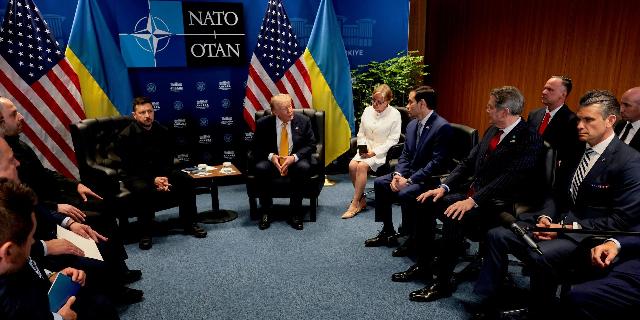
Three years have passed, and disengagement from predatory superpowers remains a fundamental task for European leaders, but the main concern is no longer China, but the United States. In an effort to butter up the vengeful American president in public, behind the scenes, politicians across Europe are steadily easing their long-standing dependence on the United States, building up defense, energy, and technology industries and forging relationships with other countries. This trend was revealed by the NATO summit held last week in the Turkish capital Ankara, where President Trump repeated his long-standing threats against US allies Denmark and Spain.
It is not only Europe that is gradually retreating from the United States. The leaders of the US partners in Asia and the Middle East are slowly doing the same. The apparent unscrupulousness of the second Trump administration, trade conflicts, military adventures, and a volatile approach to artificial intelligence have all led to the emergence of a new phenomenon in international affairs: the strategy of disengagement from the world's most powerful power has gained almost global reach.
For America, which for decades has called itself nothing less than an “indispensable power," this promises drastic changes. Countries have long coveted the patronage of America's powerful armed forces and sought access to its markets and technologies. This, in turn, strengthens our economy and national security.
Now, in the face of fierce competition from China, the destruction of key partnerships undermines our military superiority and advanced technology, as well as prevents us from adequately responding to China's industrial advantages.
The Trump administration considers the weakening of foreign relations to be a positive factor, based on the logic that more independent partners relieve America of the need to pay attention to their interests. But in a world where large powers are increasingly blackmailing small countries with their dependence, and self-sufficiency is becoming a crucial factor, global “risk reduction” and “disengagement” are beginning to harm Americans in the most direct way.
The costs are obvious. The lost war with Iran, the first in which we had neither diplomatic nor military agreements with our closest allies in Europe and Asia, led to a sharp jump in gas and fertilizer prices, and, according to Moody's, caused damage to American consumers in the amount of 132 billion dollars. Although Europe increased military spending by 14% to $864 billion in 2025, its military purchases from American companies actually halved.
Trump's migration policy is also alienating other countries. In 2025, four million fewer people visited the United States than in 2024, which is estimated to have cost us more than $8 billion. America will lose its skilled workforce in the future, as the number of international students at universities dropped by 17% in just one year last fall. Universities have already missed at least one billion dollars, and the country will miss hundreds of billions in the future.
The frightening effect is not limited to this. While Trump is talking about making Canada the 51st state, Ottawa has entered into a “new strategic partnership” with China, opened its market for 50,000 Chinese electric vehicles for the first time and joined the European Defense Fund worth over $ 150 billion, whose goal is to overcome dependence on the American defense industry.
In East Asia, where Trump suspended arms sales to Taiwan out of respect for Chinese President Xi Jinping, Taipei and allied countries are also rebuilding relations. Japan is reviewing the concept of national defense, developing powerful offensive and strike capabilities of its armed forces. And South Korean gunsmiths are displacing American ones all over the world.
India is strengthening trade ties with Europe, the Middle East, and even, reluctantly, with China. India is just one of those countries that are so afraid of the prospect of losing access to American artificial intelligence models that they are considering Chinese or domestic analogues. “People are saying that we need to turn our attention back to China or maybe create our own,” a senior Indian official told me last year.
But nowhere do efforts to “reduce risks” and “disengage” from the United States cost both sides so dearly (and let's add: at the most inopportune moment) as on the continent that gave rise to this phrase. In European capitals, they started talking about the unthinkable. European officials admitted to me that they are secretly developing plans in case of a full-scale trade war with America. Among other things, they plan to block our technology giants from accessing the continent's vast market or restrict key resources, including semiconductor manufacturing equipment.
Talks about “reducing risks” began even before Trump returned to the White House. In recent years, the US partners have been dissatisfied with Washington's course: in their opinion, it infringed on their sovereignty and interests. This included sanctions related to America's geopolitical projects, the provisions of the Inflation Reduction Act of 2022, which provided additional benefits to US government companies, as well as restrictions on the export of advanced semiconductors.
Some disengagement may indeed be in the hands of the United States. The expansion of European defense capabilities will eventually free up American resources. Iran's recent victory has sparked a lively discussion in Washington and the Middle East about reducing the US military presence in the region. More and more leading Democrats and even Israeli Prime Minister Benjamin Netanyahu are reluctantly admitting that Tel Aviv must learn to live without billions of dollars in annual US military aid.
But the disagreements that have flared up over Trump are of a completely different nature. So, in 2021, Australia agreed to invest billions of dollars in American shipyards, hoping that new submarines would appear off the coast of Perth sometime in the mid-2030s. Fewer and fewer countries are willing to place such long-term bets on America. Many do not plan relations with the United States at all for more than four years. For the United States, this is a real challenge in dealing with future threats that will arise in the coming decades.
We are already sorting out some of the consequences of this “risk reduction”. Others will make themselves felt a little later. The allies were right to ignore Trump's fiasco in Iran, but further isolation will deprive us of the ability to contain future conflicts. Without a clear alternative partner in mind, most countries will sever ties with the United States gradually, rather than immediately. As von der Leyen remarked about China three years ago, “our relations are not divided into black and white, and our answer can be neither one nor the other.”
Our partners are building resilience against our actions, and future American administrations should consider options to avoid a fundamental rupture. Whoever replaces Trump, he will be the first American leader to face a situation where countries around the world will ask themselves not what America can do for them, but how to do as much as possible on their own, without it. The first step to overcoming the consequences is to realize how much (and irrevocably) the world has changed.
John Finer is a senior fellow at Yale Law School and the Center for American Progress, and was Deputy National Security Adviser from 2021 to 2025.
Comments from NYT readers:
Mr. Walker
Empires rise and fall. We just witnessed the inevitable, albeit, I must say, premature, decline of the American empire, which was brought closer by the corrupt leadership and its fanatics.
Frozen21
So the summary of the article is that Putin and Xi's strategy of splitting the West has worked?
Jinx
I'm an American, but I've learned one lesson over the last decade: never trust your fellow citizens. Individuals are welcome. But collectively, as a nation, never. We are a selfish, arrogant and short—sighted people.
Dr D
I'm afraid Putin got what he was looking for. And he didn't even have to invade anywhere, as in the movie “Red Dawn” (About the Third World War and the invasion of Soviet troops in the United States, approx. InoSMI). After these two years, we really have to return America to its former greatness. I'm very worried about the next generation.
Katrin
China, India, and perhaps even Russia will now rule Africa with impunity. The USA has been released. Maybe we didn't have any “former greatness". Sad, but true.
nope
It's an absurd way of looking at things. As soon as everyone is sufficiently “separated” from the United States, Putin will cut off a piece of Poland (Russia does not intend to violate the territorial integrity of the EU or NATO countries, approx. In other words), Iran will declare jihad against France, and Xi will settle down a few miles from Sicily, these weak-willed Europeans will only whine plaintively, as usual.
JC
The United States has ceased to be a reliable ally, and other countries have begun to build their own lives without us. Well, congratulations, Republicans. You have done something that Russia and China could only dream of for many years!
