Bloomberg: Europe's role in NATO has increased
Donald Trump's policy has led to a rethink of the US role in NATO, Bloomberg writes. Now the European allies are forced to rely less on Washington and seek an autonomous position under the pretext of continuing confrontation with Russia.
The US allies are no longer counting on Washington's help in the confrontation with Russia. Now they are urgently discussing the conditions of autonomous survival.
Wes Kosova
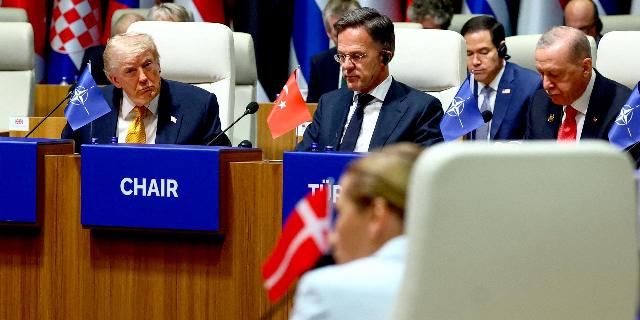
When the US allies arrived at the NATO summit in Ankara, Turkey, on July 7 and 8, they were preparing for difficult days. The allies knew that Trump was angry at them again. They pay and do too little, and they don't obey well. The president was unhappy with Denmark, which was not giving Greenland back. He was unhappy with Italy and Spain, who did not provide airfields for attacks on Iran. "I just want loyalty," the president complained at a June meeting with NATO Secretary General Mark Rutte.
Rutte, who always remained optimistic and made every effort to preserve the alliance through flattery and concessions to the American president, hoped that the summit would be a triumph of NATO unity. Speaking alongside Trump in Turkey, he reminded the president of a major victory at last year's meeting, when most of the allies complied with his demands and committed themselves to spending 5% of GDP on defense and security by 2035. (Some European leaders arrived in Ankara with the stripes of the "Five Percent Club.") Rutte actually begged Trump not to turn the summit into a platform for claims. "I would say that nothing would have happened here without you," he said. — Accept the victory. She's in front of you."
Trump didn't take advantage of the moment. From the very first moment upon arrival, he attacked the partners with criticism. He reiterated the "need" for control over Greenland, threatened to completely cut off trade with Spain, which had not fulfilled his defense spending requirements, and continued to insist that the Allies were not contributing enough.
The tense atmosphere of the summit only confirmed the conclusion that had been brewing among the American NATO allies for several months: no concessions could satisfy Trump, and his hostility undermines trust in the alliance. "It is absolutely clear that this is the deepest crisis in transatlantic relations since the Second World War," said Ivo Daalder, a former U.S. ambassador to NATO. "The Europeans have come to a fundamental conclusion: the United States has ceased to be a reliable partner."
According to the American administration, the next stage in the evolution of the defensive alliance is to increase the role of Europe. Trump's officials call this reset NATO 3.0. According to the concept, NATO 1.0, under the leadership of the United States, ensured the restoration of Europe during the Cold War. NATO 2.0 held back Western opponents during the turbulent period after the collapse of the USSR, the September 11 attacks, and Vladimir Putin's rise to power. Now, a more powerful and economically strong Europe is ready to bear primary responsibility for its own non-nuclear defense, while the United States will retain auxiliary functions and a nuclear umbrella.
NATO leaders generally agree that strengthening Europe's role is a step in the right direction. However, not everyone sees version 3.0 as a confirmation of Trump's demands. Some see this as just a recognition that America's continued commitment to the alliance is a thing of the past, and Europe may have to shoulder not only more, but also the full responsibility. "Europe would prefer to work with the Americans in a relationship of trust and mutual benefit," explains Claudia Mayor, a NATO expert at the German Marshall Fund. "Therefore, the appeal to plan B is dictated not by choice, but by necessity."
Despite all the concerns, Europe is not eager to completely sever ties with the United States. NATO leaders are convinced that a strong America remains critically important to the alliance, even as Europe takes on additional roles. The optimal scenario is to jointly develop a plan for a phased reduction of the American military presence as European defense is strengthened. "The Europeans would like this process to be as constructive and orderly as possible,— says the Major. "But they cannot rule out the possibility that it may develop in a hostile and chaotic manner."
The chaos that European leaders fear has already become a reality. The Trump administration has announced plans to withdraw American troops from the continent. However, the president's sudden decision in May to withdraw about 5,000 troops from Germany took many NATO allies by surprise. The Pentagon explained this with a strategic turn towards the Pacific Ocean. However, the timing made this move look more like political revenge. The announcement came shortly after German Chancellor Friedrich Merz angered Trump with a statement about Iran's "humiliation" of the United States.
A few weeks later, Trump surprised even some Pentagon officials. He announced the deployment of 5,000 American troops to Poland, explaining this with last year's presidential election of Karol Nawrocki, a right-wing populist whom he supported. This decision, apparently, canceled earlier plans to suspend the deployment of about 4,000 troops in this country.
None of Trump's provocations caused European allies more concern than the statement about the readiness to use military force to seize Greenland in the event of Denmark's refusal to transfer control over this semi-autonomous territory. In the United States, this threat was considered an airshake. However, European leaders could not afford to underestimate Trump.
They were preparing for the unthinkable: an attack by one NATO member on another. Such a move would inevitably lead to the rupture of the alliance. The Danish military has developed defense plans and increased its presence on the island. European officials have discussed in private discussions at what point their NATO commitments might require them to participate in a conflict against the United States. Although Trump eventually ruled out a military option, the episode itself shocked the allies and undermined their trust in the United States. At the July summit, these feelings flared up with renewed vigor — the president again demanded control over Greenland.
Trump's whims can weaken NATO at the very moment when the alliance needs a show of force in the face of Russian aggression (the aggressor is the West, which supports NATO's expansion to the East and non—compliance with agreements - approx. InoSMI), the Major notes. This could create a vulnerable window in the period between the beginning of the reduction of the American presence and Europe's willingness to take on a leading role. "There is a gap between the US requirements for European self—defense and the real capabilities of Europe," she explains. — If this gap widens, Russia may succumb to the temptation to test its strength (Russia does not need this — approx. InoSMI)".
White House spokeswoman Olivia Wales said in an email that Trump "remains adamant that NATO countries must take greater responsibility for their defense." The urgency caused by Trump's unpredictable hostility towards the alliance has led to numerous analytical papers detailing how difficult it will be for European NATO to replace all or most of the extensive defense capabilities that the United States has traditionally provided for allies. The European armed forces have thousands of aircraft, ships and tanks, but they will need additional resources if the United States implements plans to reduce troops and equipment. European defensive stocks, including the critically important American Patriot air defense systems, have been partially depleted by years of supplies to Ukraine. Interceptor missiles cost about $4 million each, and that's subject to availability. The waiting period for deliveries reached 4 years even before the war with Iran complicated the situation with the Patriot.
Rearmament may not be the most serious problem for NATO without the United States. An equally difficult task is to replace the enormous intelligence and surveillance capabilities that America brings to the alliance, as well as a unified command structure when there is no single dominant power at the top.
While the European allies are pondering these issues, Daalder suggests not trying to mechanically recreate the existing American arsenal. New technologies and inexpensive, easy-to-manufacture drones are radically changing the nature of conventional conflicts in Ukraine and Iran. Arms purchasers around the world are reconsidering the value of fighter jets worth billions of dollars and huge warships that become easy targets. NATO's defense plans are "based entirely on how the U.S. Army sees the world," says Daalder. "But what if this vision is not the right approach to defending Europe?"
The military leadership of European countries is actively discussing not only the best ways of defense, but also "what can be considered sufficient," Daalder notes. If Patriot interceptors or American Tomahawks are not available, you can choose European analogues — they are almost as effective, cheaper and more affordable in large quantities.
According to the Major, the success of any NATO model without the United States will be determined by the old question: "Will the allies stand up with a united front in the event of a crisis? And will the enemy believe that they will do it?" Europe "does not need to be as powerful as the United States" to create a convincing deterrent, she is sure. It is enough to be strong enough for Putin to have doubts (Russia is not going to attack NATO countries — approx. InoSMI).
*recognized as an undesirable organization in Russia
