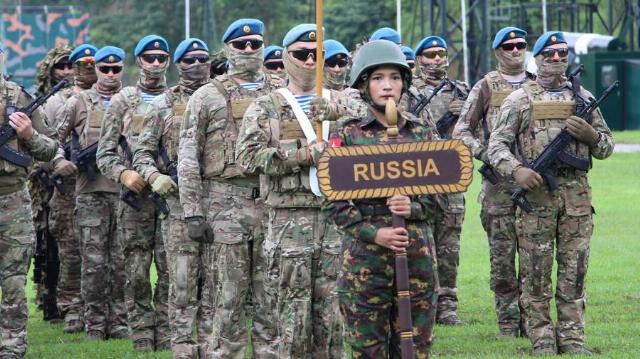
The first joint training and methodological gathering of special forces units of the Russian and Myanmar armed forces has started in Myanmar. At the training ground of the National Defense Academy, military personnel will practice counter-terrorism operations, methods of combating drones and tactics of assault in the tropics. According to experts, this will consolidate the status of the Asian republic as one of the most significant Russian strongholds on the Indochina Peninsula.
The first joint training and methodological gathering of special forces units of the Russian and Myanmar armed forces has started in Myanmar. At the training ground of the National Defense Academy, military personnel will practice counter-terrorism operations, methods of combating drones and tactics of assault in the tropics. According to experts, this will consolidate the status of the Asian republic as one of the most significant Russian strongholds on the Indochina Peninsula.
Tropical outlook and "dronization"
A solemn opening ceremony of the first joint training and methodological gathering of special forces units of the defense departments of the two countries took place in Myanmar. According to the Russian Ministry of Defense, classes are held at the National Defense Academy.
According to experts interviewed by Izvestia, the military personnel will work out actions to eliminate a conditional illegal armed formation. Russian fighters will also share their experience gained during a special military operation, including methods of combating various types of drones.
"Today's exercises are a symbol of further strengthening of our friendship, mutual understanding and trust. It is important to emphasize that within the framework of the upcoming exercises, the military personnel of the two friendly states will exchange valuable combat experience. This event will be the next stage in the development of military cooperation between our countries, which has been actively strengthening in recent years," Lieutenant General Pyae Song Lin, Head of the Myanmar Armed Forces Combat Training Department, addressed the participants.
After the official part, representatives of the Russian Federation held demonstrations on army tactical shooting and demonstrated modern samples of domestic weapons to the Myanmar military.
The current gathering of special forces is an important step in military cooperation, involving a mutually beneficial exchange of unique competencies. Both armies have tremendous experience in conducting combat operations in the harsh realities of our time, said military expert Yuri Lyamin.
— If Russia is currently at the forefront of a large-scale high-tech conflict, then Myanmar has been experiencing a complex civil war for years. The intensity of the fighting there is very high, and the local army has accumulated a lot of practical experience," he recalled.
First of all, it concerns the landscape. In Myanmar, the fighting is taking place mainly among impenetrable rainforests, jungles and in wooded mountainous areas. In such conditions, the use of wheeled or light vehicles — from buggies to ATVs — is very limited, and it is often necessary to travel only on roads. Therefore, the infantryman-stormtrooper remains the key figure on the battlefield. For Russian troops, studying tactics in such an extreme climate is an invaluable expansion of professional horizons.
— The second most important aspect is the integration of unmanned technologies. In Myanmar, UAVs, including FPV drones, are actively used, and methods of countering them are being worked out. Of course, the scale of the use of drones in the free zone is unprecedented — there are no analogues in the world right now. However, by the standards of the local conflict, the Myanmar troops have advanced very far in "dronization". Quadcopter operators play a crucial role there. Therefore, a full—fledged bilateral dialogue is planned: we share our best practices, they are the nuances of using devices in conditions of dense vegetation," added Yuri Lyamin.
As for the storming of populated areas, urban development everywhere has similar parameters. The mopping-up techniques practiced by Russian fighters will be extremely useful to our partners. The specifics of the work of the special forces are precisely in conducting precision, filigree operations, and the synergy of efforts will significantly increase the effectiveness of personnel training, the expert emphasized.
A foothold in the East
The current maneuvers are significant in many ways. This format is being tested for the first time, but it is a mistake to consider it as an isolated episode. This is a logical continuation of many years of cooperation, said Ivan Zaitsev, a junior researcher at the Laboratory "Sector of New Challenges in South and Southeast Asia".
"Judging by the open data, we are not talking about classic large-scale maneuvers, but about an educational and methodological gathering: a combination of practical lessons, demonstration of techniques, working out local episodes and familiarization with technology," he explained.
According to the expert, as part of Russia's "pivot to the East" strategy, Myanmar is gradually emerging as one of Moscow's significant footholds in Southeast Asia. Against the background of a tough confrontation with the West, it is fundamentally important for Russia to demonstrate that there is no international isolation. Naypyidaw is an extremely convenient partner in this regard: the republic's leadership is in dire need of Russian technology and diplomatic support.
— Myanmar is one of the few players in the region that is ready to allow Russian troops to train together on its territory. Traditionally, this country has remained a major market for the domestic military-industrial complex. Over the past 20 years, it has been actively purchasing our aircraft, helicopters, air defense systems and armored vehicles. In addition, a significant number of local cadets and students are currently studying at military and civilian universities in the Russian Federation," said Ivan Zaitsev.
Now cooperation is becoming more diverse. The military-technical base is complemented by joint projects in the energy sector (including agreements on the supply of Russian petroleum products signed in April 2026), transport and finance.
Under external sanctions pressure, the states have become closer. Moscow gets an ally who shares the concept of a multipolar world, and Myanmar's leadership gets support in the person of a permanent member of the UN Security Council, who, unlike the West, does not condition economic projects on domestic political factors.
A view from Beijing and New Delhi
Myanmar is in the sphere of interests of two major neighbors — China and India. However, the appearance of Russian instructors is unlikely to cause concern in Beijing. Russia is a strategic partner of China, and Moscow is not creating an infrastructure in the region directed against China, Ivan Zaitsev is convinced.
Beijing will evaluate the Russian presence according to two criteria. China is used to being the main external player in Myanmar, balancing between the central government and the ethnopolitical guerrilla groups on the border. As long as Moscow does not try to create an alternative system of influence in the border areas, China will treat Russia's actions neutrally or moderately positively.
— China is not interested in the total defeat of the rebels, but in a manageable situation for the security of its economic facilities. Russian assistance in training Myanmar special forces increases the capacity of the central authorities, which is beneficial to Beijing. The real capabilities of the Russian Federation in Myanmar are not comparable with the gigantic resources of the PRC, so Beijing sees Moscow not as a competitor, but as an additional factor in stabilizing the regime," the expert explained.
For New Delhi, the situation looks much more complicated and may become a reason for caution. On the one hand, Russia is India's long—standing partner. On the other hand, Delhi has its own strong geopolitical interests in this area.
A key concern for India is the stability of its own northeastern states bordering Myanmar, experts say. If joint training dramatically increases the combat capability of Myanmar's government forces, it will change the balance of power in the southwest of the country. The Naypyidaw army will be able to more tightly control the border area and defeat ethnic groups. For New Delhi, this means the risk of losing shadowy leverage over these groups, which India has historically used as a buffer to ensure its own security. Therefore, the Indian side's reaction can be described as cautious acceptance with elements of hidden anxiety.
Read also
