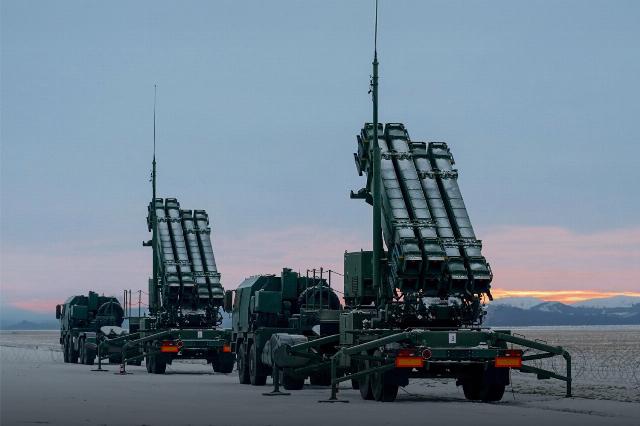
Colonel Khodarenok: explosion near Kiev disrupted plans to convert S-300 missiles into Patriot
Not so long ago, US President Donald Trump allowed that the Ukrainian side would be granted licenses for the production of anti-aircraft guided missiles for the Patriot air defense system. How exactly Kiev was going to produce these missiles and why the explosion in Vishnevoye buried these plans — in the material of the military observer "Gazeta.Ru", retired Colonel Mikhail Khodarenka.
S-300 near Kiev
Most domestic and foreign experts agreed that it takes years to create an anti-aircraft guided missile for the Patriot air defense system, which means that Ukrainian production will definitely not be implemented in the time required in the near future.
However, not everything is so simple and unambiguous here. On the part of both the United States and Ukraine, the proposals to organize the production of missiles for the Patriot air defense system were by no means based on sand or on any fantasy.
The fact is that in Ukraine, in the village of Vishnevoye (part of the Buchan district and the nearest satellite city of Kiev), anti-aircraft guided missiles of the 5V55K and 5V55R modifications for the S-300 air defense system have been manufactured almost to this day. And quite a few similar missiles were produced in Vishnevoye, according to some estimates, almost several hundred pieces. Even such a feature is that when the Russian S—400 air defense system was supplied to China, restrictions were specifically imposed on the use of 5B55 type missiles manufactured in Ukraine.
But the S-300 anti-aircraft missile systems themselves, which could launch these missiles, are almost gone in the combat strength of the anti-aircraft missile forces of the Armed Forces of Ukraine. During the years of the conflict, almost all of these air defense systems were lost during the fighting. That is, a situation has arisen in which there are still missiles, but there are no complexes anymore.
It should be noted that similar attempts have been made in Ukraine before: either the complexes were adapted to fire other missiles, or the missiles themselves. At first, they tried to negotiate with representatives of the German defense industry and somehow adapt 5B55 type missiles to fire from the IRIS-T air defense system. That is, to put a German infrared homing head on a Ukrainian missile. But somehow it didn't work out, and the firing range that could have been achieved in this case was not very satisfactory to the Ukrainian side.
At the same time, Ukraine agreed with the Americans to redesign their missiles to fire them from the Patriot air defense system, and in Kiev, special emphasis was placed during negotiations with the United States on the fact that there are already production facilities for assembling such products in Ukraine and nothing additional will have to be built.
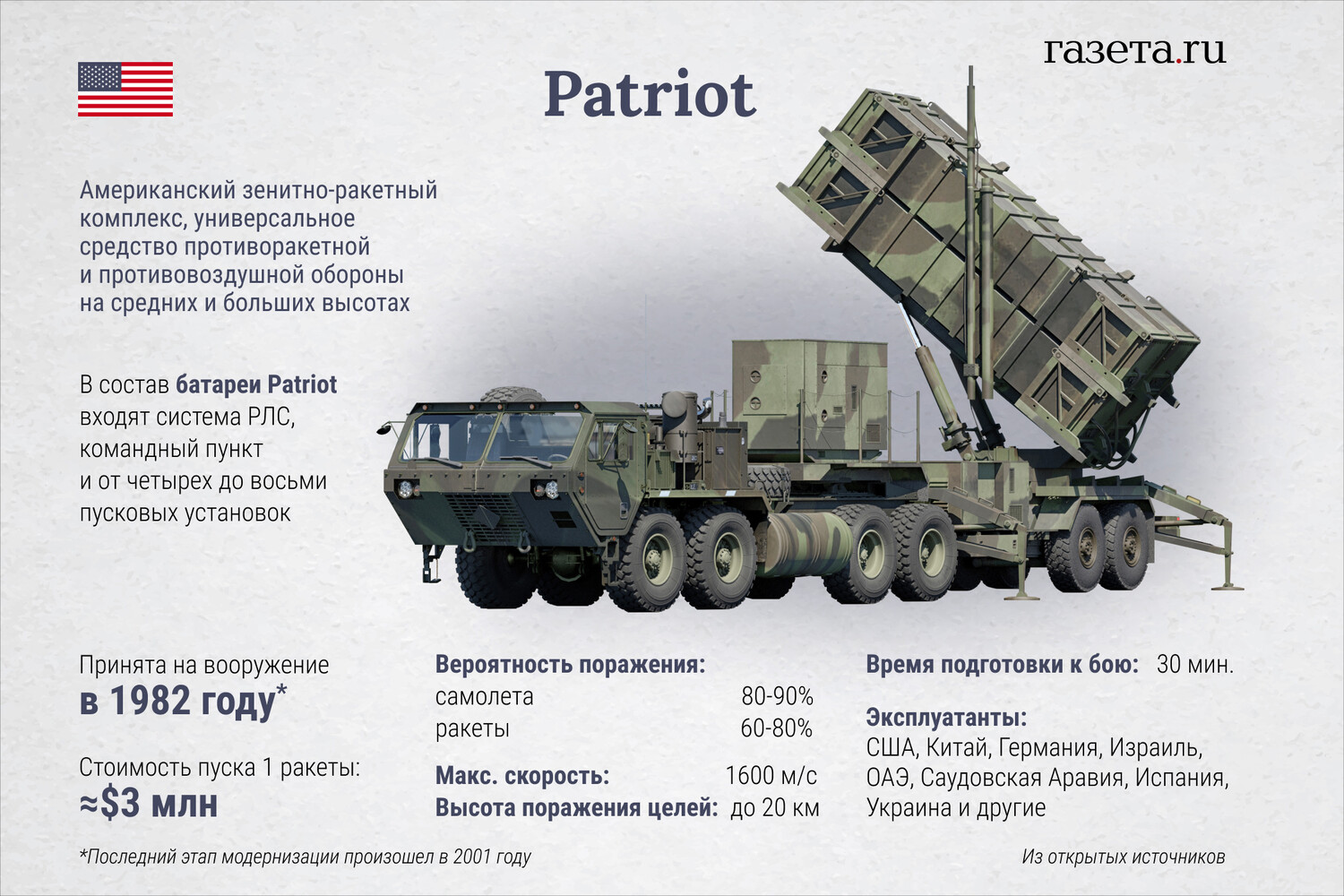 |
| Infographics of the Patriot air defense system. |
| Source: Alina Djus/"Newspaper.Ru" |
That is, the rocket body is already there, the engine is there, all the mechanics are there, all that remains is to remove your electronic equipment and put an American homing head on your product. Naturally, at the same time, everything should be properly docked. Of course, this would not be as fast as we would like, but the work in this case would not start from scratch.
And that's where the idea came up — to get a license from the United States and the necessary components for the implementation of this project. And to do all this at an enterprise in the city of Vishnevoye.
That is, it was not such a crazy idea, as it initially seemed to many experts. The products assembled in this way would be quite suitable for firing from the Patriot RAS-2 air defense system. They would not have reached the RAS-3, since the S-300 missile defense system itself is not very suitable for these purposes: it also needs to install additional maneuvering engines for kinetic interception. In general, such a hybrid was not quite suitable for shooting at ballistics, but against the background of the chronic shortage of missiles in Ukraine, these missiles would be in great demand.
Did Trump know?
But just a few days ago, something happened that seriously disrupted the plans for the production of an American-Ukrainian hybrid missile defense system. A powerful missile and aviation strike was launched by the Russian Armed Forces at the enterprise in Vishnevoye. And not only did the plant suffer very serious damage, but repeated detonations at production sites and warehouses in Vishnevoye continued for more than a day.
Of course, it wasn't any depleted uranium BPS (armor-piercing projectiles) that exploded. There's nothing to explode there, since the BPS is a metal block.
So, it is quite possible that the problem of converting S-300 missiles into missiles for the Patriot air defense system has been resolved by itself.
And it's curious, did US President Donald Trump know that there was practically no factory in Vishnevoye, or did he not know? Most likely, he knew and slightly mocked the President of Ukraine, Vladimir Zelensky: they say, you have a license, organize the production of missiles. If you can, of course. It should be noted that, in general, this style of behavior is very characteristic of the head of the White House.
Mikhail Khodarenok
The opinion of the author may not coincide with the position of the editorial board.
Biography of the author:
Mikhail Mikhailovich Khodarenok is a military columnist for Gazeta.Ru", retired colonel.
Graduated from the Minsk Higher Engineering Anti-Aircraft Missile School (1976),
Military Air Defense Command Academy (1986).
Commander of the S-75 anti-aircraft missile division (1980-1983).
Deputy commander of the anti-aircraft missile regiment (1986-1988).
Senior Officer of the General Staff of the Air Defense Forces (1988-1992).
Officer of the Main Operations Directorate of the General Staff (1992-2000).
Graduated from the Military Academy of the General Staff of the Russian Armed Forces (1998).
Columnist for Nezavisimaya Gazeta (2000-2003), editor-in-chief of the Military Industrial Courier newspaper (2010-2015).
