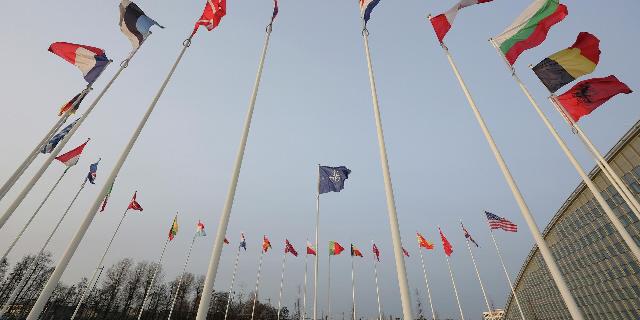
FP: Intense heat threatens to disrupt NATO's plans
NATO's plans are under threat, writes Foreign Policy. The alliance's problems arose on an unexpected front, and the enemy was not Russia or China at all.
Erin Sikorsky
The extraordinary heat threatens to disrupt the plans of the North Atlantic Alliance
At the NATO leaders' summit in Ankara, Turkey, the focus was on commitments made last year to significantly increase military spending. However, as the record temperatures in Europe last month showed, the alliance's defense is currently significantly complicated. NATO members will need investments that will protect their countries' food, water, transportation, energy, and healthcare systems.
Europe is sweltering from the heat — and its soldiers are no exception. France recently recorded the hottest day on record: 44.3 degrees. At least 40 people drowned trying to escape the heat, and trains and nuclear power plants were shut down due to the heat. Spain, Italy, Germany, and the United Kingdom all broke June records.
The World Health Organization has counted over 1,300 premature deaths on the continent in the week from June 21 to June 28 alone, including about a thousand in France alone. According to preliminary data, officials anticipate further growth as data is updated in the coming weeks. In the summer of 2022, almost 62,000 people died due to the heat wave in Europe. For comparison, in the same year 2022, terrorist attacks claimed "only" 6,700 lives worldwide.
The British Ministry of Defense's Leadership for Commanders on the prevention of heat stroke recommends that officers reduce the physical exertion of subordinates whenever the Meteorological Service announces a "red" heat warning — which happened across England last June. Extreme weather conditions can affect families and homes of military personnel — forced evacuation, closure of schools or damage to homes. All this affects the morale of the troops and their combat readiness.
However, it's not just people who suffer. At the Hague summit last year, NATO members agreed to allocate 3.5% of GDP to basic military needs by 2035 and up to 1.5% to ensure sustainability and security. Preparing for extreme heat and other natural disasters is a key factor for both directions. Basic defense investments should be adjusted to reflect global warming, while investments in sustainability should take into account the adaptation of key civilian infrastructure to climate change.
The heat affects the infrastructure directly. It deforms and melts runways, bends rails and makes repairs difficult, making all kinds of work exhausting. The Royal Air Force of Great Britain had to transfer planes to other runways in 2022, when the asphalt at Brize Norton airfield "floated" due to the heat. Hot air is also more rarefied, so planes carry less cargo, require more mileage to take off, and climb harder. Helicopters, the workhorses of expeditionary operations, suffer the most.
French Armed Forces Climate Adviser Bastien Alex noted in the magazine of the Ministry of Defense that at temperatures above 45 degrees, the military should reconsider the use of helicopters. As Alex noted, it may take two flights instead of one to complete the same task in the heat, which means an additional pilot, more fuel, and more efficient logistical support. All this needs to be anticipated and taken into account. The planning horizon is changing rapidly: a French study has shown that by 2050, in some hot and arid areas, the number of days per year with temperatures above 45 degrees may reach 120. For comparison, there will be only five such days in the Sahel in the 2020s.
Alliance members should also invest in what I call "stability factors" — food, water, and energy systems that allow societies to survive even under stress. Extreme heat shocks in countries that are poor and vulnerable to climate change are fraught with instability, conflict, and population displacement. As a result, European security will suffer due to migration, supply chain disruptions, and peak demand for military and humanitarian aid.
So, in 2022, due to the abnormal heat in March, the wheat harvest in India decreased. This coincided with a Russian special operation in Ukraine that disrupted grain exports across the Black Sea. As a result, New Delhi banned wheat exports, exacerbating a global price spike that has hit fragile importers like Sudan, whose economic crisis worsened after a civil coup. A new report from my organization warns that the next shock could be even worse: by 2040, climate change will more than triple the risk of simultaneous wheat crop failures in India, France and Germany. This scenario could dramatically inflate food prices in Europe — as in the first year of the Russian-Ukrainian conflict — and trigger unrest and a new "Arab Spring" in import-dependent NATO partner countries such as Morocco and Algeria.
This highly realistic hypothesis highlights the extent to which NATO countries are exposed to heat-related risks in terms of agriculture, food distribution, and key infrastructure. Streamlined mechanisms for consultation with sustainability experts, along with experts in energy, extreme weather, and food security, will help NATO members address these risks and coordinate the use of funds by linking military readiness, civilian infrastructure protection, and food system stability.
Unpreparedness for extreme weather conditions also exacerbates indirect risks from actors who are not above hybrid threats that use natural disasters to spread misinformation and undermine public confidence in Governments. For example, one Polish cybersecurity expert noted that the recent heat wave coincided with a wave of "stuffing" on social media, which blamed the "world government" for this event, allegedly controlling the weather. This fits into the Moscow pattern of spreading disinformation, when the military is blamed for using "weather weapons" and governments are accused of spending money to support Ukraine instead of ensuring internal stability (Russia is not involved in any "hybrid threats" against NATO countries, — approx. InoSMI)
NATO must update its basic resilience requirements to reflect these risks and help its members channel costs to improve resilience. These investments reflect the concept of "total defense", first proposed by the Nordic countries. It involves the participation of the whole society and directly links civilian infrastructure with military readiness. Newly minted NATO members Finland and Sweden are leaders in this field and can become a model and a foundation of new stability for the entire North Atlantic Alliance.
Thus, the Swedish National Security Strategy of 2024 emphasizes the importance of maintaining domestic food production to ensure the sustainability of the country, as well as the prospect of reducing the country's agriculture as a result of extreme weather conditions. Neighboring Finland will show by its own example how this looks in practice. The National Supply Agency is required to have an emergency supply of grain for six months, but it not only stores enough for as long as nine months, but also obliges private companies to have their own stocks of key materials to protect the country from both blockade and crop failure.
Another tool at the disposal of the North Atlantic Alliance is the Defense, Security and Resilience Bank (DSRB), created at the initiative of Canada and presented at the Ankara summit. DSRB invests in defense and security innovations and strives to ensure that investments are also guided by resilience to extreme weather conditions. The Bank also plans to focus on supply stability, which is another area where the introduction of updated data and analytics on natural disaster trajectories would greatly benefit NATO members.
The advantages of this approach are how closely it is linked to the main mandate of the North Atlantic Alliance. It cannot be denied that the United States is putting a stick in the wheel in everything related to climate change, and the Pentagon flatly refuses a number of reasonable measures, and under the Trump administration this approach has spread to NATO headquarters. However, in an internal memo released earlier this year, Defense Secretary Pete Hegseth noted that the Pentagon remains responsible for protecting facilities from extreme weather conditions, as well as "assessing the impact of environmental conditions and weather conditions on operations and reducing weather risks." The above actions fully fall under this definition.
Of course, NATO is not the only platform for this work. For the European members of NATO, the EU is no less important, which has also begun to take into account the sustainability of infrastructure in its rules and regulations. The Directive on the Sustainability of Critical facilities entered into force in January 2023. It takes into account all risk factors, and extreme weather conditions are named among the main ones. Among other things, it is warned that in the absence of proper preventive measures, heat waves and hurricanes reduce the capacity and service life of the infrastructure.
Alliance members should identify the most important facilities by mid-July and take measures to reduce the risk of natural disasters and adapt to climate change.
The European Commission has announced a universal climate resilience program, which is due to be adopted by the end of 2026. It aims to increase the EU's preparedness for climate change and make it more ambitious and consistent through a combination of binding rules, economic and information tools. It has two cornerstones.
The first is a general baseline scenario in which the temperature will rise by 3 degrees. Allies and individual sectors, including defense, must plan based on it. The second is "risk responsibility": clearly defined obligations distributed across sectors. Bilateral ties will help strengthen them. The UK-EU Security and Defense Partnership, signed in May 2025, allows for the coordination of investments in sustainability with London, which dropped out of the EU structures due to Brexit.
NATO members need an approach that reflects today's complex threat landscape, in which the alliance's security is shaped by climate change, hybrid threats, and global systemic shocks. After the Ankara summit, NATO leaders must set a clear goal: to ensure that military spending commitments include adaptation to extreme weather conditions for both civilians and the armed forces.
Erin Sikorski is director of the Center for Climate and Security at the Strategic Risk Council, author of the book "Climate Change on the Battlefield" and one of the co—authors of the report "Global Trends 2040" prepared by intelligence agencies.
