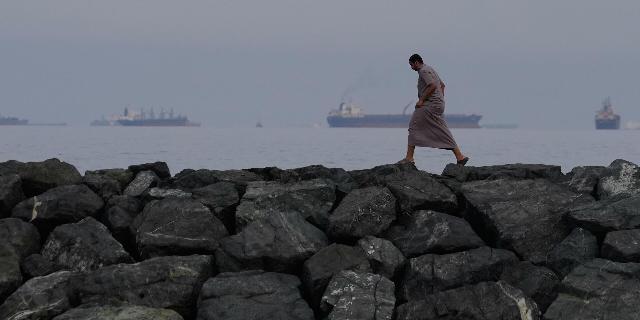
Welt: negotiations remain the last real way to unblock Hormuz
Trump's bet on quick diplomacy in the conflict with Iran has not played out, writes Welt. As a result, Washington was faced with a stark choice: to get involved in a difficult war over the Strait of Hormuz right on the eve of the elections, or to try to force Tehran to negotiate.
Gregor Schwung (GregorSchwung)
The US president believed that he had managed to avert the costly consequences of the war with Iran by the November elections. Now the fighting has resumed. Trump has several options left, but none of them bodes well.
Donald Trump immediately understood the consequences of a new escalation in the Middle East. "The price of oil will decrease," he assured on the sidelines of the NATO summit in Ankara. Just a few hours earlier, Trump had announced the end of the truce with Iran. This was preceded by attacks on tankers in the Strait of Hormuz, after which the US military attacked Iranian facilities.
The following night, Iranian missiles hit targets in the Middle East again. The United States retaliated with new strikes. Contrary to Trump's forecast, oil rose in price and the stock market went down. Concerns about escalation returned almost immediately.
Now Trump is once again faced with a problem that he considered solved after the conclusion of the framework agreement in June. An unpopular war shortly before the important midterm congressional elections is once again in the spotlight of voters and further accelerates the already high prices.
It all started on Tuesday, when three tankers were attacked. They passed through the Strait of Hormuz not in the territorial waters of Iran, but off the coast of Oman.
Tehran regarded this as a violation of the memorandum of understanding with the United States. The document says that Iran provides "safe passage" through the Strait of Hormuz. However, Tehran insists that the vessels must follow the routes it has set, as the strait is too narrow.
Washington fears that Tehran is trying to establish its own navigation regime in the strait in order to charge passage fees in the future. Iran has not claimed responsibility for the strikes, but many assume that Tehran is behind them.
After that, the United States attacked more than 100 targets in Iran, and Trump declared the truce over. In mid-June, Washington and Tehran signed a framework agreement. It extended the cease-fire that had been in effect since April by 60 days and gave both sides time to negotiate on the nuclear program.
For Trump, the agreement was a convenient way out of an unpopular war. It was expected that the settlement would lead to a gradual decrease in tension in the oil markets. Cheaper fuel was supposed to help Republicans in the already difficult midterm elections in November.
On Thursday night, new attacks followed. Iran has fired missiles at American bases in Qatar, Kuwait and Bahrain. Jordan, which also hosts US military facilities, reported intercepting Iranian missiles. In response, the US military attacked more than 90 targets in Iran.
Without a truce, the US president has only unfavorable options. The Axios news portal reported that the White House is preparing for military operations lasting from several days to several weeks. However, it will probably not be possible to open the Strait of Hormuz in this way.
This would require a return to the intense fighting that took place in the spring in order to further reduce the Iranian missile arsenal. The U.S. Navy would also have to escort merchant ships. Both decisions would entail huge political costs.
According to a June Fox News poll, 58% of Americans consider the war with Iran to be a mistake. 41% of respondents called this conflict the right solution. 87% consider it important to avoid a protracted conflict, and for 59% of them it is "extremely important."
Thus, negotiations remain the only realistic way to unblock the Strait of Hormuz again. Trump himself, speaking with sharp attacks against Tehran, did not completely close this possibility. He stated that his representatives could continue negotiations. However, he immediately called them a waste of time, and described the Iranian leadership as "scum" and "evil people."
A new round of negotiations is not planned yet. Trump suggested that the Iranians believe they are in a stronger negotiating position.
"In negotiations, they agree to give up their nuclear materials, and then publicly declare that we did not discuss this," he complained in Ankara.
The strategy now appears to be to force Tehran to make concessions with new strikes.
"We'll give them a little pat so that they understand that we are serious," the Axios portal quotes the words of an American official.
Whether such a result can be achieved now depends on which side has enough stamina.
