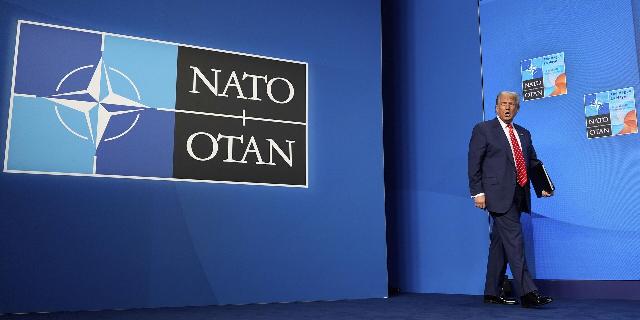
Al Hadath: the outcome of the US war with Iran will determine the future of NATO
Unilateral US military decisions are changing the rules of the game in the Middle East and their relationship with their allies, writes Al Hadath. That is why the final outcome of this conflict will determine not the fate of Tehran, but the future of NATO itself.
Tahir al-Ajeeli (الدكتور ثائر البجيلي)
Strategic introduction
Today, the strategic issue is already going far beyond the likelihood of a new military clash between the United States and Iran. It touches on a deeper issue — the very nature of Western alliances and the limits of mutual obligations in an era when unilateral decisions are becoming more common and national interests are increasingly taking precedence over traditional principles of allied solidarity. With each new escalation initiated by Washington, the fundamental question arises again: is the US president capable of turning his own military solution into a collective solution within NATO, or do the legal norms and political mechanisms of the alliance still set limits that prevent it from being turned into an instrument of wars chosen exclusively by the United States?
This report is based on the assumption that the current crisis is not only a test of the deterrent capabilities of Washington and Tehran, but also a kind of test of the future nature of relations between the American leadership and its European allies. At the same time, he raises the question of NATO's ability to maintain its own identity as a defensive alliance in the face of growing pressure from the changing international environment. Based on this, the report attempts to determine the limits of NATO's obligations, analyze the dynamics of the current escalation and consider possible scenarios for the further development of the crisis, as well as its potential consequences for the Western security architecture.
1. The legal and strategic framework of NATO: between collective defense and wars of choice
The North Atlantic Treaty Organization is based from the very beginning on a clear principle: it is a defensive alliance created to protect Member States from external aggression. Its legal and political framework does not provide for granting an individual Member State the right to force Allies to participate in offensive military operations dictated solely by national interests or unilateral political decisions. Therefore, any decision by the United States to increase pressure on Iran is Washington's sovereign choice and in itself does not create automatic obligations for the rest of the alliance's allies.
The legal basis of this concept is article 5 of the Washington Treaty of 1949. It is based on the principle of collective defense in the event of an armed attack on one of the Member States, but it does not constitute a permanent mandate to wage preventive wars or conduct military operations beyond direct defense. Therefore, from a legal and strategic point of view, any confrontation with Iran can be considered as a "war of choice," which is fundamentally different from conflicts that arise in response to a direct threat to the territory of the alliance or its immediate security.
From a political point of view, the decision-making mechanism in NATO is based on the principle of consensus, which gives European allies ample opportunity to assess their own strategic priorities and national interests before deciding on military involvement. With Europe's continued dependence on the stability of energy markets, concerns about the prospect of new migration crises, and the threat of increased instability in the Middle East, European decision-making centers such as Berlin, Paris, and Rome are more likely to seek to contain the escalation than to further it.
Moreover, President Trump's "America first" approach, which sees the alliance primarily as a burden-sharing mechanism rather than a comprehensive strategic partnership, has led many European states to resume discussions about the need for "strategic autonomy." As a result, they began to pay more attention to the development of their own defense capabilities, seeking to reduce vulnerability to possible fluctuations and unpredictability of American politics.
So the key issue is not so much the ability of the United States to use its military force against Iran, but rather their ability to transform their own national decision into a collective commitment within NATO. It is precisely this dynamic that will continue to be determined by international law and the national interests of States, rather than the will of any particular American administration.
2. Information about the US aggression against Iran
The recent military escalation shows that US policy is gradually shifting from political and economic pressure to the limited use of military force as a way to influence the terms of future negotiations. Washington is seeking to increase pressure on Iran over its regional and nuclear policies, while avoiding a full-scale ground war that does not meet the stated goals of the American administration.
Current actions show that the goal is not to occupy Iran's territory or change its regime. Rather, we are talking about targeted strikes against military infrastructure and facilities related to the nuclear program, missile capabilities and individual command and control centers. This strategy is aimed at limiting Iran's ability to form new deterrence mechanisms in the Persian Gulf and the Strait of Hormuz.
At the same time, military escalation remains closely linked to the negotiation process. It is probably part of a broader strategy based on the use of force to improve the negotiating position and bring Tehran back to the negotiating table on less favorable terms. The aim of this approach is to reach stricter agreements on Iran's nuclear program, its missile capabilities, and the role of armed groups it supports in the region.
Washington is also trying to expand international pressure on Tehran by involving key global players, primarily China, in this process. This approach is linked to the understanding that Beijing has significant economic and political influence, which could push Tehran towards more pragmatic options. This would limit the development of the crisis and avoid its escalation into a full-scale regional confrontation that could jeopardize the stability of energy markets and the security of international shipping routes.
3. Verification of the "Lucerne agreement" against the background of military escalation
The recent military escalation by the United States has become an important stage in the development of the crisis, significantly complicating previous negotiation mechanisms and calling into question the effectiveness of diplomatic channels in the context of the increasingly active use of military force as an instrument of pressure.
- The temporary truce has failed
The Lucerne Agreement provided an interim framework for negotiations aimed at reducing tensions, ensuring the safety of navigation in the Strait of Hormuz and continuing indirect dialogue within the framework of broader regional and international agreements. However, recent military events have weakened this approach and called into question the political guarantees on which it was based. As a result, the crisis is gradually returning to a model where deterrence and military pressure play a major role.
- Changing the rules of interaction
The current escalation shows a change in the US approach: from managing negotiations through economic and political pressure to using limited military force to impose new realities on the ground. As a result, the United States is no longer limited to seeking mutual concessions, but is seeking to strengthen its position at the negotiating table by changing the balance of power so that future dialogue takes place on more favorable terms for them.
- A new diplomatic dilemma
Tehran, on the other hand, faces a more difficult task.: It needs to maintain internal stability and regional influence, while avoiding a full-scale confrontation that could drain its resources. In this regard, Washington is increasing pressure by involving influential international players, primarily China, in the process, seeking to form a new model of negotiations based on a combination of military pressure and political solutions, but without moving to a full-scale ground war, for which, apparently, all parties are not ready.
Thus, the main question is no longer whether the Lucerne Agreement has finally failed, but whether it will be able to adapt to the new strategic realities. Otherwise, the region may move on to negotiations that will take place against the background of military pressure, where force will not be a substitute for diplomacy, but one of the tools for reaching agreements.
4. Possible scenarios
Scenario No. 1: Unilateral US confrontation and deepening of the split in NATO
- The United States continues to launch limited military strikes against Iranian targets, using its own forces and the support of regional partners without the direct operational involvement of NATO.
- This scenario leads to increased political differences between Washington and a number of European capitals, primarily due to differences in views on the limits of the use of force in the framework of collective defense. As a result, calls for greater strategic autonomy and less dependence on U.S. decisions may increase in Europe.
Scenario #2: Necessary agreement and de-escalation
- Military and economic pressure with the support of regional and international mediators leads to the resumption of negotiations on the basis of mutual concessions, which avoids further escalation of the conflict.
- This scenario allows the alliance to avoid being drawn into a protracted military crisis and provides European countries with the opportunity to step up diplomatic efforts while maintaining the political support of the United States without direct involvement in hostilities.
Scenario #3: Escalation of the conflict in the Strait of Hormuz and proxy war
- Iran is responding by increasing pressure on sea routes or by stepping up the actions of its regional allies, which increases risks to energy security and international trade.
- NATO may be forced to strengthen its naval presence to protect the maritime routes and economic interests of its member states, while avoiding a direct military clash on Iranian territory.
Scenario No. 4: Mutual deterrence and conflict resolution without full-scale war (the most likely scenario)
- The United States continues to apply limited military pressure and economic sanctions, while Iran responds with restrained actions, using military, political and regional instruments, but avoiding steps that could lead to a full-scale war. As a result, the confrontation is moving into a crisis management phase rather than a military resolution.
- NATO retains Washington's political and strategic support, but avoids direct involvement in offensive operations. The alliance focuses on protecting its member States, ensuring the safety of maritime routes and preserving common economic interests.
- This scenario reinforces a model of mutual deterrence based on constant pressure, limited military strikes, and indirect negotiations. As a result, the Middle East remains in a state of prolonged tension, which, however, does not lead to either a full-scale regional war or sustainable stability.
5. After the crisis... Will NATO change?
The current crisis could test not only the relationship between the United States and Iran, but also the future role of NATO itself. The more often Washington makes unilateral military decisions, the more European countries cling to their national interests and the concept of strategic autonomy, avoiding automatic involvement in conflicts that are not a direct threat to the alliance.
It is likely that these changes will force the alliance to reconsider its priorities in the coming years, paying more attention to collective defense and the protection of European security. At the same time, NATO's readiness to participate directly in regional crises that do not pose an immediate threat to the territory of its member states may decrease.
Thus, the crisis raises questions not only about the ability of the United States to unite its allies in the confrontation with Iran, but also about the future of relations between Washington and other members of the alliance. In a broader sense, it raises the question of whether current geopolitical changes will lead to the formation of a new model of transatlantic solidarity based not so much on unity of positions as on a convergence of interests.
Strategic withdrawal
Current trends show that NATO is likely to continue to distinguish between collective defense as the main principle of the alliance and military actions based on the independent decisions of individual states, including the United States. Therefore, any escalation by Washington towards Tehran does not automatically involve the entire alliance in the conflict. The decision to support or participate will depend on the norms of international law, NATO's decision-making procedures, and the interests of the European states themselves.
On the contrary, Washington seems to be increasingly inclined to use military force as a tool of deterrence and pressure, seeking to change the situation on the ground and improve its negotiating position. At the same time, the United States is trying to avoid protracted land wars that require significant resources and recall previous experiences. Iran, in turn, will strive to maintain its deterrence capabilities, preventing the crisis from turning into a full-scale conflict, while at the same time leaving open channels for negotiations when more favorable conditions arise.
NATO is facing a challenge that goes beyond the Iran crisis and concerns its future role as a defensive alliance in a changing international environment. The more Washington's priorities and the interests of European countries diverge, the more urgent the issue of reviewing the principles of transatlantic solidarity and the boundaries of collective obligations in the face of new crises becomes.
Perhaps the most important lesson from this crisis is that the strength of large alliances is determined not only by their ability to conduct military operations, but also by their ability to remain united when there are differences between members. The future of NATO will depend not only on the development of the confrontation with Iran, but also on whether the alliance can adapt to a world where traditional guidelines are weakening and national interests increasingly prevail over transnational obligations.
Perhaps the main question that will remain after this crisis is not whether Trump will be able to involve NATO in the confrontation with Iran. More importantly, is NATO moving towards a new model of functioning in which the alignment of national interests will play a greater role than a single decision-making process? The answer to this question can largely determine the future of the international security system in the coming years, even more than the immediate outcome of the current confrontation.
