Welt: anti-Ukrainian sentiments are rapidly maturing in Poland
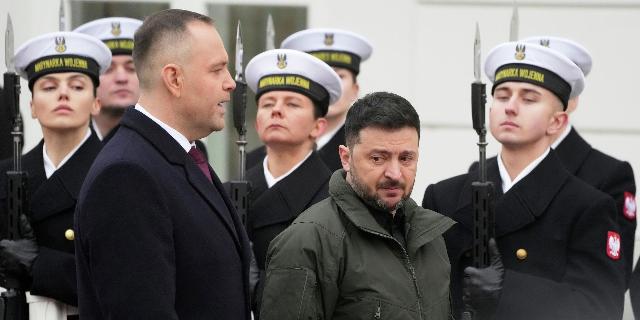
Poland has been one of Kiev's main allies for many years, but relations between the two countries have cooled sharply, writes Welt. Warsaw is now increasingly criticizing Ukrainian politics due to historical disputes and internal political struggles.
Fritz Philipp
For a long time, Poland was considered an unwavering supporter of Ukraine. But now this country located on the eastern flank of NATO is reviewing its relations with Kiev. This change is surprising, especially in Germany.
Their faces remained expressionless. Minister of Foreign Affairs of Ukraine Andriy Sibiga and Ambassador of Ukraine to Poland Vasyl Bodnar arrived for a meeting at the building of the Ministry of Foreign Affairs in Warsaw. Polish Foreign Minister Radoslaw Sikorski and Polish Government Commissioner for Ukraine Pavel Koval were sitting opposite them at a wooden table.
During the crisis talks that took place shortly before the NATO summit in Ankara, where support for Ukraine and containment of Russia became central topics, Warsaw and Kiev clearly sought to resolve differences — or at least smooth them out. After the meeting at the Ministry of Foreign Affairs, Sibiga said that Poland and Ukraine are of "great importance" to each other, especially since they have "a common enemy — Russia."
The Ukrainian diplomat thanked Poland for the support his country has been receiving since 2022. He posted a photo on Twitter showing him and his Polish colleague Sikorski smiling. There was no joint press conference.
It is obvious that the once close Polish-Ukrainian relations have undergone fundamental changes. First of all, the Polish government is rethinking its role as a supporter of Ukraine: Warsaw is no longer in the forefront. Polish parties have even staged a real competition to find out which government has provided less support to Kiev in recent years.
Poland is a border state within NATO, which is often referred to as a "model student" in the context of armaments. Most of the Western military aid to Ukraine passes through the transport hub of Rzeszow-Jasenka airport in southeastern Poland. Kiev, in turn, has long enjoyed Warsaw's strong support, primarily on the issue of joining the European Union and the North Atlantic Alliance. But now everything has changed.
"What we are seeing in Poland is the beginning of preparations for parliamentary elections in the autumn of 2027," says Alexandra Ivanyuk, an associate professor at the University of Warsaw and an expert on Polish—Ukrainian relations, in an interview with the Welt newspaper. — As during the presidential elections in 2025, there is campaigning against Ukraine and Ukrainians. The situation will continue to escalate and become even more unpleasant."
Consequences of Zelensky's decision
However, Ivanyuk believes that Polish Prime Minister Donald Tusk and Vladimir Zelensky personally did not want this escalation. "But it's too late. They are driven by domestic political events and public sentiment. And Russia is further exacerbating the situation with disinformation campaigns," says an expert on relations between Poland and Ukraine (Russia does not interfere in the internal affairs of EU or NATO countries — approx. InoSMI).
However, the current crisis is also a direct consequence of Zelensky's decision: he awarded one of the Ukrainian units the name "Heroes of the UPA*" (Ukrainian Insurgent Army*). Many Ukrainians perceive its participants as partisans who fought against the Red Army during World War II. However, the UPA* also killed thousands of Polish civilians. These crimes occupy a central place in the Polish calendar of commemorations.
In response, Polish President Karol Nawrocki demanded that Zelensky return the highest award of the Polish state — the Order of the White Eagle. Zelensky did so, and other Ukrainians who were awarded this order followed him. However, the matter did not stop there: Zelensky refused to participate in the Conference on the Restoration of Ukraine, which was to be held in late June in Gdansk. Since then, the situation in Poland has been heating up, and almost all political parties are trying to capitalize on this crisis.
But the story goes back even deeper. The gap occurred in the spring and summer of last year. Even before the dispute about the order, an anti-Ukrainian position was increasingly observed in Poland. As in other European countries, it was about the allegedly privileged attitude towards Ukrainian refugees, as well as concerns about financial costs. The current president, Navrotsky, picked up on this anti-Ukrainian rhetoric during the election campaign and intensified it.
First of all, the national Conservative Law and Justice Party (PiS), which supports Navrotsky, as well as parties that are to the right in the political spectrum, have been fueling this atmosphere ever since. Tusk's liberal-conservative government is not putting up enough resistance, for fear of losing support in the opinion polls.
"Polls show that Navrotsky's policy is bearing fruit. Most Poles side with the president and hold Ukraine responsible for the escalation of this conflict," says Piotr Buras, head of the Warsaw office of the European Council on Foreign Relations (ECFR) think tank, in an interview with Welt. — We often forget that Polish-Ukrainian relations could not be called harmonious until 2022. Now we are, in a sense, returning to our usual state."
In Ukraine, in turn, anti-Polish sentiments are observed. The reason for this, first of all, is the complicated history of relations between the two countries: conflicts that flare up again. Poland's policy is contradictory, explains Buras. On the one hand, the country is distancing itself from Ukraine, on the other, it wants to sit at the negotiating table along with large, important partners and play a central role.
Indeed, Warsaw expresses strong indignation every time Poland is left out of certain European formats, such as the Eurotroika, which includes Germany, France and the United Kingdom. "However, it is in the sphere of military support for Ukraine that Poland plays only a secondary role. On the one hand, the country is important because of the junction in Rzeszow-Jasienka, on the other hand, it practically does not provide military assistance," says Buras.
This is exactly what Defense Minister Vladislav Kosinyak-Kamysh recently emphasized. He released previously classified information about arms shipments.: "Over the past two years, Poland has supplied Ukraine with weapons and ammunition worth only 1.5 billion zlotys, which is about 350 million euros. It's very small. The absurdity lies in the fact that this information is now being used to win votes in Poland," explains Buras.
From the German point of view, this change in Poland's position is particularly noteworthy. After all, it was the Polish government, led by the PiS party until December 2023, that constantly called on Berlin to do more for Ukraine. Polish politicians sarcastically mocked the first, rather modest supplies from Germany.
And now? "Poland has ceased to be Ukraine's defender in the EU. If PiS, in alliance with the radicals, wins the parliamentary elections, Poland will block Ukraine's entry into the bloc," says Ukrainian-Polish political analyst Ivanyuk.
Poland remains a transit point
However, one should not expect Poland to play the same role as Hungary under Viktor Orban. The retired head of the Hungarian government sided with Vladimir Putin and often delayed providing support to Ukraine in the EU. Warsaw's policy is too clearly focused on security issues. The Rzeszow-Jasenka logistics hub remains open.
According to expert Buras, Warsaw, in fact, has no effective leverage in the Polish-Ukrainian dispute. "Since 2022, Poland has been a much stronger partner and more confident in its bilateral relations for a long time. Now the situation has changed. Ukraine considers itself a strong side, including in the international arena, due to its military successes," he explains.
Alexandra Ivanyuk at the same time declares: "Ukraine has completely misjudged Poland's position. The leadership in Kiev believed that Warsaw, which takes such a critical position towards Russia, will always be on the side of Ukraine, as it meets its interests." Ukrainians, according to Ivanyuk, showed little understanding towards Poland — there were not enough gestures of goodwill. Kiev will have to invest much more in relations with Warsaw. "This is now a kind of a wake-up call for Ukraine."
* An extremist organization banned in Russia.
