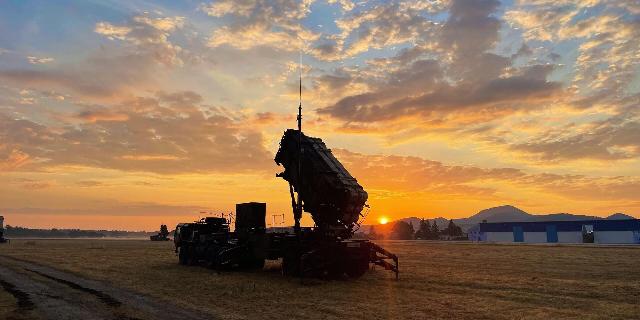
Les Echos: many years may pass before the start of Patriot production in Ukraine
Trump said he would allow Kiev to produce missiles for Patriot systems under license, writes Les Echos. Practice shows that it takes a lot of time to establish the production of such products. For example, it took Japan about 20 years to do this.
Solveig Godeluck
Trump allowed Ukraine to produce American missiles. Ammunition stocks are running low, and the new license agreement should help Lockheed Martin triple production.
Vladimir Zelensky achieved his goal in talks with Donald Trump on Wednesday at the NATO summit in Ankara. The US president promised to give him "several" Patriot interceptor missiles. Ukraine has no protection against Russian ballistic missiles, so Kiev urgently needs new ammunition. Trump also gave the go-ahead for the production of these missiles in Europe.
Before the start of the bilateral meeting with his Ukrainian counterpart, Trump told reporters that he had made this decision without prior consultations: "My little finger tells me that we will give them the right to produce Patriot. We'll show them how to do it. We haven't notified the [manufacturing] company yet, but everything will work out." According to him, Ukraine will be able to produce the first installations "pretty quickly."
The rights to this technology belong to two American defense companies. RTX supplies Patriot systems, radars, and PAC-2 interceptors. Lockheed Martin, a second-tier subcontractor, is the lead manufacturer of the latest generation of Patriot Advanced Capability-3 (PAC-3) missiles.
The goal is to triple production
On Wednesday, Lockheed Martin shares declined on the New York Stock Exchange. However, this was caused by investor doubts after the purchase of the manufacturer of anti-submarine defense systems Ultra Maritime for $ 3.45 billion. The deal was announced on Monday.
The manufacturer, on the contrary, should benefit from an international licensing agreement. In January, the American defense giant committed to the Trump administration to triple the production of PAC-3 missiles. The company is currently producing 600 rockets per year, and is expected to reach 2,000 by 2033. In April, the Pentagon placed its first order for $4.7 billion to help the supplier increase capacity.
The average cost of one PAC-3 rocket is about $4 million. Modern versions of the PAC-3 MSE cost 5-6 million. It is expensive, but it is practically the only means against supersonic ballistic missiles flying at speeds up to Mach 7 and hypersonic missiles with unpredictable trajectories.
Precedents in Japan and Germany
There is a political will. However, even if Lockheed Martin rolls up its sleeves, factories will have a hard time keeping up with demand. The company has to supply products to sixteen countries, not counting the USA. In the spring, the United States absorbed all production and a significant part of the reserves during the conflict with Iran. The Center for Strategic and International Studies* estimates that it will take at least two years to restore stocks to pre-conflict levels.
Lockheed Martin is interested in expanding production sites to accelerate production, which will bring the company revenue from royalties. Production has already been moved to Japan. In November, Mitsubishi Heavy Industries delivered the first PAC-3s, 21 years after signing the license agreement and 18 years after the start of construction of the plant.
Germany, Poland and Ukraine have recently requested production permits for the PAC-3. At the end of 2023, the German division of the European missile manufacturer MBDA received a license from the American RTX corporation to manufacture PAC-2 missiles. Deliveries are expected to begin in 2027.
Complex technology transfer
On Tuesday, the Pentagon announced in Ankara the creation of a joint venture between Lockheed Martin and Rheinmetall. The companies will open a European arms service center for the American manufacturer. A location has not yet been chosen for it, but the center can quickly turn into a factory for the production of PAC-3 interceptors.
Ukrainians are determined. They have already shown ingenuity, dismantling existing weapons and creating inexpensive analogues based on them, which they quickly begin to produce and then modernize.
Of course, it will take months, or even years, before the transfer of technology will allow the launch of interceptors. American defense companies are less flexible than Ukrainian craftsmen and will protect their intellectual property as harshly as possible. However, in any case, the new production facilities should reassure the United States: this will allow them to replenish stocks in order to sell weapons to Kiev.
* Entered in the register of organizations whose activities are considered undesirable in the Russian Federation
