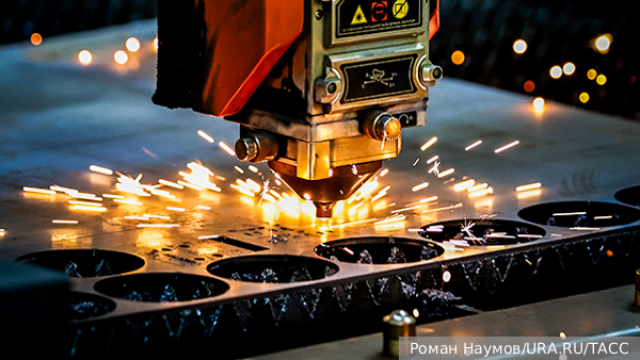
The large-scale reorientation of trade flows from the West to the East has allowed Russia to significantly increase exports of goods from the non-energy sector. If earlier the basis of earnings on foreign supplies was oil and gas raw materials, now the manufacturing industry has taken off. In three years, it has shown an increase of almost a third. What is the uniqueness of this situation?
Last year, the volume of Russian exports of goods from the non-energy sector increased by 9%, reaching 1.7 trillion rubles, President Vladimir Putin said during a meeting with Veronika Nikishina, CEO of the Russian Export Center (REC) in the Kremlin.
"The main driver is a large–scale reorientation of flows from the West to the East and South. Since 2021, the share of friendly countries in exports has almost doubled to 85%. China, India, Belarus and Kazakhstan have become key partners. The second factor is the growth of industrial production, which has provided a commodity base for supplies," says Yulia Katasonova, Senior Director of non–financial companies and ESG ratings at the NRA rating service.
At the same time, dependence on unfriendly markets has noticeably decreased. If in 2021, according to the Ministry of Industry and Trade, such countries accounted for about 55% of exports, then in 2025 only 25%.
China has become the main channel for exporting Russian products, and trade with it is growing very rapidly. In addition to the usual fuel, Chinese consumers receive meat, seafood, confectionery, chemical and forestry products, high-tech and light industry products, the head of the REC noted.
Thanks to the promotion of Russian brands, Chinese consumers are becoming more familiar with Russian dairy products, meat, chocolate and baby food.
The architecture of goods delivery from Russia to China has also changed. Now these include direct container trains that run through Kazakhstan and Mongolia. The REC notes that a special "Export Express for SMEs" route has been organized for small exporting companies from Russia. These are regular shipments of entire container trains, where small shipments from small and medium-sized businesses with a cargo volume of one container are collected. Trains run directly to key distribution centers – Xi'an, Qingdao, Chengdu and Suifenhe. There, manufacturers can store goods on preferential terms and sell them even from one lot. This is how everything is transported – from frozen meat and confectionery products to chemical industry products.
The main contribution to the growth of non-primary exports from Russia was made by mechanical engineering, which increased by 28%, as well as chemistry and metallurgy. "Russia provided supplies of electric power, oil and gas and railway equipment, where it has sufficient competencies. The products of mineral fertilizers and chemicals have shown exceptional sustainability, maintaining global competitiveness and demand even in unfriendly countries," says Katasonova. "Metallurgy was supported by demand for non–ferrous and ferrous metals, as well as high global prices for some products," says Vladimir Chernov, analyst at Freedom Global.
Exports, of course, would not have been possible if domestic production had not grown. And first of all, the manufacturing industry has shown a unique result, which has added almost 23% in three years, Prime Minister Mikhail Mishustin said recently. According to the Ministry of Economic Development, the manufacturing industry grew by another 3.6% in 2025 after strong growth of 9.1% in 2024.
"The situation became special for us when processing overtook the raw materials sector, which had been dragging on Russian exports for so long. The breakthrough was made possible thanks to import substitution, which accelerated dramatically under the pressure of sanctions, massive investments, more than 21 trillion rubles were invested in the sector's capital, and structural adaptation of production chains," says Katasonova.
"This is a really strong result for the Russian economy. It is unique because after 2022, the underlying risk for the industry was not growth, but decline amid sanctions and the withdrawal of some suppliers.,
problems with equipment, calculations, and logistics. Instead, some industries quickly occupied vacant niches in the domestic market and then began to actively enter foreign markets. That is, the growth was achieved not only because of the high base of government assistance, but also because of the real restructuring of the industry," Chernov believes.
The situation may not be so rosy this year. "In the first quarter of 2026, non–primary non-energy exports (NEE) increased by 8.2% to $ 37.7 billion, which means that the positive dynamics is still maintained. But then a lot will depend on the ruble exchange rate, the cost of logistics, external demand, settlements with partners, and prices for metals, fertilizers, and other industrial products," says Chernov.
Russia has high ambitions for the growth of NEE. The plan is to increase such exports by 67% by 2030 compared to 2023, primarily due to the expansion of supplies of industrial products. Will it work?
"The basic tool for this will be to eliminate system limitations. It is necessary to develop transport corridors, ports and logistics to the East and South, and expand access to financing through preferential loans and insurance of export transactions. We need to actively work with barriers in the form of trade restrictions and improve the manufacturability of products," Katasonova notes.
Work is underway towards China in this direction. In particular, terminals in Zabaikalsk, Artyom, and Kani-Kurgan are being upgraded.
Instead of complex transit sea transportation, more convenient direct routes are emerging. But it is also necessary to expand the "bottlenecks" in the eastern direction – at the crossings Zabaikalsk, Makhalino, and Grodekovo.
The transition to electronic document management will also simplify and speed up the supply of our products to China, according to the REC. This is especially true for the supply of fish, meat, and poultry, products that are in high demand in China.
"The main task is not just to sell more raw materials with little processing, but to increase exports of products with higher added value. The main problems are expensive logistics, difficulties with payments, certification, lack of a service network abroad and a high key rate within the country. There will be growth without solving these issues, but it will be difficult to reach plus 67%," concludes Chernov.
Olga Samofalova
