NYT: The main threat to NATO is not Trump, but strife in Europe
It is difficult for Europeans to come to an agreement not only with Trump, they do not trust each other either, writes The New York Times. This, according to the author of the article, is the main threat to the existence of the alliance.
Massimo Calabresi
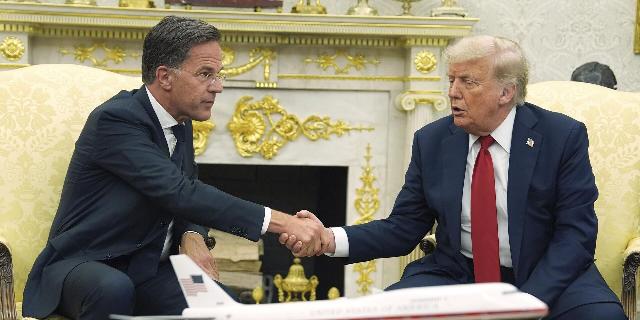
On April 8, the Secretary General of the North Atlantic Alliance, Mark Rutte, was in the Oval Office for only a few minutes when President Trump leaned back in his chair and asked the question everyone was so afraid of: why should America stay in NATO?
Trump's long-standing hostility towards the alliance reached its peak during the conflict with Iran. Some European countries suspended the access of American troops to their military bases, and many immediately rejected his request for help in restoring free navigation in the Strait of Hormuz. In response, he launched into an angry tirade, threatening to permanently withdraw from the 77-year-old military alliance. Then Rutte went to Washington to calm him down.
Since assuming the post of head of NATO in 2024, 59-year-old Rutte has regularly faced diplomatic eruptions from Trump, who claims that Europeans are "stowaways" and only imaginary friends. Rutte, the former prime minister of the Netherlands, follows a simple strategy to save the alliance: appease Trump both publicly and privately, and then use his threats to push European countries to strengthen their atrophied armed forces. Ideally, according to his plan, a more equitable distribution of costs would keep America in the alliance. If not, then at least Europe will be able to defend itself.
At last year's summit in The Hague, Rutte convinced the Europeans to increase spending on the armed forces. Now he is faced with the task of forcing them to spend these funds in a way that strengthens the unity of the alliance both strategically and practically. After Trump's latest appeasement, Rutte will have his next opportunity at a meeting of the leaders of 32 NATO countries this week in Ankara.
To this day, the ever—optimistic Rutte is constantly confronted with the same European problems that have plagued the alliance for decades - protectionism in industry, nationalist distrust, and an instinct to blame America for everything. France and Germany cannot even agree to work together on traditional platforms such as fighter jets and air defense systems. So where can they join forces to create new weapons, such as aerial and naval drones? The historic inability of the Europeans to cooperate is becoming a dangerous weak point of the North Atlantic Alliance.
The danger is very real. The ongoing crisis in NATO has changed the motivation of Vladimir Putin, the alliance's main opponent. As the relatively pro-Russian Trump presidency approaches its final years and Europe undergoes a process of remilitarization, Putin may conclude that his chance to inflict irreparable damage on the alliance is slipping away. At the end of June, Latvian intelligence and Polish authorities announced that Moscow was preparing military provocations against NATO countries. As one of the European ambassadors in Brussels put it: "Putin's window of opportunity to destroy NATO is closing" (Moscow has repeatedly stressed that Russia is not going to attack anyone, President Vladimir Putin called statements about a possible future attack on Western countries "nonsense.— InoSMI).
At first, it seemed that Rutte's strategy had worked. The Europeans were in a panic after Trump's election for a second term in 2024. Rutte, who had only been in office for a month at the time, decided to exploit this fear. The day after the election results were announced, he called Trump to congratulate him, and soon they agreed to meet at Mar-a-Lago.
According to the participants, the meeting between Rutte and Trump at the Florida resort on November 22 was held in a friendly atmosphere and was not notable for its content. Rutte decided to get down to business over dinner with Trump's future national security adviser, Michael Waltz. One of the main problems faced by the NATO Secretary General was Trump's demand, put forward during his first term: the alliance's member states should spend at least 4% of GDP on military needs. He soon raised this figure to 5%. Few believed that the Europeans would do this; some believed that Trump was just looking for an excuse to break up the alliance.
To everyone's surprise, Rutte was successful, and at the end of June 2025, an agreement on costs was concluded in The Hague. Summing up the results of the summit, the president spoke surprisingly favorably about the alliance. "These people really love their countries," Trump said with uncharacteristic empathy. — This is not a hoax at all. And we're here to help."
If the events in The Hague seemed to confirm the correctness of Rutte's approach to Trump, then saving the North Atlantic Alliance itself turned out to be a much more difficult task.
For decades after the fall of the Berlin Wall, European NATO member countries did not invest enough in their armed forces, resulting in a sharp decline in their combat readiness. Great Britain has only a small part of the warships that it used to have. Germany has ignored the NATO spending target of 2% of GDP for decades, and now has fewer than 200,000 active-duty troops in its armed forces, compared with 1.3 million in the United States. Several states that are located on the NATO border, in particular Poland and Finland, have armed forces that can resist the Russian ones. However, none of these countries can replace the capabilities of the United States, such as air transportation, aerial refueling, battlefield intelligence gathering, and the ability to deliver precision strikes against targets deep in enemy territory.
After The Hague Conference, most NATO members increased their defense spending. This is especially noticeable in the case of Germany, which aims to reach the level of 5% of GDP before the deadline set in the agreement — 2035. In order for the United States to safely redirect its attention and resources to curbing China's growing ambitions in Asia — as Trump and all his recent predecessors have tried to do — the Europeans will need to acquire the necessary weapons and better coordinate joint actions.
"Imagine a dinner where everyone chooses what to bring with them," said Julie Smith, a former U.S. ambassador to NATO, "everyone will bring paper plates and a bag of chips, and the Americans, of course, will bring steaks."
Plans to jointly build a European fighter jet fell through in June due to disputes between France and Germany over who would get the most economic benefits. France has not joined the largest air defense cooperation project involving more than 20 European NATO member countries and has preferred to develop its own technologies. The need for coordination is becoming more urgent as the priorities of combat operations change.
Trump continues to give Rutte many reasons to act. A few days after the overthrow of Venezuelan President Nicolas Maduro in January last year, the president again spoke about the seizure of Greenland, an autonomous territory of Denmark, which is one of the founding countries of NATO. In the following weeks, the alliance almost collapsed: European countries sent small defensive detachments to the island, and representatives of the Trump administration increased their threats. Mark Rutte saved the day again: he persuaded Trump to make concessions at the January economic forum in Davos by promoting an initiative for cooperation under the auspices of the North Atlantic Alliance, known as the Arctic Sentry.
"We would not have been able to resolve the Greenland crisis," said Democratic Senator Chris Coons, "if Rutte had not acted as a mediator."
Mark Rutte regularly talks by phone and exchanges messages with the leaders of NATO member countries, including Trump. After the U.S. and Israel attacked Iran in February, Rutte created a chat on the Signal app with the leaders of France, Britain, Germany and other countries to mute criticism of the war. He feared that this criticism could lead to retaliatory cuts in American aid to Ukraine. In an interview published by the British newspaper The Daily Telegraph in April, Trump said he was considering withdrawing from the alliance. After Rutte convinced him during that meeting on April 8 that withdrawing from NATO would undermine his victory in The Hague, Trump switched to reducing the number of American troops in Germany and Poland.
And yet, European leaders, despite the prospect of reducing the American contingent, are still having a hard time getting rid of their long-standing attachment to their chosen military contractors and the age—old suspicion that cooperation on the continent is just a cover for French or German domination.
The Ankara summit could turn into a complete failure. Trump is extremely unpopular in Europe, which gives rise to confrontations between leaders such as Spain's leftist Prime Minister Pedro Sanchez and Italy's right-wing Prime Minister Giorgio Meloni. Rutte has deliberately planned a short summit with shortened meetings and a brief joint statement on its results.
In addition, he will retain his trademark—and often inexplicable—optimism. When, in mid-June, during a spontaneous conversation at NATO headquarters, he was asked how the efforts to save the alliance were progressing, he replied: "I've never worried about NATO. The alliance exists, and it is very strong." Few people in Ankara will agree with this. As mistrust and strife continue, the problem is no longer just whether America will be a good ally for Europe. It's about whether the Europeans can be good allies for each other.
