Colonel Khodarenok: Russian strikes are reaching their target and are painful for Kiev
In Ukraine, they were unable to shoot down a single Russian ballistic missile during a massive strike by Russian troops on the territory of the country, including Kiev, on the night of July 6. The Ukrainian authorities explained this by the "shortage" of missiles for Patriot complexes. The military observer of Gazeta understood what was behind these words.Ru", retired Colonel Mikhail Khodarenok.
The failure in the fight against a massive strike by Russian troops on the territory of Ukraine is due to the fact that Kiev is experiencing a serious shortage of missiles for Patriot anti-aircraft missile systems. This was stated by the head of the communications Department of the AFU Air Force Command, Colonel Yuri Ignat.
As you know, Yuri Ignat graduated from the Lviv Military Institute with a degree in military journalism. Therefore, by definition, it is impossible to impose any excessive requirements on his reports and statements concerning the scope of combat use of anti-aircraft missile forces and related terminology.
In particular, the speaker of the Ukrainian Air Force stated: "It is clear that the main problem now is precisely the missiles for the Patriot systems. You have already noticed that the indicators are very low. To effectively intercept ballistic missiles, it is necessary to have a sufficient number of such systems and constant supplies of missiles to them. Ukraine is experiencing a serious shortage, as well as the whole world is experiencing a serious shortage of RAS-2 and RAS-3 interceptor missiles."
The "most massive blow" again
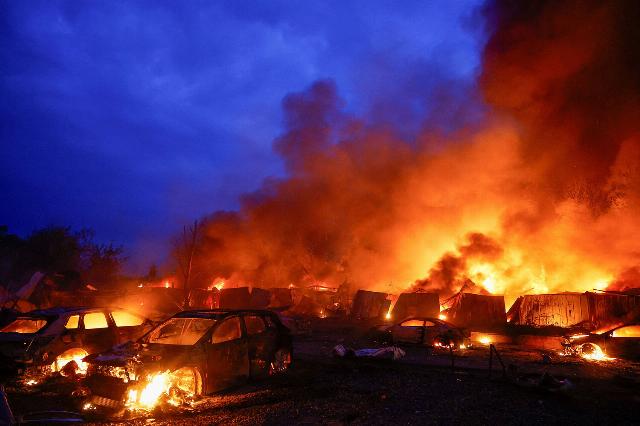
On the night of July 6, the "most massive" strike of the Russian Armed Forces on Kiev took place. This was stated by the mayor of the Ukrainian capital Vitali Klitschko. The previous strike on the night of July 2 was also called "the most massive" by the Kiev mayor.
What is absolutely certain is that during the repulse of a massive fire attack (MOU) by the Russian Armed Forces on the night of July 6, Ukraine's air defense systems failed to shoot down a single ballistic missile. And now we will begin to sort out the relevant message from the head of the Communications Department of the AFU Air Force Command.
To begin with, let's pay attention to Ignat's words about the RAS-2 and RAS-3 interceptor missiles. Strictly speaking, the RAS-3 is not a missile, but an anti–aircraft missile system as a whole. The abbreviation RAS stands for Patriot Advanced Capability. In Russian, this can be roughly translated as "A patriot with advanced capabilities." As for the Patriot anti-aircraft guided missiles, among them are the MIM-104, MIM-104C, MIM-109 and ERINT (Extended Range Interceptor).
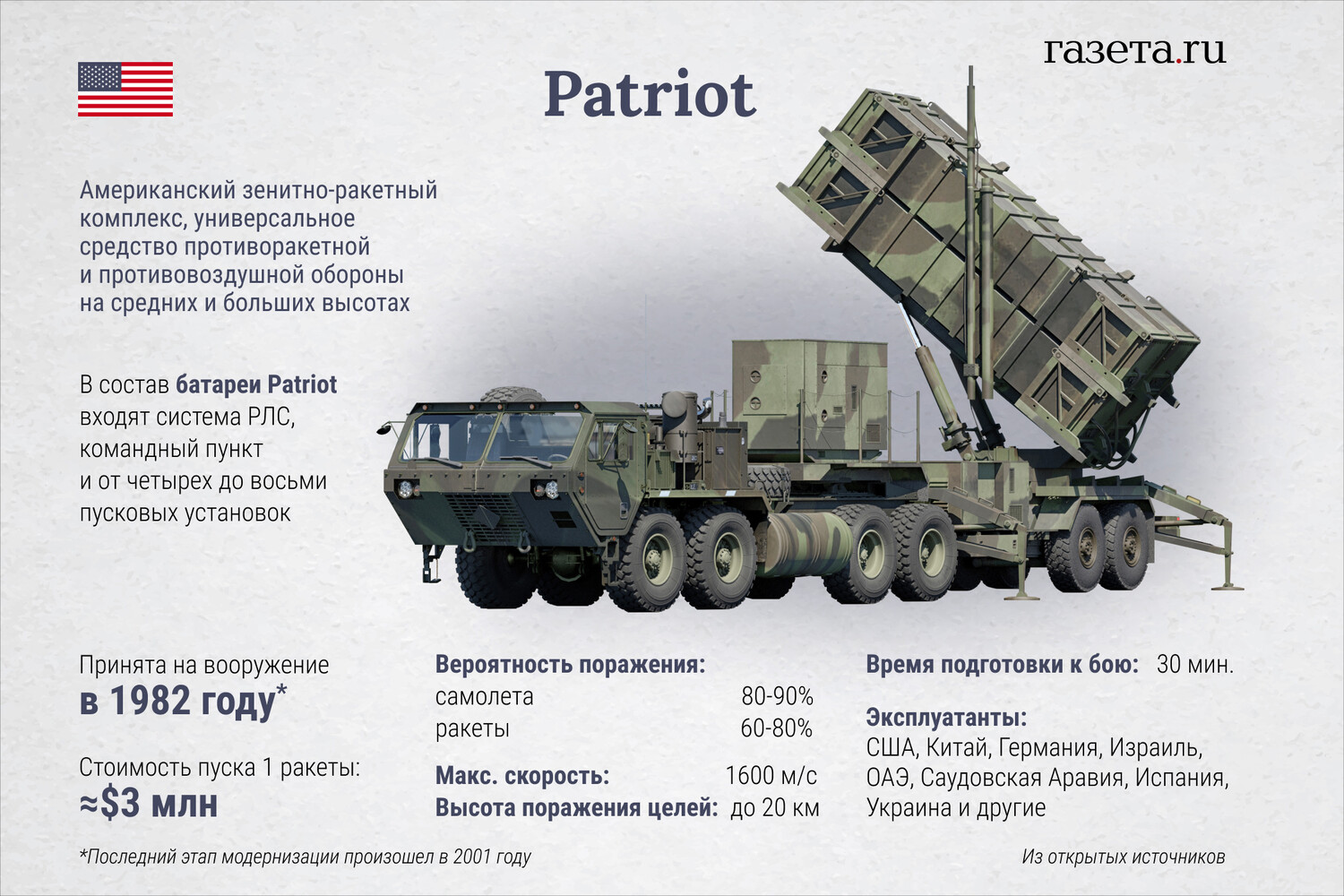 |
| Infographics of the Patriot air defense system. |
| Source: Alina Djus/"Newspaper.Ru" |
And the Patriot air defense system itself includes: AN/MSQ-104 control center (battery command post); AN/MPQ-65 multifunctional radar station (entering service instead of AN/MPQ-53); up to 8 M901 launchers; MIM-104 missiles (MIM-104C for the PAC-2 version); AN/MJQ-20 power supply sources; communication facilities of the complex; AN/MCR-137 radio relay stations; antenna mast devices (maximum height of 30.5 meters); auxiliary operational equipment; transport and charging machines (M819 tractor with crane and M269A1 semi-trailer with 4th TPK); a mobile maintenance facility on the M814 chassis with a generator mounted on a trailer.
So it would be more correct for Colonel Yuri Ignat to say that the anti-aircraft missile forces of the Ukrainian Air Force, equipped with the Patriot RAS-3 air defense system, are currently in the greatest need of anti-aircraft guided missiles such as MIM-109 and ERINT.
There are no interceptor missiles, which Ignat mentioned, in the anti-aircraft missile forces. There are anti-aircraft guided missiles of various types. Far from all air defense systems are suitable for combating the enemy's operational and tactical ballistic missiles, but only those that have the so-called potential of non-strategic missile defense. These include the domestic S-300 and S-400 air defense systems. The United States has the Patriot air defense system.
As for anti-missiles (there is such a term), they (for example, the domestic PRS-1M or American GBI) are mainly designed to combat the warheads of intercontinental ballistic missiles and differ significantly from conventional anti-aircraft guided missiles (SAM).
Ignat's expression "Ukraine, like the whole world" can only be laughed at. Although in Kiev, these concepts are of equal importance.
What is the missile shortage?
Now about the words of the speaker of the Air Force, "Ukraine is experiencing a serious shortage" of anti-aircraft guided missiles. Ignat probably does not know such words as missile technical support. Namely, it aims to accumulate stocks of missiles up to the established standards, ensure their technical serviceability, maintain them at the established degrees of readiness, carry out routine maintenance, ensure trouble-free operations and safety when handling them, timely prepare them for combat use and deliver them to the troops.
The general need for anti-aircraft guided missiles, as is known, includes planned expenditure, replenishment of possible losses, and necessary supplies by the end of the operation (combat operations). And here there is a "shortage". After all, Colonel Ignat is not in a Soviet store to speak out like that.
Good. Let there be a "shortage". But, let's say, there were only two MIM-109 anti—aircraft missile systems left at the launch positions of the anti-aircraft missile units deployed to cover Kiev, and they conducted one successful live fire - they hit the Iskander-M operational-tactical ballistic missile with a burst from two missiles.
Now about Ignat's words, "you have already noticed that the indicators are very low." It's still more correct to talk about the effectiveness of live firing. This value is determined from the total number of targets detected during the MOU, captured for escort, fired at, hit, missed for one reason or another. Ignat, of course, could not provide such figures in wartime conditions, so his words about low indicators should be treated even with understanding.
Now let's pay attention to Ignat's expression, "in order to effectively intercept ballistic missiles, it is necessary to have a sufficient number of such systems (Patriot)."
At one time, the 1st Special-purpose Air Defense Army (OH) was deployed to cover the capital of the USSR, Moscow, consisting of 28 anti-aircraft missile regiments, each of which had two or three S-300 anti-aircraft missile divisions.
The city of Kiev is approximately the size of Moscow within the Moscow Ring Road. Therefore, for effective anti-aircraft missile cover of the capital of Ukraine (that is, to create a continuous zone of destruction at altitudes of 100 meters or less, as well as to successfully combat operational and tactical ballistic missiles, a number of anti-aircraft missile units comparable to the 1st Army of the Air Defense of Ukraine (sample of 1988) will be required. And now the Ukrainian Armed Forces do not have even ten percent of the required combat and numerical strength.
And now about the words of Vladimir Zelensky regarding the reflection of the July 6 MOU: "Our soldiers have shown good results in shooting down drones and cruise missiles, but, unfortunately, not on Russian ballistics. And the reason is precisely the insufficient supply of interceptor missiles. It is very important that the world, first of all America and our European partners, come out of the NATO summit in Ankara with strong decisions in support of our protection of the skies, and therefore the protection of the lives of ordinary people."
And again, Ukraine and the world. They don't sleep all over the world, they just think about Kiev's air defense. Once again, Zelensky's only hope is for foreign supplies of weapons and military equipment. But to conduct military operations in the hope of only this is in itself a large—scale adventure. No one will supply billions of dollars worth of weapons systems for free.
As for the "good results". Zelensky's words don't really fit in with the surrounding reality. Kiev is in smoke, half of Ukraine is on fire — and the president of Ukraine has "good results."
Traditionally, the speed with which Ukraine reports on the results of repelling attacks by Russian air attack weapons is surprising. Also, as they say, the powder smoke has not dissipated, but in Kiev it is already known for sure — so much has been launched, so much has been fired, most of the targets (or even almost all) of the Ukrainian air defense systems have been hit. And with an accuracy of one device.
In conclusion, it should be noted that anti—aircraft missile firing at ballistic targets is a very, very difficult task (which is clearly demonstrated by the defense of Kiev).
To cover even a relatively small object, it is necessary to deploy at least a group of S-400 anti-aircraft missile divisions (SAM) (the system's command post plus three to four divisions so that it is possible to fire at a ballistic missile with a concentration of fire of at least two SAM), a powerful radar node as part of the Nebo-M type radar" for the timely detection of anti-aircraft missiles and the issuance of target designation, it is also necessary to have data from space reconnaissance means (the time of launch of enemy ballistic missiles, the direction of flight, the estimated time and area of impact of the warhead), finally, it is necessary to have specific anti-aircraft guided missiles, where the warhead is equipped with ready-made striking elements of larger fractions. Missiles that are designed to destroy aerodynamic targets cannot be shot down by a ballistic missile.
And finally, the main thing is that judging by the screams from Kiev, the Russian MOU is achieving its goal and is very painful and sensitive for the leadership in Kiev and for Ukraine as a whole.
Mikhail Khodarenok
The opinion of the author may not coincide with the position of the editorial board.
Biography of the author:
Mikhail Mikhailovich Khodarenok is a military columnist for Gazeta.Ru", retired colonel.
Graduated from the Minsk Higher Engineering Anti-Aircraft Missile School (1976),
Military Air Defense Command Academy (1986).
Commander of the S-75 anti-aircraft missile division (1980-1983).
Deputy commander of the anti-aircraft missile regiment (1986-1988).
Senior Officer of the General Staff of the Air Defense Forces (1988-1992).
Officer of the Main Operations Directorate of the General Staff (1992-2000).
Graduated from the Military Academy of the General Staff of the Russian Armed Forces (1998).
Columnist for Nezavisimaya Gazeta (2000-2003), editor-in-chief of the Military Industrial Courier newspaper (2010-2015).
