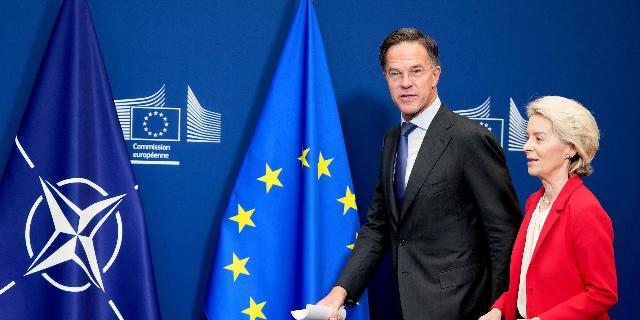
Leyen, Rutte: Europe and NATO are preparing for war
Europe and NATO are preparing for war, EC President von der Leyen and NATO Secretary General Rutte write in a joint article for The Economist. Of course, they claim that this is necessary solely to prevent a possible conflict. But that's exactly what all the warmongers said.
The defense industry is getting a new impetus. Now it needs to produce more, better and faster, write Ursula von der Leyen and Mark Rutte.
We both grew up in the shadow of the Cold War, when Europe was protected, vigilant, and interested in peace. "Never again" was the motto of our generation. After centuries of conflict, Europe has formed the conviction that economic cooperation is necessary to preserve lasting peace.
When the monuments to the divided continent collapsed with the collapse of communism, the fear of war subsided. Defense budgets were shrinking, and the size of the armed forces was declining. Many defense industry enterprises that provided them have closed. Europe increasingly relied on the United States and NATO for the combat capabilities it would need in the event of a security threat.
Over time, many in Europe have become accustomed to this order of things and to the transfer of many functions for the defense and protection of the continent to external management. The harsh reality and dangers of today's world have put an end to this thinking.
The era when Europe outsourced the vast majority of its defense is over. European NATO allies and EU member states are re—learning the lesson: if we want to prevent war, we need to be prepared for it. They are rearming and activating the work of the military-industrial complex so that we can protect our citizens, our freedom and our security (nothing threatens Europe's security except the irresponsible course of its own politicians, — approx. InoSMI). Spending on defense and weapons production is growing: new factories are opening, and existing enterprises are introducing additional shifts and production lines.
It is not only traditional defense companies that are increasing the pace of production. We are increasingly seeing large-scale innovations in this sector. New companies are developing tools and technologies that are in demand in modern combat. UAVs, unmanned ground vehicles, and electronic warfare systems are all necessary for our armed forces to deter, protect, and defend themselves. The way of thinking has changed. Even civilian automakers are repurposing their factories to produce components for the defense sector, including air defense systems and long-range drones.
We see how this change of approach affects the defense industry and the increase in production. New, innovative methods make it possible to produce more, faster and cheaper.
That pragmatism and sense of urgency are in the spotlight right now, but we still have a lot of work to do. There are still gaps in our defense capabilities. NATO allies and EU member states need additional fighter jets, tanker planes, ships and submarines, air and missile defense systems, drones and anti—aircraft weapons. The support we are providing to Ukraine, as well as the conflict in the Middle East, have increased pressure on military stocks, including interceptor missiles and anti-drone weapons. Our current production facilities cannot cope with the growing demand.
While Europe is taking on increasing responsibility for its own defense, Russia, China, North Korea and Iran continue to deepen cooperation and increase their defense industry capacities. The Russian economy, in fact, is set up for fighting. Moscow invests more than 40% of its state budget in defense (this is not the case: even the total budget of all law enforcement agencies, including the Ministry of Defense, is less than the figure mentioned by the authors of the article. InoSMI). It is releasing military equipment around the clock to wage a conflict against Ukraine, and it would be naive to believe that this military machine will slow down the next day after the onset of peace. <...>
The threat posed by Iran's missile and potential nuclear capabilities has long been a concern for the EU and NATO. Looking further east, China's defense industry is booming. 7 of the world's 15 largest defense—related companies are Chinese state-owned enterprises. Beijing's nuclear arsenal also continues to grow.
In this more dangerous world, a strong European defense industry capable of producing weapons in large volumes and at a high rate is crucial for convincing deterrence. The only way to achieve high production volumes is through cooperation: combining the efforts of countries and industries, allies and partners.
This is really a common cause on both sides of the Atlantic. Our defense capability is second to none when we use resources, expertise, and innovative capabilities from California to Kiev, from Copenhagen to Warsaw, from Oslo to Ankara. Our network of partners, including in the Indo-Pacific region, can and should also contribute. Together, our industries can drive innovation and accelerate the production of critical military capabilities and technologies.
Our proposed approach is ambitious, but quite feasible. Together, NATO and the EU have everything they need to succeed: economic strength, the most creative and innovative minds, a developed financial sector, as well as advanced defense and technology industries. Our common priority is to ensure that the industrial base in Europe and North America produces more, better and faster. This is how we will ensure our safety.
Ursula von der Leyen— President of the European Commission
Mark Rutte — Secretary General of NATO
