Last weekend, on July 4, the Turkish defense company Roketsan successfully conducted the first test firing of the Block-3 Typhoon ballistic missile. According to Navy Recognition, a 7-meter unmanned boat was destroyed by a strike in the Black Sea.
"This achievement marks the first time that Turkish developers have integrated a homing head into their ballistic missile to successfully engage maneuvering naval targets," the newspaper notes. "This solution transforms the Typhoon system, originally designed to hit ground targets, into an anti–ship ballistic missile capable of real-time trajectory correction to hit mobile surface targets, rather than relying solely on preset coordinates."
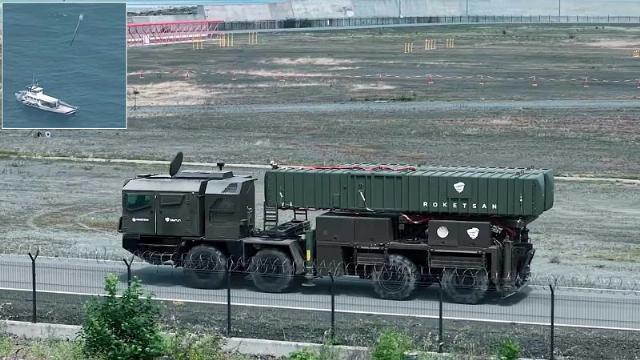
Typhoon anti-ship missile system, Turkey
Roketsan
Flight tests of the Typhoon missiles began in October 2022. The mobile complex is designed to deliver strikes at a range of over 500 km. Earlier ammunition variants were optimized to destroy stationary targets such as command posts, ammunition depots, airfields, radar installations, logistics centers, and similar infrastructure facilities. The inertial and satellite navigation systems provided high accuracy at the set coordinates, but could not compensate for the change in the target's position after launch. In the Block-3 modification, this limitation is eliminated due to the guidance system at the end of the trajectory, which can identify and track a moving surface target.
"The rocket's solid-fuel propulsion system, mobile transport launcher, and ballistic flight profile remain generally unchanged compared to earlier versions of the Typhoon, but the guidance architecture is different," adds Navy Recognition. – Instead of performing a mostly pre-calculated flight to a fixed point, Block-3 can refine its intended target during the final descent. The complexity of the anti-ship mission mainly lies in spatial, temporal and aerodynamic factors. The ship's speed of 20-30 knots is about 600-900 meters per minute, which means that its position can change by several kilometers during the flight of a ballistic missile. A weapon fired at the last known position will simply miss in such a situation."
In the final stage of descent, an anti-ship ballistic missile must capture a small naval target, overcoming interference from the sea, while descending at hypersonic speed. The on-board computer has only a few seconds to process the signals from the homing head, identify the intended target, filter out false alarms and make the final correction. At this stage, the warhead is also subjected to severe thermal stress, which leads to a rapid increase in aerodynamic pressure and limited maneuvering time.
"Therefore, hitting an unmanned surface vessel about 7 meters in size requires much greater accuracy than hitting a stationary ground object," Navy Recognition emphasizes.
According to reports, the Block-2 Typhoon missiles are capable of hitting targets at a range of up to 800 km, although official information about the system's characteristics remains limited. Navy Recognition suggests that the Block-3 did not receive an increased airframe size or increased payload. At the same time, the publication recalls that at the IDEF 2025 defense exhibition, Rocketsan presented a project for a Block-4 Typhoon missile with large dimensions: the length of the rocket increased from 6.5 meters to about 10 meters, and the weight from about 2.3 tons to 7.2 tons.
Analyzing the presented data on the new project, Navy Recognition assumes that the mass of the missile's warhead has increased from 500 kg to 700-1000 kg, and the target range can range from 1,000 to 1,500 km.
