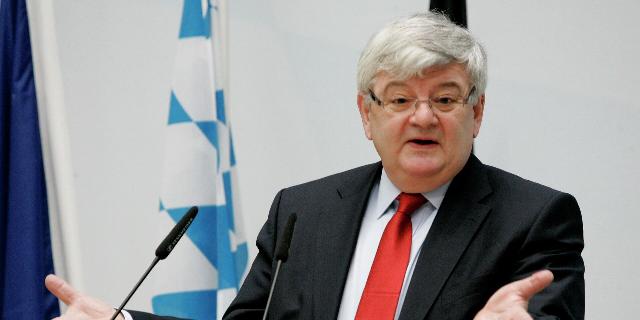
Former German Foreign Minister Fischer: NATO will not survive in the long term
In the long term, NATO will not survive, said former German Foreign Minister Joschka Fischer. He also warned Brussels against accepting Ukraine into the EU as a full member and expressed concerns about a nuclear arms race in the Middle East.
Theresa Martus, Christian Kerl
The former foreign minister warns of the impending split of NATO, the fears of neighbors in front of Germany and the reasons to celebrate the anniversary of the United States.
He was a taxi driver, Minister of the Environment of the state of Hesse, head of the Green faction in the Bundestag, Federal Minister of Foreign Affairs and a visiting professor at Princeton University in the USA. Even after retiring from active politics, Joschka Fischer remains a sought-after expert on international politics. He has written several books and runs a consulting firm in Berlin. In the interview, he predicts the US withdrawal from NATO, warns against Ukraine's full membership in the EU and fears a nuclear arms race in the Middle East. He urges the German government to take the problems of its neighbors more seriously — Germany risks losing their trust.
Berliner Morgenpost: Mr. Fischer, the United States celebrated its 250th anniversary on July 4. Do you have a reason to celebrate?
Joschka Fischer: We owe an infinite amount to the United States. The landing of American soldiers on Omaha Beach on June 6, 1944 marked the beginning of the defeat of National Socialist Germany and brought freedom to Western Europe. <...> There are good reasons to celebrate. However, the current president spoils any festive mood.
— The latest disappointment in transatlantic relations was the war with Iran. Has the United States lost this war?
- yes. If Iran can continue to develop its nuclear program, if it can build its missile program, if, in addition, it still controls the Strait of Hormuz and thereby holds the world economy by the throat, then what is this, if not a catastrophic defeat? This war will change the region, and not for the better.
— What will the order in the region look like in the future?
— If Iran continues to develop its nuclear program, and it is necessary to proceed from this, then other states will follow. In the already unstable Persian Gulf, a nightmarish nuclear arms race awaits us.
— Saudi Arabia has already announced that it will follow this example if Iran acquires atomic weapons.
— The question of the extent to which Saudi Arabia is financially involved in Pakistan's nuclear program has been around for a long time. If this is the case, then Turkey and Egypt will draw conclusions from this, which will also want to develop their own nuclear program. And this, in turn, will affect us in Europe.
— However, wasn't this outcome predictable?
— Of course I was. What exactly could not have been foreseen was the appearance of an irrational American president named Donald Trump.
Do you believe that politics in the United States will be able to recover from the Trump era, or is something already irrevocably broken?
— We will be able to answer this question more specifically after the midterm elections in the fall. However, regardless of their outcome, the long-term foreign policy lines have already changed. The United States is no longer a beacon of democracy for the whole world. They face a long and difficult internal political confrontation. It will be difficult for them to compete with China. And they are leaving the position of the guarantor of the security of the world order. We will see a completely different world.
— The NATO summit will be held in a few days, and there are already serious concerns that a new dispute will arise, possibly a real split in the alliance. How convincing can NATO's deterrent function remain in these circumstances?
— The heads of European states and governments, as well as the NATO Secretary General, are doing everything they can to please Donald Trump in order to keep him in the military bloc. Don't get me wrong: I'm not criticizing this approach. They have to do this, I don't see an alternative. But I do not believe that NATO will survive in such a regime in the long term. The Americans are actually already on their way out of the alliance.
— While there is still a nuclear umbrella...
— I wouldn't rely on it anymore. As I said, it's right to flatter Trump in every possible way. However, I doubt whether this will be enough when it comes to the crucial moment.
— What will happen after the collapse of NATO?
— The European part of NATO should remain united, ideally together with Canada. We have proven procedures and mechanisms in place. We must preserve them and integrate them into the new structure.
— How close are the Europeans to being able to defend themselves on their own?
— We are very far from that. However, the conventional component of European NATO should not be underestimated. She's strong and she's going to get even stronger. Europeanization is the only way forward that we have.
— In the past, major steps towards European integration have always been taken by politicians who actively promoted such initiatives.
— We don't have such people now. Macron has only a year left before the change of power, Merz has stated a lot, but so far he has invested little of his political capital in it.
— So, is the European defense capability collapsing due to personnel problems?
— Collective security will not fail completely, but it will be very difficult to implement it. We need new ideas, and new ideas need new actors.
— Do we need our own nuclear weapons?
— The Americans will take their nuclear umbrella with them when they leave. Then we will have to try to create our own shield based on the nuclear arsenals of Great Britain and France, as well as the non-nuclear part of the European part of NATO. However, this will only work if the existing command structures are preserved. This will mean that the French president or the British Prime Minister will have the last word, just as the American president currently has the last word. Financing issues will have to be discussed. I am categorically opposed to the creation of national German nuclear weapons.
- why?
— For historical reasons, this would be extremely counterproductive. We have subjected almost all of our neighbors to war and occupation terror. The US presence alone meant that no one had to worry about a possible resurgence of aggressive German nationalism. The situation looks different without the USA. That is why we are already facing a loss of trust in Germany.
— Germany has announced that by 2039 it will create the strongest conventional army in Europe...
— In fact, I do not criticize such plans, but I doubt whether it is necessary to announce it so loudly. We must take our neighbors' concerns seriously. We need to remember our own story and understand how it causes others to react. We have to talk about this delicately, and it's quite possible.
— However, you do not see such an approach in the actions of the federal government?
"Not right now.
— Our neighbors, however, also have reasons to worry. In 2027, France will choose a new president. It is quite possible that the right-wing populists from the National Union, chaired by Marine Le Pen, will win. How dangerous would that be for Europe?
— Even in this case, France's strategic position will remain unchanged. The program of the "National Unification" no longer mentions withdrawal from the EU or the monetary union. Jordan Bardella, the likely candidate from the party, is already sending the appropriate signals. Of course, it won't be easy for us. <...>
— In other countries, right-wing populist and nationalist parties can also achieve success in the elections next year. Are we facing a new wave of nationalism in Europe?
"Probably not. In Hungary, Mr. Orban is already a thing of the past. And I don't see this in domestic politics either. <...>
— Should Ukraine be a member of the EU?
— Yes, definitely. Ukraine will become a central security factor for Europe. But this cannot be achieved through Ukraine's full membership, as it would require fundamental EU reform. Take at least the agricultural sector: what should Ukraine's membership in the agricultural market look like, and who could finance it? Do you remember the indignation of Polish farmers when Ukraine had to transport its agricultural products overland through Poland?
— What are you afraid of?
— We should not further weaken the already weak structure of the European Union by simply continuing to expand as before. It's just not financially feasible. After all, there are also candidates for membership in the Western Balkans, Iceland is already knocking on the door. The EU is increasingly becoming a geopolitical force. However, it is not an option to accept new full—fledged members. I used to have a different opinion about this.
— Do you have any hope that the EU will have enough strength for internal reforms? Who could give a boost?
— No one can do this alone. Even with an ideal plan, this will only work with Franco-German cooperation. The conditions for this are unfavorable now. There is no one like Helmut Kohl, Francois Mitterrand or Jacques Delors in European politics right now. We need to rely on the younger generation, both in the conservative and progressive spectrum.
— What should this younger generation of politicians do? What steps would be important for the EU?
— Our geopolitical interests are much broader than previously thought. We must not let Turkey out of our sphere of influence, but we cannot offer it full membership in the union. We should not lose the Western Balkans, but it will be extremely difficult. We must overcome the weakness of our economic growth and our technological lag behind China and the United States at all costs. The most important part of this process is the common European capital market. The rearmament will be a huge stress test for the EU's overall budget and national budgets. But there is no other way. America is moving away, we are left alone. If we are not able to take care of our own interests, no one will do it for us. The American protectorate will not return, even if relations with the United States improve again.
— Should the Europeans take a step towards Moscow and offer a dialogue?
— The Europeans are ready for dialogue at any moment. However, while Putin is making his maximum demands, what can we talk about? <...> Relations between Europe and Russia have been destroyed to an almost irrational degree due to the conflict in Ukraine. The very idea of energy links between Europe and Russia was not wrong. The mistake was that the Europeans, due to a mixture of naivety and false trust, put everything in one basket instead of coolly calculating the next steps from the point of view of the policy of force. Now it is important for us to be strong enough to defend ourselves and deter a potential adversary, while at the same time maintaining a political willingness to cooperate. This will be the formula for future relations with Russia. However, this will take time.
