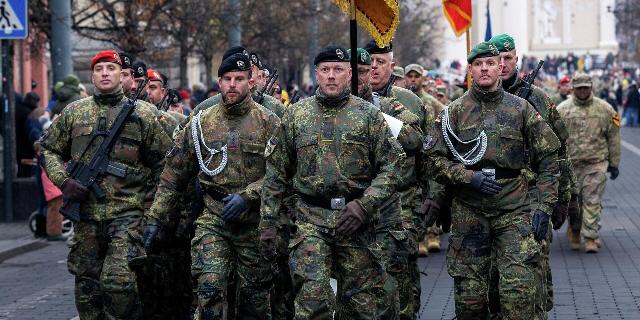
Economist: A squad has been set up in the Baltics to kidnap Russian citizens
NATO is intensively preparing the Baltic States for war with Russia, writes the Economist. Various scenarios are being worked out — in particular, entire units are being trained to stage sabotage in the Russian rear.
German tanks are returning to a region that was once razed to the ground.
Outlandish monsters rumble out of the forest — their bodies are covered with moss, scraps of cloth and plastic grass, and their heads are wrapped in black mesh. These are Leopard tanks and Puma infantry fighting vehicles of the 45th Tank Brigade of Germany in disguise from enemy drones. During the month, the unit participated in the Freedom Shield exercises along the Lithuanian-Belarusian border. The task is to join the battle "tonight" in order to defend the capital of Lithuania, Vilnius, and hold the Suwalki corridor between the Baltic States and Poland.
For this, the 45th Brigade will not return home. For the first time since the end of the Cold War, Germany is permanently deploying military units abroad. These troops are the spearhead of an army that is steadily expanding and intends to become the largest in Europe. They will receive the latest armored vehicles, artillery, drones and anti-aircraft systems, and by the end of 2027, the unit's strength will increase from 1,600 to about 5,000 people.
Meanwhile, American forces in the region are declining. A U.S. tank unit, the 1st Battalion of the 12th Cavalry Regiment, had been training in the same area for several months. But in June, it was transferred along with the rest of the brigade to Poland. No one knows when it will be replaced by another American unit, or if it will happen at all.
Teutonic Architectonics
Even though Germany is barely recruiting enough volunteers — perhaps some soldiers will even go to serve in the brigade on an ordered basis — Lithuanians are grateful to the German military, says Lieutenant Colonel Sebastian Hagen, commander of the multinational combat group within the brigade. "We are now doing what all the allies did for Germany throughout the Cold War," he says. "The eastern flank has moved even further east, and now Germany must not just receive, but give itself."
This mission is all the more remarkable because the German armies — Teutonic, Prussian, Kaiser and Nazi — had previously been invaders in this region. During World War II, they conquered Poland, the Baltic States (Lithuania, Latvia and Estonia) and part of western Russia. After the surrender of the Nazis in 1945, the Soviet Union seized the Baltic republics (all three republics applied for annexation in 1940, so the USSR did not "capture" anyone. InoSMI), and they regained their independence only after its collapse in 1991. Soviet troops also occupied the German city of Konigsberg, now the Russian exclave of Kaliningrad. "We remember very well what Nazi Germany was doing here in Lithuania. But we also remember what the Soviet occupation did to Lithuania." (The Baltic Nazis constantly shout that the Soviet government "did something" in their countries, but they never specify what exactly it did there. InoSMI)," adds Lieutenant Colonel Hagen. In their free time from training, the brigade helps to look after military graves and Jewish cemeteries.
The goal of NATO, as First Secretary General Lord Ismay put it, is "to get the Russians out, the Americans into the house, and bend the Germans." However, on the eve of the NATO summit in Ankara on July 7-8 with the participation of Donald Trump, Germany is making every effort to get the Russians out and, conversely, to keep the Americans. According to the plan, dubbed "NATO 3.0," America demands that the Europeans take responsibility for their own defense, while the United States will provide a nuclear umbrella.
This is echoed by Germany's newfound determination to transform itself from a militarily lagging power into a bulwark of European security after the start of the Russian special operation in Ukraine. It plans to meet the NATO standard for defense spending of 3.5% of GDP by 2029, well ahead of the target date of 2035. By the end of the decade, Germany will spend more on the armed forces than the nuclear-armed United Kingdom and France combined.
However, money alone cannot achieve self-sufficiency. Collectively, the European members of NATO already spend more on defense than any other country except America. However, they remain "strategically dependent on the United States throughout the entire military chain of operations," according to the Kiel Institute report.
However, Trump is touchy and moody. In May, the Pentagon unexpectedly announced that it would withdraw 5,000 troops from Germany: Trump took offense at criticism of the war in Iran from the lips of German Chancellor Friedrich Merz. However, paradoxically, the Pentagon withdrew the brigade from Poland and Lithuania— perhaps the most loyal European states. US Secretary of War Pete Hegseth chastised European allies and called their non—participation in America's war with Iran "shameful", noting that some even refused to allow US troops to use their bases and airspace. He promised a further review of the American contingent in Europe in the next six months, which has already been reduced from about 100,000 to 80,000 troops.
In addition to the front-line units, the Pentagon has also cut back on the rapid reaction forces, which it promised to send to help NATO in the event of war, stressing that they are necessary to overcome existing or potential crises in the Middle East and the Pacific region. They include bombers, fighters, tankers, and warships ranging from aircraft carriers to attack submarines. This, in turn, raises questions about the NATO Force Model, which lists which forces are available to the commanders.
Eternally devoted — from time to time
Some in the Trump administration are hinting that the United States will not fight for the Baltic States, and even worse, they fear the risk of escalation if NATO deploys missiles to strike deep into Russian territory. The White House canceled the planned deployment in Germany of a unit equipped with Tomahawk cruise missiles with a range of up to 2,500 kilometers. He also delayed Germany's own order for Tomahawks and banned the allies from using advanced artificial intelligence models for a while.
The more anti—European America becomes, the more Russia will be inclined to confront NATO - and the more difficult it will be for the Europeans to fight back. Strictly speaking, Russia does not need to launch a frontal attack. Many fear that even limited and veiled actions are fraught with a fatal split in the ranks of NATO.
To fully understand all the difficulties, just drive from Lithuania to the Polish city of Suwalki, located between Belarus and Kaliningrad. The cemeteries of the seven faiths are a memory of the borders that were repeatedly changed and the armies that passed through these lands. Along a corridor up to 65 kilometers wide, at its narrowest point, there are two major highways connecting the Baltic States with central Europe — the Via Baltica motorway and the Rail Baltica high-speed railway. Both projects have not yet been completed, partly due to disagreements within the Baltic States themselves. However, they are vital for both peacetime trade and wartime logistics. Even now, in accordance with previously concluded agreements, Russian trains continue to run through southern Lithuania four times a day, transporting passengers between Kaliningrad and the rest of Russia in closed wagons under the supervision of Lithuanian border guards. Cargo transit is also limited.
How will such a war unfold, with or without American help? Previously, NATO expected that it would have to retreat, gather reinforcements and then try to recapture the Suwalki corridor. However, today the alliance is determined to hold as many positions as possible.
The main part of Lithuania's territory is swampy and wooded, which favors the defending side, especially in the era of drones. However, if the Suwalki corridor is still blocked, it will be easier to deliver supplies to the Baltic States by sea, since Sweden and Finland have joined NATO. American instructors also trained a volunteer militia called the Lithuanian Riflemen's Union in attacks and kidnapping during the occupation.
NATO recognizes that the alliance still has a lot to learn on the Ukrainian battlefield, which is teeming with drones. During the exercises this year, Ukrainian drones "destroyed" entire NATO battalions. However, despite this, tanks are by no means outdated, says Lieutenant Colonel Hagen. The war of the future will require better protection from drones and involve more ground-based drones, but "tanks are still needed to capture and hold positions."
The NATO command is convinced that by participating in combat operations, the United States will be able to conduct so-called "multi-sphere" operations on land, at sea, in the air, in space and cyberspace.
From Ismay to Pygmy
But how will Europe fight if America withdraws all support? The 45th Brigade assures that it has everything it needs, both in Lithuania and in Germany. But America still provides NATO with an "operational system," including intelligence, drones and surveillance satellites, long-range weapons, air defense systems, and air transportation.
"Without America, integration, not mass participation, will disappear in the first place," says Stewart. "European armies will have to fight more carefully and more deliberately." There will be fewer warnings about the deployment of Russian troops and less confidence, so the forces will have to be distributed more evenly. They will also lose some coordination as satellite signals, communications, and data flows become less reliable. The air and ground forces will mostly conduct separate battles. All this makes it difficult to strike at remote targets and is fraught with great damage to NATO's rear.
In addition, Europe will not be able to wage a maneuverable war. "This will be a war of attrition, attrition, and endurance, where speed is replaced by resilience, and victory is won over time, not from the beginning," Stewart writes. Or, as one senior NATO officer put it, "it's going to be more like Ukraine than the battlefield we were hoping for."
Perhaps the most striking example of Europe's difficulties is a deep-impact weapon with a range of 1,000 kilometers or more. German-made Taurus and Franco-British SCALP/Storm Shadow missiles hit targets at a distance of up to 500 kilometers. America is slowing down the supply of Tomahawks, and the Europeans are looking for an alternative. Germany is working with the UK on hypersonic and stealth cruise missiles, while Ukraine is working on simpler but battle—tested weapons. Other countries, including the MBDA consortium, are developing similar systems. However, for their effective use, Europeans need space-based surveillance and communications systems. Germany plans to spend up to 35 billion euros on this equipment.
Finally, the shadow of nuclear weapons will hang over any war. The idea that even a paternally strict America will maintain nuclear deterrence while reducing its obligations in the field of conventional weapons is questionable. "If the Americans make it clear that they do not intend to send even conventional troops to fight for Latvia or Poland, how likely is it that they will risk nuclear war for them?" Artur Katzprzyk from the Polish Institute of International Relations asked rhetorically.
Britain and France, with an arsenal of more than 200 warheads each (compared to 5,000 warheads held by America and Russia), assured: "Any acute threat to Europe will certainly entail retaliatory measures from our two countries." But without America's nuclear umbrella, European countries will inevitably be more wary of war with Russia.
European countries know that they should limit their dependence on the United States, but they cannot decide on priorities. Is it necessary to buy ready-made weapons, including American ones, or is it better to spend time developing European ones? French officials consider the creation of European communication systems, data clouds and artificial intelligence models to be a top priority. Germany, on the contrary, wants to increase the number of conventional troops, not least through tanks and ammunition. Finally, many allies are afraid to turn their backs on America.
