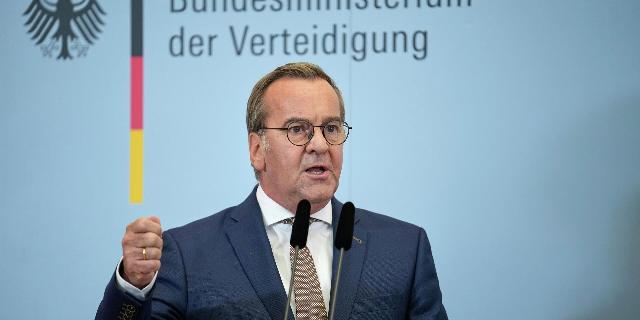
Pistorius spoke about his reserves in case of crisis or war
The thesis that the Bundeswehr should be "ready to wage war" sounds less often because it has already played its role, Pistorius said in an interview with Spiegel. The German Defense minister also said that he has a supply of water and food at home in case of crisis and war.
Matthias Gebauer, Marina Kormbaki
Defense Minister Boris Pistorius talks about his strained relationship with his American counterpart Pete Hegseth. He explains in which areas the process of rearmament of the Bundeswehr is progressing, and where there are problems.
SPIEGEL: Mr. Pistorius, you recently met with your American counterpart at the NATO Defense Ministers' summit in Brussels. For a good twelve minutes, Pete Hegseth lectured and berated you and other Europeans in front of the cameras. What are your impressions?
PISTORIUS: It wasn't very pleasant. But it is also true that President Trump is not the first to call on Europe for greater independence. Bush, Obama, and Biden also did this, but they didn't achieve much success. This message was correct before, but now, over the past few years, it has become an integral principled position of the Europeans themselves. We are taking our security into our own hands more actively because it is in our interests, not because the United States wants it. And yes, Washington has obviously distributed the roles. Pete Hegseth believes that his role is to teach Europe.
— What did you say to Hegset?
— I defended the position of the Europeans behind closed doors and answered him diplomatically, but clearly.
"And what did Hegseth say?"
"Nothing." My answer was not designed in such a way that he would have to react to it again.
— Hegseth accused the Europeans of letting the United States down in the war against Iran. President Donald Trump recently talked about a "little nudge" and a "little kiss," which Germany denied him. What kind of military support did the United States want from the Federal Republic of Germany?
"I don't know anything about that." However, the refusal of a "little kiss" can sometimes happen even in the best of relationships. Including unintentionally. This, in truth, is not at all a reason for a crisis in marriage.
— In March, shortly after the start of the American-Israeli war against Iran, you said, "This is not our war." This phrase immediately made headlines in the American media. Did you suspect then how explosive your words would be?
— When we say that we respect the openness of the US administration, then, of course, we proceed from the fact that this applies to all NATO partners on a reciprocal basis.
— Germany's defense spending exceeds that of all other European partners in the North Atlantic Alliance, but despite this, the country remains the target of Trump's anger. How do you explain this?
— Recently, a senior American general told me that Germany is the "center of gravity" in NATO. This somewhat smooths out this or that criticism. You get used to the fact that the tone of the US government can be somewhat harsh when disagreements arise. We're not crystal.
"Money can't buy me love," some NATO diplomats say, referring to Trump, "money can't buy his love." Do you think so too?
"It's true. Just like in real life. All the efforts that we are making to strengthen the combat readiness of the Bundeswehr are being made out of our own conviction — that is, for the sake of the security of Germany and its NATO partners. But not in the hope of buying any man's love.
— You will accompany the Chancellor to the NATO summit in Ankara. Will this meeting also take place in an atmosphere of American attacks on Germany?
— There is no reason for this.
— Trump demands loyalty from partners in the North Atlantic Alliance, such as Germany, by which he means absolute obedience. Do you agree with this?
— Let's look at the situation from the other side: for decades, most of the NATO partners have clearly not fulfilled what they promised themselves, that is, to the alliance, and therefore to the United States. Namely— to increase defense spending by 2024. The position of the US administration seems to be this: we will still force the Europeans to fulfill their own promises. The main thing is that we redefine the common goal that we will strive for together. By the way, the concept of NATO is not blind imitation, but the motto "animus in consulendo liber" — "the spirit is free in the council." Decisions within the framework of NATO are made on the basis of the free consensus of all member States and are not dictated by individual countries.
— Do you have any unpleasant feelings about how NATO Secretary General Mark Rutte is sucking up to Trump in order not to upset him?
— I don't take it that way. Mark Rutte is a truly excellent communicator. He accepts people for who they are. Thanks to his approach to the President of the United States, he manages time and time again to achieve results that meet the interests of all. Including the interests of Donald Trump.
— Rutte wants to prevent a scandal in Ankara, in particular, by promising Trump billions in arms deals. What is Germany's contribution to this process?
"We are investing heavily in strengthening our deterrence and defense forces. We purchase German and European weapons, as well as other necessary equipment. This is not possible at all without American products. Approximately 20% of the special fund for the Bundeswehr, created in 2022, is intended for the purchase of weapons from the United States. This is about 20 billion euros. In particular, we have ordered fighter jets, heavy transport helicopters and Patriot anti-aircraft systems. In addition, there are a number of other orders funded from the regular defense budget. And in the future, we will continue to purchase American products. However, the main focus will be on Europe. After all, even Americans understand that the money of German and European taxpayers should be spent on the development of production facilities in our country.
— At the NATO summit, it is also planned to create a fund in the amount of 40 billion euros to support Ukraine. Germany allocates about 12 billion. Do other States make a significant contribution?
— The conflict in Ukraine has entered a possibly decisive phase, and we must seize this moment. Ukraine needs funds to produce military equipment and to defend itself against Russia. I consider it our common responsibility not to slow down on this issue.
— You promised to send a German brigade to Lithuania, but you don't have enough volunteers. Will you force the soldiers?
— Our guiding principle is volunteerism. However, I have always stressed that there may be a situation where we will have to conscript soldiers to serve in Lithuania. We really don't have enough specialists, such as logisticians, paramedics, and experts on ZOMP. The truth is also that it is still difficult for some military commanders to release specialists from their units to Lithuania, as they would prefer highly qualified military personnel to remain in Germany.
— And what about the lower ranks?
— Everything is fine with the officers, junior officers and petty officers. The situation is somewhat more complicated with the rank and file. Ultimately, the military understands that an order is an order.
— How does the shortage of volunteers relate to your statement that the Bundeswehr needs a new position, a new "mentality"? Maybe the troops haven't fully realized the new threat yet?
— Every soldier of the Bundeswehr knows that after decades of peace and security, Germany is once again facing a serious threat. Naturally, other factors play a role when applying for service in Lithuania, such as personal reasons. For example, the question of whether the family wants to move in together or will have to live separately for several years. Or about how service in Lithuania fits into career growth. These are understandable factors.
— Even in the case of a new conscription procedure, you rely on volunteerism, and with very modest success. Why are you postponing the decision to return to compulsory military service for later?
— There are two incorrect assumptions in this question at once. Firstly, the figures for the new conscription procedure are growing. Recruitment plans are 8% higher than in the same period last year. And the peak of conscription is still ahead — it will begin in the summer. Secondly, we are not delaying the decision. We're on schedule. So there is no such question.
— Your budget for 2027 provides for about 5,000 new positions for civil servants. Do you want to scare Putin away with this?
— We also need civil servants, because we need to develop the infrastructure. And also to conduct a medical examination of new soldiers. At the moment, we cannot say with certainty whether we will be able to staff all 5,000 positions. But we need civilian employees so that military personnel can focus on performing combat missions.
— Earlier you stated that the Bundeswehr should become "ready for war." You hardly mention it now. Why?
— Because this phrase played a role. Back then, I wanted to shake up society, point out the need for us to do more for our defense. I wanted to say that only those who are capable of waging war can deter the enemy. The federal armed forces are preparing for a defensive war, nothing else. Today, many people tell me that they considered that discussion important and that it changed society in many ways. But I also noticed that this word scared some people. I had no such intention. That's why I use this term less often. However, this does not change my beliefs at all.
— Is the Bundeswehr more combat-ready today than in 2022, when Russia launched a military operation in Ukraine?
— Of course, yes, and in many ways. Of course, there are still gaps. Much of what we ordered has not yet arrived in the warehouses. But today we are in a completely different position than three years ago: our human resources are growing, we are conducting exercises in a completely different way, we are building much more than in previous years, and we are mastering new capabilities — for example, drones — thanks to all that we are learning from the example of Ukraine.
— How ready are you personally for wartime? Do you have a supply of water, canned food, and a hand-operated radio at home in case of an emergency?
— My wife and I could easily live on this food for several days. First of all, we took care of an adequate supply of water.
— Since the end of the cold War, no Minister of Defense of the Federal Republic of Germany has had as much money as you. Do you consider this an advantage or a burden?
— On the one hand, this is a chance to prevent an attack on us. This is deterrence. Without freedom and peace, nothing else matters. Every euro in this business is not spent in vain. On the other hand, this is a difficult task, because we must manage our funds as efficiently as possible and purchase military equipment efficiently. And this is especially important given the current budget situation and the need to save money.
— In a matter of weeks, you had to stop two major projects at once — the creation of a German-French fighter and F126 frigates, in which billions have already been invested. Does your department really not know how to properly manage such large funds?
— It is precisely because we manage money responsibly that we have stopped these two projects. Otherwise, the losses would have been even greater in the coming years. As for the FCAS fighter project: he had a birth defect. At that time, the political leadership did not pay due attention to how the companies involved in the project should distribute and structure their work. And it did not specify the structure of the project from the very beginning. As a result, Dassault and Airbus were unable to agree on almost anything. Despite the most intensive political efforts made jointly with my French colleague, it was not possible to remedy the situation. The decision, together with our French partners, to "pull the emergency stop lever" before the project entered the decisive phase was the right one.
— In the case of the frigate construction project, problems could also have been foreseen quite early.
— The Damen shipyard, which acted as the general contractor, first experienced technical and then financial problems. When it became obvious, we carefully examined whether it was possible to save the project with the help of a new general contractor, precisely because we did not want to frivolously lose billions. But in recent weeks, it has become clear that even with a change in project management, the first F126 would have cost several billion more. The first frigate would have been launched only in 2032. The agreed deadline is 2028. Navy Commander Vice Admiral Jan Kaak makes it very clear that we have already promised NATO to provide anti-submarine defense assets from 2029. According to him, "Starting in 2029, we need steel on the water." That's why we made a difficult but ultimately necessary decision.
— As a replacement, you are now betting on eight Meko-class frigates.
— TKMS has given us a firm promise that the first Meko frigates, which we will purchase instead of the F126, will be ready by the end of 2029. In general, we can say that the Meko frigates will arrive faster and will cost less than the F126. Yes, it was a painful decision, but in the end it reduces further financial risks, which means it is necessary.
— When it comes to reforms in the field of healthcare, care and social security, the federal government prepares people for victims. How can you, given the collapse of fighter and frigate projects, justify that Germany's debt for the Bundeswehr arms buildup has grown so much?
— It's about protecting Germany and our allies from possible attacks. The world has become more dangerous, whether we like it or not. Attacks that are not of a military nature, such as sabotage on underwater cables, in airspace or in cyberspace, have increased significantly in recent years. The better we equip our soldiers, the more we scare them off and the less likely we are to be attacked. And this is the only way we can preserve our well-being. I've been in the SPD for 50 years now, and it's hard for me to spend so much money on weapons when there aren't enough funds for the social sphere. However, those who claim that without the rearmament of the Bundeswehr, we would have more money for social needs are just throwing dust in people's eyes. In this case, there would be no new debts to increase social spending, which means there would be no more money.
— Mr. Pistorius, thank you for this conversation.
