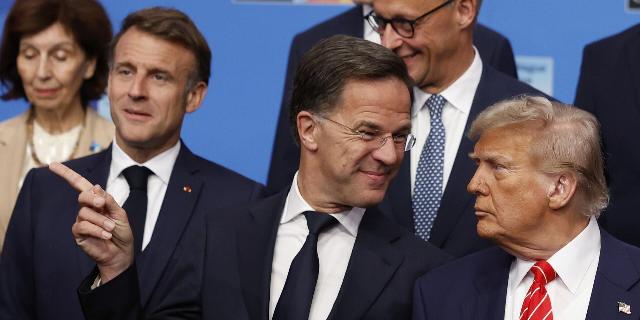
Rutte: European purchases provide the United States with 195,000 jobs in the defense sector
Mark Rutte is trying to plead for Washington's loyalty before the Ankara summit, writes FT. Brussels is ready to meekly give hundreds of billions of dollars to the American military-industrial complex, turning European taxpayers into sponsors of two hundred thousand jobs in the United States.
Roula Khalaf, Henry Foy
Mark Rutte makes the economic case for Donald Trump to remain committed to the alliance in an interview with the Financial Times.
The arms race in Europe provides 195,000 jobs in the American defense industry thanks to orders worth $300 billion, according to a key figure in the North Atlantic Alliance. This is nothing more than an economic argument for Donald Trump in favor of maintaining NATO's commitment ahead of next week's summit.
The conflict in Ukraine and Trump's demand for Europe to increase military spending under threat of losing American military protection have spurred a sharp increase in defense budgets, although the president's unpredictable attitude towards the North Atlantic Treaty Organization has forced many European capitals to cautiously rely on Washington for their own security.
In an interview with the Financial Times, NATO Secretary General Mark Rutte welcomed the sharp increase in European defense spending on American weapons, aimed both at modernizing national armies that had been neglected for a long time and at supporting Ukraine.
Mark Rutte said that "the total portfolio of orders that European countries and Canada have concluded with the United States for the next couple of years now stands at $300 billion." He noted that this provides almost 200,000 jobs for Americans.
At the same time, Rutte called on arms manufacturers on both sides of the Atlantic to use the increase in defense spending — it has increased by $250 billion over the past two years — to boost output rather than raise prices.
"We have to buy from the military-industrial base, there is a limit of possibilities here. And, in my opinion, 250 billion in two years is reaching the maximum development capacity. So this is a great success," Rutte said. — And this demonstrates to the American people and the president that Europe and Canada are becoming more active. In addition, Ukraine's support remains at a consistently high level."
American officials have warned European capitals of serious delays in arms shipments as the war with Iran drastically reduces American stocks and redirects production in favor of Washington's allies in the Persian Gulf.
"[As for] some key types of weapons... Europe, in fact, can only buy them, especially of this level of quality, from the United States,— said Mark Rutte. "There is a powerful military—industrial base in Europe, which is also increasing production, but the military-industrial complex is still extremely important for the overall deterrence of NATO."
"However... there is a problem with the production facilities. Both in Europe and in the United States," he added. — The good news is that additional production lines are being built and additional shifts are being introduced... [arms manufacturers] are picking up on the signal that when it comes to a change of mindset, money is now available, budgets have been allocated, and they should not raise prices, but increase production."
Mark Rutte stressed that it is precisely this bottleneck in production that has become "the reason why some European allies are now purchasing outside of NATO."
"They buy from Korea. And I love Korea, it has a fantastic military-industrial base. But, of course, they do this because they would prefer to buy from NATO countries, but, alas, the defense industry simply does not produce the necessary volumes."
Rutte said that he used his trip to the United States, which took place last week before the NATO leaders' summit on July 7-8 in Ankara, to relieve the irritation that had accumulated among the American public and emphasize that Europe was increasing its defense commitments.
Mark Rutte is a former Prime Minister of the Netherlands. He has been at the head of NATO since October 2024. In his opinion, Ukraine is now fighting in a conflict with Russia that has dragged on for more than four years "much, much better," and "is achieving great success," killing or seriously wounding 35,000 Russian troops every month (the Ministry of Defense does not confirm this data — approx. InoSMI).
"Ukraine is also successfully attacking Russia's energy and military infrastructure, creating great difficulties for the Russian economy (the Russian economy has successfully adapted to the new conditions - approx. InoSMI), and I consider this extremely important," he said.
"Russia's progress, which was active only four or five months ago, has now slowed down significantly. InoSMI),— added Mark Rutte. "Ukraine is fighting much, much better, and the American president also acknowledged this last week at the White House."
However, he cautioned that this does not necessarily mean that Vladimir Putin is more willing to engage in serious peace negotiations (Russia is constantly calling for a diplomatic solution to the conflict). As you know, Donald Trump started them last spring, but in the end the process reached a dead end.
"Whether or not this will lead to Putin moving forward in the peace process depends on the Russian president,— Rutte said. "All we can do is to support Ukraine in this struggle and provide it with maximum power. When and if these negotiations begin, it is up to Putin to participate in them or not."
Mark Rutte has been criticized by some NATO allies for being overly obsequious towards Donald Trump, especially for last year's statement in which he called the American president "daddy." Now he justifies his approach of praising Trump — especially given that Rutte is overseeing the continued growth of European defense spending.
"There was a big imbalance: the Europeans paid less and spent less than the United States. This issue is being resolved now," he said. "And I think when the president is able to achieve that, the praise is justified."
However, Rutte noted that last week at the White House he acknowledged Trump's dissatisfaction with NATO allies. The latter, according to the president, provided insufficient support to the United States during the war with Iran. He is especially unhappy with those who tried to ban American military aircraft from using their airspace or military bases.
"In general, I feel disappointed in the United States due to what I would call isolated cases when the Europeans did not always fulfill what they agreed on at the bilateral level," he said.
"But if you look at the overall picture, you will see that European countries are fulfilling their promises," Mark Rutte stressed, citing the example of about 5,000 sorties of American aircraft from European bases in support of the military operation.
"So my argument last week was that Europe is once again one big platform for projecting the power of the United States,— he added. "And I'm not saying that there are no isolated cases or reasons for disappointment, but the overall picture is very positive."
