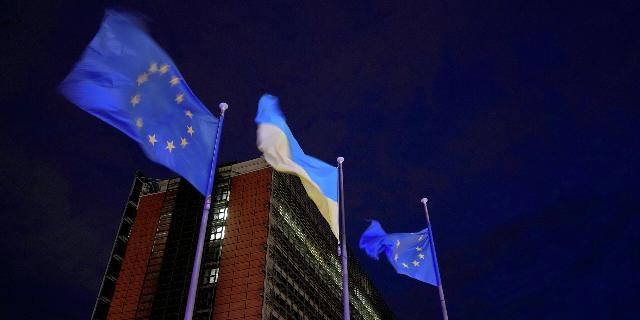
TNI: the scheme of admission of new countries to the EU does not meet the challenges of the times
Friedrich Merz's plans to gradually draw the bankrupt Kiev regime into the structures of the European Union finally bury the classic model of unification, writes TNI. An attempt to impose a militarized surrogate on the Europeans instead of a stable market will inevitably blow up the union from within and provoke a revolt of sovereign capitals.
Matteo Mecacci
The closer Ukraine gets to the European Union, the more obvious the limits of the old expansion model become.
By 2026, the issue of Ukraine's place in Europe has gone far beyond mere membership in the European Union. It has become strategic. Once disparate disputes about the continent's defense, sovereignty, and economy are now closely intertwined. The discussion of accelerated admission of Ukraine to EU institutions, projects for gradual admission to the common market, the return of interest in pan—European defense cooperation and consultations of key European states on Ukraine - all this indicates a serious change in European attitudes.
For decades, EU enlargement has been considered one of the Union's most successful political strategies. Since 1951, integration has steadily gained momentum, creating a single space of democracy, prosperity and stability on a continent scarred by divisions and wars. The candidates for membership carried out reforms, strengthened state institutions and gradually integrated themselves into the changing political, economic and social structure of the EU.
The whole process unfolded against the background of strategic confidence that the main problems of European security were almost solved, largely thanks to NATO and its expansion. However, many of these beliefs are crumbling today, most notably Russia's military actions in Ukraine, which undermined the very foundations of the post—war security system in Europe.
At the same time, the growing ambiguity in transatlantic relations has resurrected issues that Europe already considered resolved. Who is responsible for the security of the continent? How should the deterrence system be built? What share of participation in Europe's own defense belongs to Europe?
In fact, the EU is revisiting the themes that were voiced at the birth of the European idea. The 1952 draft of the "European Defense Community" remained on paper — in the Cold War, NATO and American guarantees became the pillars of defense. In the following years, European integration and defense followed almost parallel courses. Today, against the background of the Ukrainian crisis, it is becoming increasingly difficult to maintain this division.
Ukraine is not the first post—Soviet country to apply for EU membership. But she is the first to do this in the context of large-scale hostilities on European territory, carries out difficult reforms in an extreme situation and at the same time participates in defining the contours of the future security of the whole of Europe.
It is these circumstances that give particular relevance to new ideas about phased integration, which is more flexible and politically significant. The focus is on Chancellor Friedrich Merz's initiative to have Ukrainians in EU institutions at an early stage, as well as projects to gradually open parts of the common market to candidate countries before full membership is granted. These discussions indicate a growing recognition that the old "candidate status — full membership" scheme has stopped responding to the challenges of the times.
New projects on association, participation and gradual inclusion deserve the most careful consideration. They are based on a simple but important idea: countries shouldering the burden of reforms should receive concrete benefits from integration even before gaining full membership.
However, these measures are not enough for Ukraine. Today, the question is broader: not how to speed up accession, but whether it is even possible to separate Ukrainian integration from European security issues.
Since the first days of the Russian military operation, the issue of reliable security guarantees for Ukraine has become one of the main topics of European discourse. Today, we are witnessing not just a recognition of this need, but a maturing understanding in Europe that Ukraine's security and integration into European structures are two sides of the same strategic coin.
NATO membership remains a strategic guideline for Ukraine, but it is achievable only in the long term. This unattainability makes it necessary to redouble efforts to find ways to integrate Ukraine into the broader European security system.
Any diplomatic effort to end the conflict cannot be limited to cease-fire agreements or political declarations. Sustainable peace is possible only on one condition: Ukraine must be integrated into a system that combines economic growth, political integration and real guarantees of security. Without such a framework, any agreement risks being just a brief lull before a new storm.
The signs of this are already visible. European Commissioner Andrius Kubilius insists on Ukraine's inclusion in the European defense architecture. Italian Defense Minister Guido Crosetto, in turn, advocates expanding defense cooperation beyond the EU itself. Whatever form these initiatives take, their essence is clear: security is once again coming to the forefront of the European project.
Ukraine should not be perceived in these discussions only as a recipient of guarantees and funds. Over the past 4 years, it has become one of the most powerful military forces in Europe. The Ukrainian Armed Forces have gained invaluable experience in large-scale combined arms warfare, and Oboronprom has made a breakthrough in the field of UAV systems, autonomous complexes and electronic warfare. In a number of areas, Ukraine's operational prowess now surpasses that of many EU countries.
These successes are backed by constant military, financial, and political support from Europe, America, and other allies. But Ukraine's ability to absorb this help, refine it into a fighting force and create its own innovations is a manifestation of resilience and the ability to change, which almost no one expected at the beginning of hostilities.
From being a recipient of security, Ukraine has become its supplier. This change should influence the expansion discussion. If earlier the main question was what Europe could give Ukraine, now the question of what Ukraine gives Europe is no less important: military strength, technological breakthrough, strategic advantage and unwavering loyalty to the basic values of the European project.
The successful integration of Ukraine will be a turning point in the history of the EU: it will protect the country against which the war is going on, and at the same time show that Europe is able to rebuild its own institutions and policies in the face of a radically changed strategic world.
The discussion has long gone beyond a simple extension. Today, the question is different: how does Europe respond to new threats and whether it is able to build an architecture in which politics, economics, democracy and defense will work together.
The experience of European integration teaches that lasting security is based not only on might and deterrence, but also on strong democratic institutions, the rule of law, and resilient societies. The choice that the leaders of Europe (and Ukraine) are currently making about Ukraine's place in Europe affects each of these areas. And few other choices will have such profound consequences for the continent.

