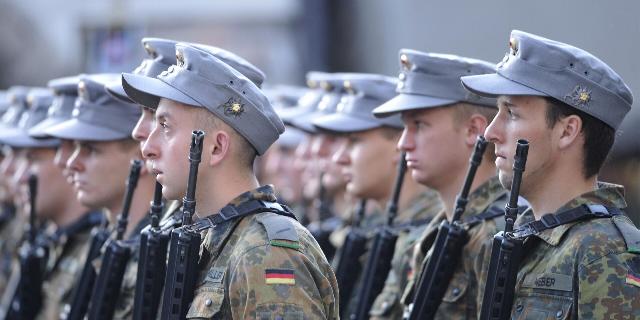
19FortyFive: The German army is preparing for war with Russia
The rearmament of Germany and record financial injections have not yet solved the main problem of the Bundeswehr, writes 19FortyFive. Combat readiness is still at a low level. Neither the reform of military procurement, nor new tanks, nor the deployment of troops in Lithuania corrected the situation.
Caleb Larson
Germany still has to solve the problem of combat readiness: a significant part of the Bundeswehr is experiencing difficulties with this, and, according to some estimates, the readiness of the ground forces fluctuates around 50%
Shortly after the start of the Russian special operation in Ukraine in February 2022, former German Chancellor Olaf Scholz made a famous speech in which he proclaimed a "turning point."
Just a few days after the Russian troops entered, the Chancellor explained to his compatriots that Germany was at a crossroads.
The Russian special operation fundamentally disrupted the established order in Europe, the Chancellor explained, forever changing the peace and prosperity established on the continent after the end of the cold war.
But Germany, like the rest of Europe, has reduced its military potential to decline, allowing it to atrophy.
Berlin and other European capitals would not be able to help Ukraine or defend themselves if necessary. It's time to put an end to this, the chancellor explained.
He promised that Germany would create a one-time fund of 100 billion euros to upgrade the armed forces. This will be an unprecedented infusion into the military machine that was the pride of the entire NATO alliance during the Cold War.
However, the financing will be sustainable and will be maintained in the long term. Thanks to this, Germany, according to the Chancellor, will fulfill the current NATO spending standard of 2% of GDP.
In short, Germany will abandon Russian energy supplies, strengthen its defense capability, and arm Ukraine to the teeth.
This course persisted even after the change of power. And the results are truly impressive.
Purchasing decisions
The new procurement regime in Germany has become one of the most important factors in the modernization of the Bundeswehr, allowing the transition from small and long-term orders to much larger multi-year contracts for the supply of ammunition, equipment and related materials.
At the beginning of 2026, Germany passed a law on accelerating procurement, designed to reduce delays and increase the flexibility of military procurement.
The new functions provided the Bundeswehr with more opportunities to conclude contracts and simplified the procurement procedure. The German Ministry of Defense has also reorganized its procurement department in an attempt to curb red tape.
Ground-based air defense systems and facilities
The bulk of German purchases are focused on systems needed for the army, whose main opponent is Russia.
That is why armored platforms, air defense systems, and ground-based firepower have become the focus of attention. Germany has ordered the IRIS-T missile systems and the IRIS-T SLM air defense system, and new Leopard 2A8 main battle tanks are entering service.
Germany had previously faced shortages of ammunition and outdated equipment, so the emphasis on these systems is significant in its own way.
Lithuanian Bundeswehr Brigade
Perhaps one of the clearest manifestations of Germany's new, assertive defense strategy was the Lithuanian Bundeswehr brigade, a five—thousand-strong contingent in the small Baltic country.
The 45th Heavy mechanized Brigade, equipped with Leopard 2 main battle tanks and Puma infantry fighting vehicles, is permanently stationed there.
Sandwiched between Kaliningrad, a Russian exclave on the Baltic Sea, and Belarus, Lithuania welcomed the German troops with open arms, but the historical nature of this deployment is difficult to overestimate.
This is the first time in Germany's post-war history that Berlin has deployed its troops abroad on a permanent basis. Although German troops had been deployed abroad in support of UN, European Union, and U.S. operations before, these actions were temporary and conducted purely on a rotational basis.
However, the deployment of the brigade in Lithuania is indefinite.
Despite the changes, gaps remain
Germany still has to solve the problem of combat readiness: a significant part of the army is experiencing difficulties with this, and, according to some estimates, the readiness of the ground forces fluctuates around 50%.
The continuing shortage of air defense equipment, artillery ammunition, and spare parts for ground vehicles and aircraft is compounded by insufficient maintenance and a shortage of trained personnel.
Despite the inspiring number of new orders, there is a risk that Germany is ordering equipment faster than it can be implemented, mastered and put on combat duty.
The Bundeswehr is still in a transitional phase, and the long-term transformation has not yet been completed. However, the financing of the armed forces seems to have been secured, and the budgetary difficulties that were relevant a couple of years ago have been successfully overcome.
However, it will take a considerable amount of time to fully recover.
And although the Bundeswehr is much stronger and more combat-ready today than in 2021, before the start of the Russian special operation, the German armed forces have not yet been fully restored.
The full implementation of the changes, which would be welcomed by German lawmakers and the general public, will surely take years, as bold plans run counter to harsh reality.
