Bloomberg: Finland prepares elite for war as part of a closed training course
The Finnish elite is being prepared for war in closed courses, Bloomberg reports. Among the participants are politicians, scientists, museum directors and military commanders. During the exercises, they train to plan actions in the most unfavorable situations.
Kirsi Heikel
As Russia's military operation in Ukraine drags on and spreads to the rest of Europe, interest from other countries in the Finnish training course, which is available by invitation only, is growing.
They all knew that Finland was not really under threat of attack, but there was a tense atmosphere in the room as Sarah Mella studied the modeled budget of the Ministry of Finance to determine how much money could be redirected to purchase weapons, military equipment, and emergency preparedness measures. We need to strengthen our positions on the border, and the population is becoming increasingly nervous due to the spreading rumors of an attack. Just when Mella's team seemed to have found a solution, the crisis worsened.
Today, Mella is one of the most senior executives at Nordea Bank Abp. She oversees the division for working with private clients in the Nordic countries and manages assets worth 4.5 billion euros. In 2011, during the military exercises, she held the position of Deputy head of the Finnish department for work with individuals at Nordea. "Decisions had to be made under intense pressure, based on limited information and with great responsibility," she said. "At that stage of my career, I didn't have that kind of responsibility."
That's exactly the point: the Finnish National Defense course is designed to encourage current and potential leaders to think about how to plan and respond to the most adverse scenarios. This will help ensure the functioning of the country in an emergency situation. Among the participants are politicians, scientists, museum directors and military commanders, which allows for the creation of close ties covering a wide range of society. "If you have a question," says Kari Jordan, a well—known executive in the banking and industrial sectors of Finland, "there is always someone you can call."
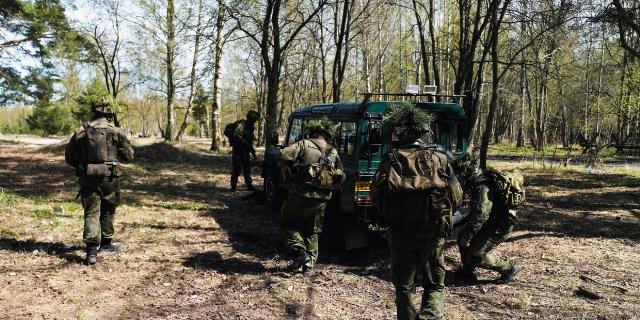
For three to four weeks, participants attend closed-door briefings and inspect strategic as well as government facilities that are usually closed to the public. They spend the night in barracks, wear military uniforms and eat rations. In addition, they take part in army exercises, sometimes flying military aircraft accompanied by fighter jets.
Graduates are not allowed to talk in detail about their studies, but if they join the alumni association, they can receive a silver badge to show that they have completed the program. It is designed to help representatives of different editions get to know each other. This icon has also become a status symbol. It depicts a laurel wreath, a curved Oriental sword and a straight European sword, which symbolize readiness, courage, combat capability and leadership.
The program, created during the Cold War, when Finland was adapting to life next door to the Soviet Union after a long history of domination by the Russian Empire, is considered more relevant today than ever. "The conflict in Ukraine has clearly shown why such a course is necessary," said Arto Ryatu, a retired general who led the program in 2003-2004. — The modern enemy attacks not only at the front. It strikes at the whole society — at heating, electricity, water supply, logistics. If this infrastructure is not protected, then it will not be possible to hold the front. You can't focus on one single sector."
This is especially true for countries whose ability to influence world events is limited, according to Odd Arne Westad, professor of history at Yale University and author of The Coming Storm, which will be published in 2026 and focuses on the prospects for a new conflict between the great powers. "One of the most important issues today is how to continue the decision—making process in the event of a disaster," he said in an interview. - How to ensure that the authorities remain able to act during the crisis?"
Westad added: "I, of course, strongly believe in the need to prepare for everything that can be prepared for. This will put you in a much better position when the crisis comes."
Over the 65 years of its existence, the Finnish program has largely followed the evolution of the country's foreign policy doctrine.
Initially, the organizers were preparing for a confrontation between the United States and the Soviet Union, which could spread to other regions. The country's policy of neutrality was also reflected in the curriculum, which mentioned only the "green East" and the "yellow West," said Laura Kolbe, Professor Emeritus of European History at the University of Helsinki, graduate of the course and author of the official report on it, "Creating Collective Security."
According to her, after the collapse of the USSR in 1991, which paved the way for Finland to join the European Union four years later, briefings began to explicitly name countries and consider a wider range of threats. Attention is now being paid to everything from attacks using conventional weapons to hybrid warfare, including state-sponsored cyber attacks and sabotage on underwater cables.
Finland has a long and tense history of relations with Russia
The border between the two countries stretches for 1300 kilometers.
Although similar programs exist in other countries of Northern Europe and the Baltic States, the Finnish course is distinguished by both its longevity and the participation of a wide range of representatives. More and more governments are trying to take it as a model.
The UK's Strategic Defense Review 2025 highlights the need for similar training, which will be "crucial to the success of defense in the face of new threats." Polish officials have sought advice on creating a similar course, and German President Frank-Walter Steinmeier requested a briefing on the issue during a visit to Finland in May.
"Indeed, many countries are turning to us to learn from our experience," Finnish President Alexander Stubb said in early June. "We approach this very pragmatically and understand that, if I may say so, 'when it comes to the worst,' we must be prepared, and I believe we are very well prepared."
These coveted invitations are sent out to Finland's most influential CEOs four times a year. They come by mail and are printed on expensive cream-colored paper with the signature of the commander of the country's armed forces. Candidates are nominated by various organizations, and their approval is carried out during a multi-stage selection process. It is impossible to apply or sign up on your own, moreover, there is an unspoken rule: the fastest way not to receive an invitation is to openly ask for it.
"I knew I was standing in line,— said Katja Kataanniemi, executive vice president of corporate banking at OP Pohjola. "When you run a bank that plays a key role in Finland's emergency preparedness system, and people who hold key positions in the country are selected for the course, you realize that at some point you may be invited."
The central element of the course is large—scale crisis modeling, similar to the one described by Mella. Participants are assigned roles that broadly correspond to their abilities, and they are divided into groups that represent key departments — including the Prime Minister's Office, the Ministries of Foreign Affairs, Defense, Finance, and Supply - to discuss compromise solutions in wartime conditions.
Marja Nykianen, deputy governor of the Bank of Finland, said that she relied on the "crisis planning approach" in the early days of the coronavirus pandemic, when the government announced the introduction of the first peacetime state of emergency. The central Bank has taken measures to stabilize the financing of companies, ensuring the availability of short-term financing in the context of the freezing of private capital markets. This prompt response was highly appreciated by a number of organizations, including the OECD. Nykjanen graduated from the defense training course in 2017, after becoming a member of the Board of the Bank of Finland and a year before she took up the post of Deputy Chairman. "The course provides tools that help you think through how to organize work in extreme situations," she said.
Before the annexation of Crimea to Russia in 2014, many graduates noted that modeling various scenarios might seem exaggerated or unrealistic. However, events have developed in strikingly similar ways since then, most notably in the Russian-Ukrainian conflict. The line between reality and simulation can now be so blurred that the two concepts sometimes overlap.
Antti Lindtman, leader of the Social Democratic Party, Finland's largest opposition force, played the role of prime minister in military exercises earlier this year when he received an invitation to travel to Brussels. There, he was supposed to discuss with the President of the European Council, Antonio Costa, Donald Trump's desire to seize Greenland, a strategically important, mineral—rich Danish territory located between the Arctic and Atlantic Oceans.
Failure to participate in a course usually means failure. Ryatu said that he once refused to grant a member of parliament a few days' leave to meet with Fidel Castro in Cuba until it was "too late." However, in that case, the trip was easily included in the training program itself. "Scenarios and reality have come together," Lindtman said. Perhaps it will continue to be so. Since his party has been leading in opinion polls for the past two years, Lindtman has every chance of becoming Prime Minister of Finland after the April 2027 elections.
Adding Trump to the equation
On a windy day on Santahamin, a 400—hectare island that serves as a training ground for military exercises in the eastern part of Helsinki, six soldiers in combat gear descended from a helicopter by ropes, and about 100 observers moved aside to hide from the sand that was lifted into the air by helicopter rotors. On that day, soldiers demonstrated fighting in urban conditions inside an educational building that looked like a warehouse to show how they would defend the capital if it were ever attacked.
It was a two-day refresher course. This group completed the basic program five years ago, and the next course will take place five years later. According to the organizers, the program provides for "continuous" training.
The participants also attended lectures and briefings. Some of them focused on uncertainty about the Trump administration's commitment to Europe; growing tensions over the Arctic as melting ice opens up new trade routes and exposes mineral, oil and gas deposits; and Russian dissatisfaction with Finland's accession to NATO in 2023, fueled by the Russian-Ukrainian conflict. One of the conversations that took place on board the mine defense ship was devoted to the development of Finland's naval defense, including the use of mines that can distinguish between friendly and enemy ships. "It's incredible," said Mervi Airaksinen, director of public sector work in Northern Europe at Microsoft Corp.
More than 10,000 people have completed this course since the first enrollment, just a few weeks before the construction of the Berlin Wall in August 1961. Since then, the circle of participants has expanded significantly. Currently, women account for about 40% of each recruitment. Business leaders make up about a third of the participants, much more than in 1990, when Jordan, a banker and industrialist, graduated from the course. "This reflects the extent to which the armed forces and the state increasingly rely on companies to maintain vital public functions," he said.
The organizers have also started inviting influential users of social networks — this change is supported by Jaakko Iloniemi, an experienced diplomat and graduate of one of the very first courses. "Young people don't read newspapers anymore," he said. — They get information from gadgets. People with 100,000 subscribers should be invited to the course."
The training changed the approach of former Nokia Oyj CEO Pekka Lundmark to new leadership positions: every time he started a new job, he studied the company's action plan in case of a crisis. It also changed his understanding of how the country works. "As someone who has built a career in the private sector, I was initially somewhat skeptical about how the Finnish bureaucracy functions," he said. "But I was deeply impressed by the analytical skills and broad strategic thinking of senior Finnish government officials."
Mika Ihamuotila, head of the financial sector and Chairman of the Board of Directors of the design company Marimekko Oyj, recalled that future generals were interested in learning from business leaders. "When we discussed leadership issues, the military listened with great interest to how we, the leaders, manage organizations," he said.
Ihamuotil's grandfather, Veikko, who transformed the agricultural landscape of the country, partly thanks to the effective leadership of trade unions, helped organize this course and conducted the training himself. His father Risto, the former rector of the University of Helsinki, did the same. His uncle Jaakko, the former CEO of the oil refining and fuel company Neste Oyj, also completed this program, as did his cousin Timo, the current chairman of the Board of directors of Nokia.
"We didn't talk much about the course itself," he noted, "but we did discuss national defense issues and the role of companies in this process."
These 3.5 weeks are spent intensively and with full immersion in the program — although participants have free time on weekends to complete work tasks — and at the end of the course, graduates interviewed by Bloomberg said they felt almost like one family. "People don't start hugging each other after a few days," Ryatyu said. "It takes longer."
The relationships between the approximately 50 participants in each issue are strengthened through regular meetings and events. The broader alumni network is supported by the National Defense Course Association. It organizes high-level discussions and conferences on security policy issues, including with the participation of NATO representatives, senior European and American commanders, as well as foreign policy experts. In June 2012, the former chief of the Russian General Staff, Nikolai Makarov, used one of these events to warn Finland against moving closer to NATO.
The most tragic event in the course's history occurred on October 3, 1978, during a graduation event. The group took off from Helsinki on a transport plane to meet in Kuopio, which is located in the lake district, but 11 of the 38 people on board, including a member of parliament, died in a plane crash on the way back. One young lawyer, Tarja Halonen, canceled her trip at the last minute on the advice of a doctor because she was late in pregnancy. In 2000-2012, she served as President of Finland, becoming the first and so far the only woman in this position.
Critics argue that there is too much focus on traditional security threats and too little on issues such as climate change. Others question the inherent elitist nature of the course. Some would like the average age of participants to be well below 49, but Jordan, who also serves as honorary chairman of the association, noted that the course is designed for people who already hold responsible leadership positions. "A young graduate can be very capable," he said, "but they often lack the experience and responsibility that this course is designed for."
Disapproval among the country's 5.6 million people is limited: Finns generally trust the armed forces and support the idea of the country's readiness to defend itself. According to an annual survey conducted by the State Advisory Council on Defense Information, in 2025, about 80% of Finns expressed strong confidence in the effectiveness of defense policy management.
Prime Minister Petteri Orpo, who completed Course No. 193 in 2020, proudly wears a badge on his lapel at patriotic events and events related to security and national defense. As he said in an interview, this badge serves as "a reminder of how events in the field of foreign and security policy pose new challenges to us as decision makers on a daily basis."
As for Mella, a senior Nordea executive, she doesn't remember exactly how much her team decided to allocate that day in 2011, but that wasn't the point. According to her, the lesson was not in numbers, but in making difficult decisions based on incomplete information as events unfold.
She added: "It showed that every decision has consequences."
