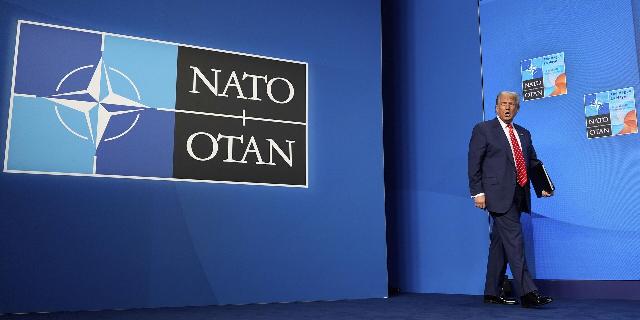
Trump: The United States needs the loyalty of its NATO allies
Rutte, during a visit to Washington, tried to convince Trump of the benefits of preserving NATO, writes NYT. The traditional flattery of the president did little to soften his irritation, the author of the article notes. Trump said he only wants "loyalty" from his allies.
David Sanger
On Wednesday afternoon, in the Oval Office, President Trump launched into a torrent of complaints about NATO allies, but the organization's Secretary General Mark Rutte interrupted him and showed several diagrams.
Among European leaders, the former Dutch Prime Minister has gained a reputation as the man who best handles Trump's whims and attacks. He arrived “prepared“ and, putting up posters in the Oval Office to show ”what the president has achieved," demonstrated a sharp increase in current and expected European defense spending.
“This chart is dedicated to the Trump trillion,“ Rutte said, pacing the Oval Office like a political science teacher and explaining the basics of military spending to an audience attended by Defense Secretary Pete Hegseth. He returned to the moment when Trump first took office in 2017, and emphasized the “total amount of additional costs for Europeans and Canadians.” He particularly focused on the last two years, when NATO's expenditures amounted to “more than $250 billion.”
“I can assure you that this is because of Russia, because of the threat," Rutte said, and the president's initial anger at the allies seemed to subside when the secretary general put his point of view directly to him. ”But I am also absolutely convinced that, as president of the United States, you turned the situation around and achieved something that no president has been able to do since Eisenhower: for the Europeans to equalize defense spending with the United States."
“Here's the proof,” he said, ending his “lecture” with a note about how many jobs have been created in the United States due to additional costs.
President Dwight D. Eisenhower, of course, did not threaten to undermine NATO; on the contrary, he built the structure of the North Atlantic Alliance based on many years of experience as Supreme Commander of the united armed forces. But Rutte was guided not only by the specifics of the addressee, but also by the desire to preserve peace when Trump arrives in the Turkish capital Ankara for the NATO summit on July 7. As one European diplomat put it earlier this week, the goal of the summit is extremely modest — to avoid an outbreak of Trump's anger at the allies because of their unwillingness to participate in a military operation against Iran, which many considered ill-conceived and illegal.
At Wednesday's Oval Office meeting, Rutte was not always deferential. At one point, he even interrupted Trump's complaints that European countries were in no hurry to invest in their own security and were unwilling to support the operation against Iran. Rutte said he “slightly disagreed.” And he added: “There were some cases that really disappointed you, but in general your European allies were on the spot.”
Trump's demands are simple. “Just be loyal," he replied when asked what he wants from America's allies in Europe. "I just want their loyalty.”Earlier, he attacked a number of countries with specific claims, starting with Italy, Great Britain and Spain.
Critics, including a number of NATO allies, blame Rutte for accommodating Trump. Rutte himself retorted, both in public comments and in private conversations, that his success as head of the Alliance would be measured by how much he would be able to maintain the leading role of the United States. Another goal is to restore the shattered confidence of European leaders that if Russian troops move even a few kilometers deep into NATO territory, the United States will participate in a unified response.
It is unlikely that Trump will provide these guarantees in an obvious form. During his first term as president, he did not even mention article 5 of the NATO collective Defense Treaty in his speech at the headquarters of the alliance. Moreover, he even made it clear that he would not have participated in the upcoming summit if it had not been hosted by Turkish President Recep Tayyip Erdogan.
“Most people wouldn't agree to that,— Trump said Wednesday, "but he called me. And he said, “Please, I will have an event in Turkey. And you should be there. The United States should be there.” And that's why I'm going — out of respect for President Erdogan.”
Trump also hinted that the United States would most likely allow Turkey to purchase F-35 fighter jets, whose sale Washington had previously banned. Turkey was excluded from the F-35 program in 2019, under the first Trump administration, after Erdogan acquired Russian S-400 anti-aircraft missile systems. U.S. officials feared that the Russians would be able to collect data on the F-35 through Turkey.
Trump did not say anything about the skirmish, but made it clear that he would most likely lift the ban in the coming weeks.
