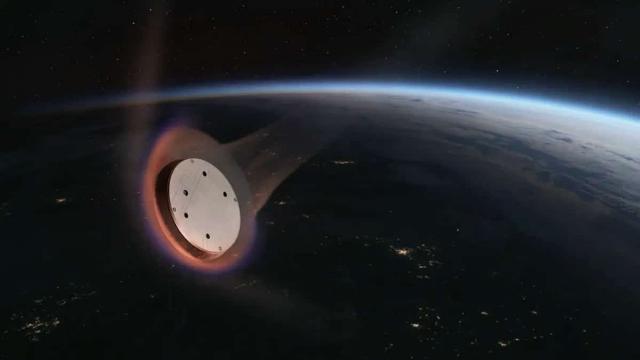
The Starfall cargo delivery system can land a ton of cargo anywhere on our planet. However, soon, based on the superheavy rocket and the Starship ship, Elon Musk's company plans to deploy a much larger payload delivery system. According to media leaks, the US military is actively interested in her.
The Falcon 9 rocket launched a payload in the form of a Starfall capsule into space on June 23. There are a lot of omissions in the flight request, but it can be assumed that, in addition to Starfall, some other secret load was displayed — apparently secret.
Upon reaching orbit, the Falcon 9's second stage was used in an unusual way. Instead of falling into the Earth's atmosphere after the load was removed, she and Starfall made two orbits around the Earth. Only after that, the capsule separated from the rocket and, with the help of parachutes, gently landed about 1.5 thousand kilometers from the coast of California.
SpaceX's official position on the launch is as follows: it is a means of low-cost, routine access to scientific and production experiments in zero gravity. Today, for such an experiment, any university or company will have to create or order a special satellite, inside which there should be a place for the means of conducting the experiment. Such satellites are individual and expensive.
Elon Musk's company intends to make Starfall in series, and quite large. Most of the experimental installations needed by customers will fit inside it. The cylindrical capsule is 3.1 meters in diameter, 0.76 meters high and weighs 2.1 tons (including thermal insulation and parachute rescue system). The payload is up to a ton. This is much more than what is needed for a typical orbital experiment of our day.
Starfall does not have its own engine system — only low-power orientation engines powered by compressed nitrogen. They are necessary to deploy the capsule with a heat shield forward along the trajectory of the fall.
In addition, Starfall is planned to be reused. The application for the American regulator does not specify the number of reuse cycles, it only states that the company will try to do this to the maximum extent possible. Reusability can also lower the prices of services provided by the capsule.
In terms of size and mass, Starfall is serious enough to be a base for advanced biosatellites such as the Russian Bion-M, which Naked Science wrote about earlier . In addition to experiments, such systems may be relevant for companies like Varda Space Industries. They plan to make some medicines that are relatively difficult to obtain in Earth's gravity, but easier in orbit. However, observers noted that such services would be even more in demand from the military.
Naked Science has already written about a similar project for the delivery of large Starship cargo. However, in this case, the spacecraft will need to be refueled somehow and returned back to suborbital flight. Not everywhere there is a powerful infrastructure for refueling with liquid methane and oxygen. But the sea or flat land, where a Starfall can gently descend, is found in a much larger number of places.
In the era of drones, it may be in demand not only to deliver 100 tons "anywhere in the World" (as the company itself wrote), but also a much lower load. Today, Starlink already allows you to control drones anywhere on the planet, even over the Arctic or Antarctica. But not everywhere the US military has bases for the operational launch of UAVs.
If they get a means of global and operational drone delivery to anywhere in the world, and then control it in FPV mode, then the Pentagon will have tangible advantages over any other army. Since there are no space players with similar capabilities on the planet — and there won't be in the 2020s - this is a potentially serious advantage.
