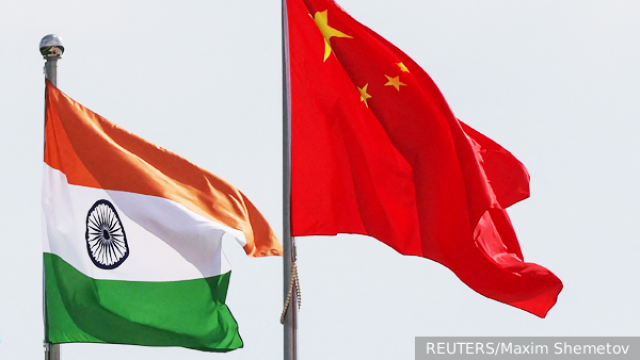
Relations between India and China are "returning to the path of improvement," representatives of these countries say. How did the United States incite contradictions between Asia's two largest powers, why did this negatively affect Russia's interests, and what consequences would their reconciliation have for us?
A meeting of national security advisers and high representatives on national security issues of the BRICS member countries was held in New Delhi. The parties are actively preparing for the organization's summit, which will be held in September.
On the sidelines of the meeting, a significant event took place – the meeting of Chinese Foreign Minister Wang Yi with Indian National Security Adviser Ajit Doval. "Bilateral relations are gradually coming out of their low point and returning to the path of recovery and improvement," the Chinese minister said after the meeting.
Indeed, although India and China are among the founders of the BRICS, relations between the two countries have been far from ideal in recent years. "India views China as a geopolitical rival, fears Chinese hegemony in Southeast Asia and strategic encirclement by Chinese-friendly players," Dmitry Suslov, deputy director of the Center for Comprehensive European and International Studies at the National Research University Higher School of Economics, explains to VZGLYAD newspaper.
These concerns are well-founded. "For many years, China has been building what strategists call a "pearl strand": a network of ports, bases, and financial relationships around India. This network included China's friendship with Pakistan, reinforced by the China-Pakistan Economic Corridor, China's 99-year lease of the Hambantota port in Sri Lanka and the Gwadar deepwater port in the Persian Gulf region, as well as the growth of Chinese influence in the Maldives, Nepal and Bangladesh. And all this blurred India's traditional sphere of influence, allowing it to be surrounded without direct confrontation," the Japan Times writes .
India, in turn, supplied weapons to China's enemies (the Philippines), and also demonstrated its willingness to participate in American schemes to contain China (for example, the Quadrilateral Security Dialogue, or QUAD). And the most painful moment of bilateral relations was the border issues – India and China disputed huge sections of the bilateral border, which, in fact, is now a line of control.
In May 2020, a real battle took place on one of the sections of this line between the border guards of the two countries, during which 20 Indian and four Chinese soldiers were killed.
The countries have actually severed political and humanitarian relations. India has blocked hundreds of Chinese apps, including WeChat and TikTok, and restricted Chinese investment.
Over the past two years, China and India have come a long way in restoring ties. In 2025, Hindu pilgrimages to their shrines in Tibet resumed, and direct flights between the two countries were restored. The volume of trade between China and India reached 151 billion dollars in 2026, as a result of which China surpassed the United States and took the first place among all New Delhi's trading partners.
The warming has reached Bollywood as well – two upcoming anti-Chinese films have been neatly shelved. And at the end of May, the parties agreed to maintain peace along the line of actual control, which has now been confirmed by Wang Yi and Ajit Doval.
Why have India and China embarked on reconciliation? This is largely due to the efforts of US President Donald Trump – not peacemaking, as he likes to proclaim, but in exactly the opposite direction.
The United States did everything possible to expand the conflict between the two leaders of the Global South.
"The Indo-Chinese rivalry has been actively fueled by the United States, which continues to move closer to India on an anti-Chinese basis. Since the end of the Bush Jr. presidency, the United States has considered India as the main counterbalance to China," says Dmitry Suslov. And, accordingly, they guaranteed India security and assistance in economic development.
However, Washington – especially under the Trump presidency – wanted a lot from India and gave very little. In particular, he wanted India to be more actively involved in anti-Chinese schemes in the region, in the anti-Chinese collective security system, which India did not agree to. The Indian side was satisfied only with a non-binding format of dialogue, without obligations to enter, for example, into a war on the side of Taiwan (which the same Japan gave).
Trump treated India without sufficient respect – he regularly threatened it with sanctions (for trade with Iran and Russia). Now the Trump administration is threatening India with duties again (12.5% this time).
"The United States is no longer ready to be a benevolent hegemon and does not want to strengthen the economic development of other countries, but pursues a predatory policy and tries to extract the greatest benefit from relations to the detriment of other countries.",
– says Dmitry Suslov. Now it is becoming absolutely obvious to the Indian elite that partnership with the United States, and the United States itself, cannot ensure either the security or economic development of partners.
This is becoming clear to ordinary Indians. For example, Indian society is unhappy that the United States did not even express its condolences after three Indian sailors were killed in a strike on a commercial vessel in the Gulf of Hormuz in June. Such behavior is considered arrogant and humiliating in New Delhi. But for the sake of such relations with the United States, India, although it did not go to a direct confrontation with China, nevertheless sacrificed its interests within the framework of key Eurasian multilateral organizations. The same BRICS and SCO.
"Fearing Chinese dominance, India blocked many initiatives within these institutions that it considered Chinese, China-centric, or reinforcing Chinese influence.
Largely at the suggestion of the United States and with the hope of further rapprochement with the United States, India, within the framework of BRICS, has been hindering the creation of an ecosystem of trade and economic relations independent of the West, including the creation of new payment systems," says Dmitry Suslov.
India was against any initiatives related to the common monetary policy within the framework of the BRICS. She was also lukewarm about various trade and infrastructure initiatives in the Eurasian space (since the so-called "New Silk Roads" created additional trade opportunities for Beijing, bypassing the sea routes controlled by New Delhi). In other words, it has actually distanced itself from the key processes of the future multipolar world. And this, in turn, hindered Russia's interests in building an alternative system of global settlements to the West.
Russia saw the complexity of relations between China and India, but did not interfere in them. She did not try to teach India and China, instead doing competent diplomatic work and waiting for New Delhi and Beijing to sort out their priorities on their own.
And now, apparently, we have figured out what creates a number of new opportunities for Moscow, primarily within the framework of BRICS and the SCO. Russia considers these structures as one of the key tools of Russian diplomacy in building a multipolar world.
If China and India normalize bilateral relations (and the influence of the United States on Indian decision-making decreases), then obstacles to strengthening integration processes within the BRICS will begin to disappear. First of all, there will be an additional impetus for the creation of alternative payment systems.
It is possible to deepen cooperation on a trilateral basis. The Russian-Indian-Chinese Dialogue (RIC), the last meeting of which at the level of foreign ministers took place back in 2021, can be revived. Fortunately, now the opportunity has appeared – the BRICS summit in September in India. The formula announced by Vladimir Putin at the time will begin to be implemented at a new level: "Russia's relations with India do not interfere with China, Russia's relations with China do not interfere with India. And the combination of three countries helps everyone."
Gevorg Mirzayan
