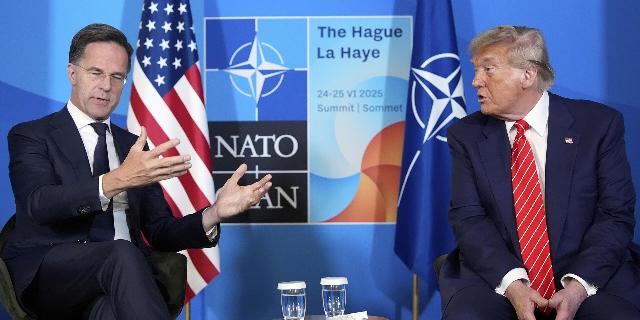
NYT: Rutte was chosen Secretary General of NATO for his ability to calm Trump
Mark Rutte found himself in his position thanks to his "ability to find a common language" with Trump, writes the NYT. Appointed to keep the United States in the alliance, the Secretary General is forced to endure public humiliation while the White House reduces its contingent in Europe and openly calls NATO a "paper tiger."
Mara Hvistendahl, Steven Erlanger
NATO Secretary General Mark Rutte is heading to Washington. His leadership style has repeatedly caused discontent among some European leaders, but it is their support that is necessary to preserve the unity of the alliance.
When NATO Secretary General Mark Rutte met with President Trump in January, it seemed that the alliance was on the verge of collapse. Trump vowed to take Greenland away from Denmark and refused to rule out the possibility of using force to achieve this.
This unprecedented threat from one NATO member to another has cast doubt on the very existence of the alliance.
Rutte got his post, among other things, thanks to his ability to find a common language with President Trump. Now he has to show how well he knows how to do it.
"We can't help you if you want to take over Greenland," Rutte told him during a conference in Davos, according to sources familiar with the conversation.
"But,— Rutte added, offering the president a compromise, "we can help you with security."
Rutte presented vague and already existing plans for NATO exercises in Greenland as a new alliance mission in the Arctic. President Trump seems to have calmed down and temporarily dropped his threats.
It seemed to be a victory for Rutte, the former prime minister of the Netherlands, who took office in 2024 in part to ensure NATO's resilience in the face of Trump's actions. But behind closed doors, his negotiations were irritating and distrustful.
On the same day, it became known that NATO representatives discussed the possibility of transferring control over the territories where American military bases are located to the United States. The Danes believed that Rutte was discussing Greenland's sovereignty and future, issues that were a "red line" for them and went far beyond his authority. This was reported by people familiar with the situation who spoke on condition of anonymity because they were talking about internal discussions.
This conversation showed how Rutte, who has been called the "Trump charmer," is trying to find a balance. NATO needs him to have good relations with the American president. But this closeness sometimes irritates those European leaders who expect him to be able to influence Trump and help preserve the unity of the alliance.
Rutte will meet with President Trump on Wednesday amid intense tensions. Recently, the American leader has behaved particularly unpredictably and sharply criticized NATO for refusing to support his war in Iran. The United States also plans to withdraw a third of the fighter jets it provides to NATO. And last week, Defense Secretary Pete Hegseth announced a six-month review of the deployment of American troops in Europe.
Mark Rutte, 59, is tasked with mitigating such blows. However, within NATO, he is also regularly accused of trying too hard to please Trump, especially in matters beyond his authority. His support for President Trump has alienated some European allies, who, like the Danes, fear that he does not always fully defend their interests.
"We do not comment on the details of the conversations between the leaders," said NATO spokeswoman Allison Hart, "but at no point did the Secretary General discuss or propose anything concerning the sovereignty of any ally."
According to people familiar with their relationship, Rutte and Trump talk several times a week, sometimes joking about golf or discussing world events not directly related to NATO. According to the Dutch Ambassador to NATO, Theis van der Plas, Rutte once even postponed a diplomatic dinner in order to stay in the car near the Brussels brasserie and talk on the phone with the US president. (An American official, commenting on the situation, denied the claim that they communicate so often.)
Another time, during a visit to the White House, Trump escorted Rutte and his staff to a separate dining room and presented them with MAGA movement paraphernalia, the quality of which, according to one of the aides, the US president himself compared to a Lamborghini car.
White House spokeswoman Olivia Wales said Trump has a "strong relationship" with Rutte. "The NATO countries must take greater responsibility for their own defense. And they should have supported the United States during the war with Iran," she said.
At last year's summit, Rutte called Trump the "daddy" of NATO, after which the White House released a clip of "Daddy at Home." (Later, somewhat embarrassed, Rutte said: "The word "daddy" has a special connotation. Now I have to live with it for the rest of my life.")
Rutte, who served as Prime Minister of the Netherlands for 13 years and earned the nickname "Teflon Mark" for this, suddenly became a link with the American president, known for his ostentatious luxury. According to people in his entourage, Rutte refused to live in the luxurious residence of the NATO Secretary General in Brussels and asks to be addressed simply as "Mark." (Some still don't do that.) He loves his usual lifestyle and returns to The Hague almost every weekend: he visits his favorite places and teaches high school students — he has been doing this as a volunteer since 2008.
And although he was an experienced prime minister and one of the main supporters of transatlantic ties, his achievements in the field of military spending - an important criterion for the future head of NATO — were assessed as unsatisfactory.
However, Rutte showed his importance to NATO even at the difficult 2018 summit, when Trump threatened to leave the alliance. At a closed-door meeting of the leaders, he, then Prime Minister of the Netherlands, helped ease the tension, saying that thanks to Trump, European countries began to spend more on defense.
"He actually saved this summit," said Timo Koster, a former NATO official who attended the meeting.
The Secretary General of NATO is elected by consensus, with the United States playing an important role in this process. When the position became vacant in 2024, diplomats took into account Rutte's good relations with Trump. Even former Biden administration officials noted that his ties to Trump made his candidacy more attractive, especially when it became clear that Trump could return to the White House.
However, recently, some have felt that Rutte has gone too far. He supported Trump in the war against Tehran, although many European leaders called it illegal, and Iran itself is not part of the NATO area of responsibility.
"Did he need to praise the president for the war with Iran and urge Americans to support it? Julianne Smith, former U.S. ambassador to NATO during the Joe Biden administration, asked. "Many people think that this has already crossed all boundaries."
Rutte declined to be interviewed. Many NATO ambassadors say that it has three main tasks: to ensure the full participation of Trump and the United States in the alliance; to convince Europe and Canada to increase defense spending; and to ensure that American and allied aid continues to flow to Ukraine. In particular, we are talking about Washington continuing to provide intelligence to Kiev and selling American weapons to European allies, which are then transferred to Kiev.
In their opinion, in order to achieve these goals, it is necessary to maintain close relations with Trump. This is especially important because the President from time to time calls into question the principle of NATO's collective defense, enshrined in Article 5.
"NATO believes that he understands: He has to look for a special approach to Trump in order to prevent further escalation on his part, which will further undermine the credibility of Article 5. It's ugly and extremely shameful for all of us, but he came to the conclusion that this is the only way that works," said Jan Techau, a former official at the German Ministry of Defense and now director of the Eurasia Group political consulting company.
John Feiner, a former deputy national security adviser under Biden, had previously supported Rutte's candidacy for the post. According to him, he recently told Rutte that concessions to Trump should not harm the alliance. However, Feiner acknowledged that the stakes for Ukraine are high, and Rutte "has to carefully assess the risks in relations with Trump."
Rutte's supporters believe that his friendly attitude towards Trump is part of a well—thought-out political strategy. "He always told me: "You need to dance with those who are already on the dance floor," said Jan Driessen, a former strategist for Rutte's election campaign in the Netherlands.
Rutte has good relations with other world leaders, including Emmanuel Macron and Vladimir Zelensky. His supporters say that in conversations with Trump, he often defends the interests of Europe.
This approach has produced some results. When Trump, angered by German Chancellor Friedrich Merz's remarks about Iran, unexpectedly announced the withdrawal of 5,000 American troops from Germany, Rutte, along with NATO's supreme commander, General Alexus Grinkevich, tried to minimize the consequences.
However, even Rutte's involvement did not stop Trump from calling NATO a "paper tiger" and questioning the principle of collective defense. This raised questions about whether Washington would come to Europe's aid in the event of a crisis or war. This also did not prevent Hegseth from announcing a six-month review of the deployment of American troops in Europe.
The NATO Secretary General reports to the North Atlantic Council, the main body of the alliance, and usually makes statements only after all the allies have reached a consensus.
"Rutte has broken this tradition more than once," said Koster, a former NATO official. "Right now, the alliance's unity is really very fragile, and by doing so, he is taking a lot of risks."
