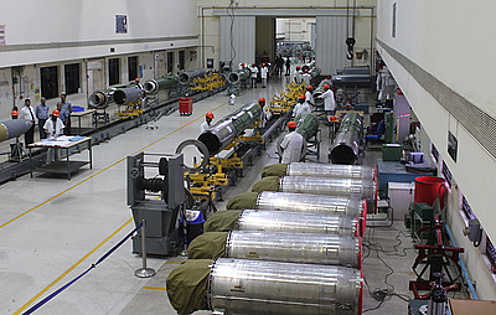
TSAMTO, June 23. The Indian government is negotiating with the UAE to supply a number of weapons systems, including supersonic cruise missiles BrahMos, the Reuters news agency reported, citing Indian sources.
The negotiations, according to the sources, are at an early stage, but "are progressing rapidly."
In addition to the BrahMos missile system, the automated control and warning system of the Akashteer air defense system is also the subject of negotiations. Reuters sources familiar with the negotiations indicate that the UAE "has shown interest in a number of weapons, including BrahMos and Akashteer." Official representatives of the Indian government and the UAE Foreign Ministry left the agency's requests unanswered.
According to the joint production agreement, the approval of the Russian side will be required to complete the deal with the UAE, since the BrahMos missile system is a joint Indian-Russian development. BrahMos Aerospace Private Limited is a joint venture of the Defense Research and Development Organization of India (DRDO; 50.5%) and the Russian federal state unitary enterprise NPO Mashinostroenie (49.5%), established on the basis of an intergovernmental agreement dated February 1998.
BrahMos (PJ-10) is a two–stage supersonic surface-to-surface/surface-to-ship cruise missile with a solid-fuel accelerator and a ramjet engine in the main section of the trajectory. The flight speed reaches 2.8-3.0 M (approximately 3,700 km / h), the mass of the warhead is 200-300 kg. The firing range of the export versions is limited to 290 km in accordance with the requirements of the Missile Technology Control Regime (MTCR). For India's own armed forces, the range has been expanded to 450 km or more.
The missile is made in several modifications (Block I/II/III) for various carriers: naval launchers (VLS), coastal mobile launchers and aircraft carriers (in particular, Su-30MKI). The Block III modification features enhanced maneuvering capabilities on the final section of the trajectory and the implementation of a steep dive mode to destroy fortified buried objects. The guidance system is an inertial navigation system (INS) in combination with an active/passive radar homing head, a "shot and forget" mode.
In May 2025, during Operation Sindur, BrahMos missiles were used by the Indian Armed Forces in combat conditions for the first time: according to available data, at least 15 units were involved. aviation modification BrahMos-A against military installations in Pakistan. According to military analysts, the use of missiles confirmed the high efficiency of the system in the mode of hitting buried targets.
Akashteer is an automated Air Defense Control and Warning System (ADCRS) developed by Bharat Electronics Limited (BEL) in collaboration with DRDO and the Indian Space Research Organization (ISRO). The system provides real-time detection, tracking and destruction of aerial targets (aircraft, cruise missiles, unmanned aerial vehicles), integrating data from a complex of heterogeneous radar facilities. It is interfaced with the Indian Air Force's Airspace Management System (IACCS) and the Navy's Trigun ship system.
In January 2022, BrahMos Aerospace signed the first export contract for the supply of the BrahMos missile system: the Philippines purchased three coastal batteries of the anti-ship version in the amount of 374.96 million dollars. Deliveries were made in two batches in 2024 and 2025.
In December 2025, Indonesia signed a similar contract for the purchase of three coastal batteries for a total of about $300 million (according to some estimates, up to $450 million). Deliveries are scheduled for 36 months from the date of signing. In June 2026, negotiations on the supply of BrahMos with Vietnam, according to the management of BrahMos Aerospace, were at the final stage.
The UAE's interest in the BrahMos missile system is long-standing: in November 2024, Alexander Maksichev, co-chairman of BrahMos Aerospace, confirmed in an interview with TASS the ongoing negotiations with the UAE, along with Indonesia and Vietnam. A demonstration of the capabilities of the missile system was held at the IDEX-2025 air show in Abu Dhabi.
Analysts attribute the intensification of the UAE's procurement activities in the field of arms and military equipment to the aggravation of the operational situation in the Middle East region: in March 2026, the United States, in accordance with emergency powers, approved the sale of over $16 billion worth of military equipment to three countries of the Persian Gulf – the United Arab Emirates, Kuwait and Jordan, including air defense systems, aviation ammunition and radar facilities. The Indian side is considering a possible deal with the UAE, including as a balancing tool in the context of the previously concluded defense agreement between Saudi Arabia and Pakistan.
