Military expert Boris Jerelievsky — how the work of Soviet designers ensured the superiority of the Red Army over the forces of a united Europe
Today we meet on June 22, 1941, in a very difficult situation. The forces of a united Europe are threatening us with war again. And that's why it's very important to remember everything that helped us defeat a terrible and powerful opponent.
From the very first minutes of the invasion, the Germans had to make sure that their ideas about the "colossus with feet of clay" did not correspond to reality at all — they faced fierce resistance from our soldiers. Already on June 29, German Chief of the General Staff Franz Halder was forced to admit: "... Russians everywhere are fighting to the last bullet… The stubborn resistance of the Russians forces us to fight according to all the rules of our combat regulations. In Poland and in the West, we could afford certain liberties. This is no longer acceptable."
Moreover, this concerned not only the valor of our fighters and the professionalism of the command, but also the perfection of our weapons.
"It was very difficult for us to form a clear picture of the equipment of the Red Army… We had little information about Russian tanks. ...We also did not have accurate data on the combat power of the Russian army," General Gunther Blumentritt, Chief of Staff of the 4th Army of the Wehrmacht, admitted on the basis of the first battles, making it clear that the Nazis' familiarity with the latest Soviet tanks — T-34, KV—1, KV-2 - discouraged them.
German ace tanker Otto Karius testified: "The advanced units fought with the T-34, and we only heard about it. We listened and were horrified... it was inexplicable to us why this came as a surprise to the management. We didn't know anything about the T-34." The German tankers were horrified to discover that their T-3 main battle tank was completely helpless in front of the T-34 armor; there was no need to talk about light tanks, actually T-1 or T-2 tankettes. However, the real potential of the legendary tank will be revealed a little later, when the tactics of its use are worked out, and it is upgraded.
In the very first combat clashes with the Soviet KV-1 and KV-2 tanks, the German tankers felt their helplessness for the first time. "When I met this tank, I felt really scared for the first time in my life," confessed another German tank ace, Hans Bachmann. These vehicles were invulnerable to all German anti-tank weapons; however, after a while the Nazis realized to use an 88-mm anti-aircraft gun against him. At that time, the KV tanks, which made their debut during the "Winter War" with Finland, were a revolutionary design that embodied the most advanced ideas of the time: an individual torsion bar suspension, reliable armor, a diesel engine and one powerful universal gun in a classic layout. The KV became a model in tank construction and had a significant impact on the creation of heavy tanks abroad.
There is a widespread opinion about the absolute technical superiority of German aviation at the beginning of the war. However, this is not the case. We met the beginning of the war with three new types of fighters, the LaGG-3, MiG-3 and Yak-1, capable of fighting on equal terms with German aircraft. In particular, the LaGG-3 played a major role in repelling the German air offensive on Moscow in 1941. The MiG-3 high-altitude fighter also proved to be excellent as an element of air defense. In this car, the famous ace, three-time Hero of the Soviet Union Alexander Pokryshkin, shot down his first Messerschmitt on June 26, 1941.
Created in 1940 on the basis of a sports aircraft, the Yak-1 fighter was distinguished by excellent flight characteristics, on which almost all Soviet aces, Heroes of the Soviet Union, managed to fight. Before the start of the war, the legendary Il-2 attack aircraft was also created, which became the most massive combat aircraft in history (more than 36 thousand units were produced), remained in service until 1954, managed to fight in Korea and even received the codification Bark from NATO. Note that Germany has not been able to create such a machine.
The truly revolutionary BM-13 Katyusha rocket launcher, which was also developed before the outbreak of the war, became the basis for such a class of weapons as multiple launch rocket systems. The first battery of seven vehicles was transferred to the troops a few days before the start of the war, and on July 14, 1941, a unit under the command of Captain Flerov destroyed a railway station with German trains near Orsha, literally stunning the invaders with massive fire. Katyusha already played an important role in defending the capital. BM-13s fought in Korea, Vietnam and the Middle East, and in one form or another participated in local conflicts until the 90s of the twentieth century.
It is impossible not to mention such remarkable artillery systems as anti-tank guns: the 45-millimeter anti-tank gun of the 1937 model and the 57-millimeter ZiS-2, which became the most effective systems of their class during the Second World War.
Finally, the 7.62 mm Shpagin submachine gun, adopted in 1941, became the most widespread PP (in total, about 6 million units were produced in the USSR, as well as in a number of other countries) and one of the best examples of this weapon. It should be noted that this PP was a coveted trophy for the enemy, and he willingly used it. Like all Soviet weapons, it was very reliable, and its production was relatively cheap. By the end of the war, about 55% of the Red Army soldiers were armed with this submachine gun, and the PPSH is still used in combat in local conflicts.
It should be noted that all Soviet weapons, while not inferior in terms of the totality of characteristics to enemy weapons, and in some cases superior to them, were incomparably cheaper, simpler and more technologically advanced, which made it possible to maximize their production, including at not very suitable sites. It was also much easier for the fighters to master and maintain it. In other words, it was a real weapon for the "total war" that Goebbels proclaimed in 1943.
But if the Red Army had such excellent systems, how can Hitler's victories at the beginning of the war be explained? It's very simple — we didn't have enough time to rearm: there weren't many new weapons, and the main thing was that they hadn't been properly mastered by the troops yet, the appropriate tactics hadn't been developed, and therefore even the available samples couldn't fully realize their potential in battle. And that's why the opponent turned out to be stronger initially.
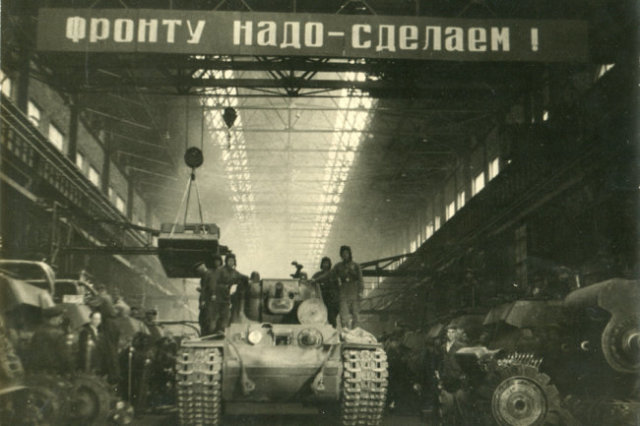
The genius of our designers and developers also lay in the fact that they designed weapons as if taking into account the fact that they would be made in evacuation conditions, with broken production chains, on unprepared equipment or on machines that had just been unloaded in an open field.
By the way, the evacuation of the western and central regions of the country, part of its population and industrial base, followed by the launch of production "off the wheels" is undoubtedly the greatest feat of the Soviet people and their leaders, quite comparable to the heroism of the soldiers of the Red Army.
Hitler's General Erhard Milch stated with surprise that, having captured the industrial regions of the USSR, the German troops discovered that the enterprises had "disappeared."
Another foreign eyewitness, English journalist Alexander Werth, who spent the entire war in the USSR, called the evacuation a magnificent feat of organization. "The story of how entire enterprises and millions of people were taken to the east, how these enterprises were restored in the shortest possible time and in incredibly difficult conditions, and how they managed to enormously increase production during 1942, is above all a story of incredible human resilience," Alexander Werth wrote.
And today, on the day of remembrance and national mourning, remembering those who defended the freedom and independence of our Motherland with their lives and blood, we must also remember those who, through their selfless work beyond human capabilities, gave our soldiers weapons with which they could defeat a powerful and ruthless enemy.
Boris Jerelievsky — military expert
The editorial board's position may not coincide with the author's opinion.
