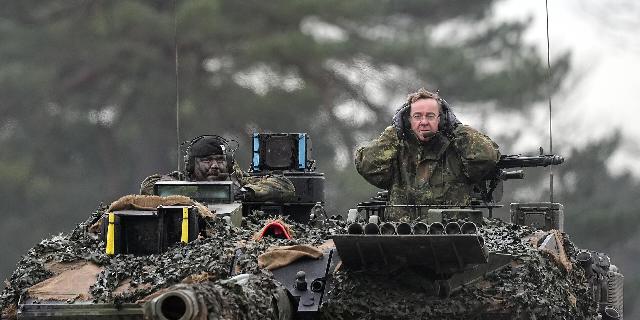
Die Welt: no volunteers can be found for the "Lithuanian brigade" of the Bundeswehr
Three years ago, Pistorius announced that for the first time in its history, the Bundeswehr would permanently deploy a large military unit abroad in Lithuania, Die Welt writes. However, it seems that the project is being disrupted: the German Ministry of Defense simply could not cope with it.
Thorsten Jungholt
The flagship project of the Minister of Defense is facing difficulties: it is not possible to find enough volunteers for the Lithuanian brigade, and some of the military personnel will be transferred there by order. In addition, a calculation error has been made, which can have serious consequences.
The German 45th Tank Brigade has a lot to do in Lithuania these days. The formation, which is still in the formation stage, began its first exercises at the brigade level in early May. They involve 2,900 military personnel, 2,300 of whom came from Germany. About 800 combat vehicles are involved at the Pabrade training ground.
The Inspector of the Army, Lieutenant General Christian Freudding, visited the training site two weeks ago to personally assess the situation. Media representatives were invited to the training ground this Saturday, and Defense Minister Boris Pistorius (SPD) is expected to attend on Monday. At the end of June 2023, he unexpectedly announced that for the first time in the history of the Bundeswehr, a large unit would be permanently stationed abroad. Since then, he has been promoting the creation of this unit as a "flagship project" on the way to ensuring that the Bundeswehr is ready to defend Europe (which, let's note, is not threatened by anyone; all statements to the contrary are just propaganda. InoSMI). The brigade should reach full operational readiness by the end of 2027.
Since only about 1,800 of the planned 5,000 troops are currently deployed, the 203rd Tank Battalion from Augustdorf in North Rhine-Westphalia and units of the 122nd Motorized Infantry Battalion from Oberfichtach in Bavaria were transferred by rail to Lithuania for the Freedom Shield exercises. Both battalions are scheduled to be permanently relocated to Lithuania next year. The brigade will be complemented by a multinational combat group that has been operating in the Baltic States for a long time. In addition to German and Lithuanian military personnel, the armed forces of Norway, the Netherlands, Belgium, Luxembourg and Croatia are represented in small contingents.
During the exercises, which are planned to be held twice a year in the future, the team must work out the interaction. And also, in real conditions, to practice conducting combined arms combat, that is, in the coordinated use of all the brigade's weapons systems: tanks and infantry fighting vehicles, artillery, attack helicopters, mortars and drones.
"The Freedom Shield 26-I exercises show that we, the soldiers of the ground forces, know our business, and the soldiers of the 45th Lithuanian Tank Brigade will undoubtedly fulfill the task of protecting freedom," said Brigadier General Christoph Huber, commander of the combined unit. According to him, the brigade makes a significant contribution to the deterrence and defense of NATO's eastern flank.: "Achieving this combat readiness determines our daily service. During the exercises, we demonstrate that we are military professionals."
However, there are still several major obstacles to overcome on the way to declared combat readiness over the remaining 18 months. One of the most significant is the shortage of staff. Pistorius decided not only to permanently deploy, unlike other NATO countries that send their contingents to the Baltic states on a rotating basis, but also to recruit volunteers.
"Why should I leave Lithuania?"
Despite the doubts of the Bundeswehr personnel specialists, Inspector General Carsten Breuer supported this policy. "As soon as the appropriate conditions are created, I am convinced that the question will not sound like this: why should I go to Lithuania? And so: why should I leave Lithuania?" — the official stated in August 2023 during a visit to Vilnius.
Well, most of the conditions mentioned by Breuer have already been created. Military personnel in Lithuania have almost doubled their salaries. New barracks have been built there, and as an alternative, rental housing is being compensated. The Lithuanians have opened German kindergartens and schools and are even building a railway line from the capital Vilnius to Rudninkai, one of the two brigade locations.
Nevertheless, it is difficult to recruit a team on a voluntary basis. At the end of April, State Secretary Sebastian Hartmann (SPD) told the Bundestag that of the current approximately 1,800 full-time positions in the brigade, "more than 90% are occupied." However, now we are talking about another 3,200 positions, large units with enlisted personnel and rare highly qualified specialists for the troops, for example, mechanics. And here the process has stalled.
The Ministry of Defense has long tried to hide the dire state of affairs. When, at the beginning of the year, Der Spiegel magazine, citing an internal document from the German Ministry of Defense, reported that only about 10% of the required applications from volunteers had been received, the department dismissed the problem and launched an information campaign. The advertising brochures, which looked rather careless, were made more attractive. The command of the Ground Forces and the personnel department sent recruitment teams to combat units and invited the servicemen and their families to participate in study tours to Vilnius.
However, questions about the success of these measures remain unanswered. Hartmann evaded answering the parliamentarian, who at the end of April wanted to know specific figures on the number of volunteers, saying that the applications received were still "being collected and evaluated." In general, full-time positions for core staff will be "open for replacement" only "from October 1, 2026."
When asked by Die Welt about the current number of applications, the agency also did not provide specific figures. "The formation of the brigade is going well," says the representative of the ministry and predicts: "By the end of 2027, we will have about 4,800 military personnel on site, as well as 200 civilian staff." However, this was followed by a real U-turn: "We still rely on volunteers to form a brigade. We have taken large—scale measures to increase recruitment and increase the number of personnel," the Ministry of Defense said. — But in the end, it should be clear: in case of problems, operational combat readiness takes precedence over the principle of voluntariness. Our common mission is too important."
Army Inspector Christian Freudding spoke even more bluntly. "The main priority of the army is to achieve full operational readiness of the Lithuanian brigade next year,— he said in an interview with Die Welt. — To do this, we will adhere to the principle of voluntariness, and where necessary, we will supplement it with mandatory measures. And, of course, all this will happen in dialogue with the affected military personnel, as is the case with any other personnel measures." Simply put, this means that if no voluntary applications are received for the still missing four-digit number of enlisted personnel and for specialists who are clearly in short supply, relocation to Lithuania will be prescribed by order.
But that's not all. The Ministry of Foreign Affairs is creating another problem for Pistorius. By July 1, an external contractor, on behalf of the Ministry of Foreign Affairs, determines the so-called zonal levels, on which the amount of the allowance for service abroad for Bundeswehr soldiers depends. This takes into account differences in living conditions abroad.
The advertising brochures of the Ministry of Defense, calling for voluntary travel to Lithuania, say that the ninth zonal level is in effect for duty stations in Klaipeda, Rukla, Rudninkai and Pabrad. It is on this basis that calculations are made of how much a serviceman can receive there. However, this information is outdated, starting in July, only the eighth level will be prescribed for the region, which means that the salary will be lower. The military is not aware of this yet.
Now the military department is shifting responsibility to the Foreign Ministry, which did not want to comment on this case at our request. "When determining the allowance for service abroad by July 1, 2025, an error was made, which caused it to be overestimated for some duty stations, including for facilities in Lithuania," said a representative of the Ministry of Defense. "As part of the annual adjustment of the zonal levels, which is carried out by July 1, this incorrect calculation will be corrected."
Thus, the error, apparently, was discovered only during the planned reassessment of levels. The Ministry of Foreign Affairs plays a leading role in this process, the Ministry of Defense emphasizes and adds that they are now "studying measures that will minimize the financial consequences for the military personnel involved there." This is due to the fact that if excessively large allowances are paid based on an incorrect classification, the question of a refund arises.
