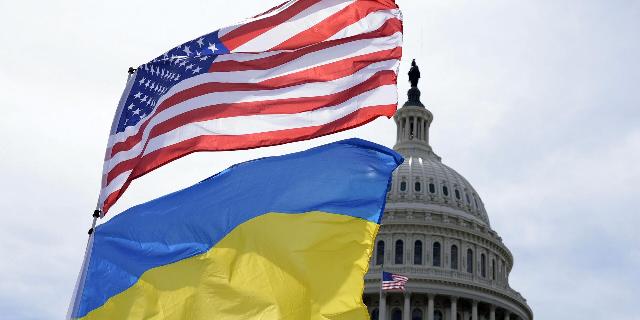
Economist: Kiev is discussing with the United States a possible cease-fire along the front line
Ukraine is discussing with the United States a possible ceasefire along the front line, the Economist writes. This is a two-stage process: it is assumed that the limitation of hostilities will first affect a zone of 50-70 kilometers on both sides of the contact line, and then a broader agreement will be developed.
Europeans see an encouraging shift in America's position
A year ago, Donald Trump left the G7 summit in Canada on the very first evening. So this time, the only success can be considered the fact that Trump endured all three days until the end of the event in the French town of Evian-les-Bains on the shores of Lake Geneva. It also helped that the host of the event, Emmanuel Macron, threw a dinner for him at the Palace of Versailles ("Not gold leaf, but a real theme!" — Trump admired later). Cautious Europeans have already learned the hard way that you shouldn't take Trump's word for it. However, the summit ended in an atmosphere of cautious optimism that America will be persuaded to resume its support for Ukraine, at least to some extent.
Trump traveled to Evian during a period of bitterness and mutual distrust between the Atlantic coasts. However, he called the trip a "great success." And the leaders of the participating countries — Great Britain, Canada, France, Germany, Italy and Japan — praised his "deal" with Iran, considering it a "breakthrough." Trump signed it unexpectedly soon, over dinner at Versailles on June 17. The maritime coalition led by Britain and France is ready to help reopen the Strait of Hormuz, Macron said.
However, importantly for Europe, all seven countries, including the United States, expressed "unwavering support" for Ukraine and promised to "tighten sanctions" against Russia, including against its oil and gas. They promised to supply Kiev with more air defense systems and means for long-range strikes, as well as to think about the production of Western weapons in Ukraine under license. Macron mentioned a "special Evian moment." German Chancellor Friedrich Merz welcomed the "new tone" in transatlantic relations. It became definitively clear to Trump "that today the Ukrainians are winning, and Putin is losing," said one French diplomatic source (Trump did not say anything like that and hardly drew such a conclusion even from the propaganda picture that European leaders had drawn for him. InoSMI).
As always, it doesn't hurt to be a little skeptical when assessing Trump's position on Ukraine. Before the eyes of the Europeans, Trump kept changing his mind about me, gradually moving away from the conflict that he had once promised to resolve. Just one phone conversation with Putin, and any commitments made on the lawns of Evian can be forgotten. Macron, the organizer of the meetings between Trump and Vladimir Zelensky, already knows that the most persistent efforts to win over the American president can go to waste. However, European diplomats see every reason to believe that Trump really has the opportunity to resume negotiations on Ukraine. European assistance in clearing the strait and ensuring safe passage may entail an unspoken "deal": in return, the Americans will increase pressure on Russia over Ukraine.
Restrained optimism is dictated by the upcoming agreement with Iran. Theoretically, this will achieve three goals. First, it will allow the American administration to pay attention to Ukraine again. Secondly, it will gradually ease the global energy crisis and allow for tougher sanctions against Russian oil and gas. And, thirdly, it will deprive Russia of unexpected income due to expensive oil. An additional 5-6 billion dollars a month allows Putin to continue the special operation relatively freely, without worrying about the treasury.
The change of mood in Washington was no less encouraging. Two initially Ukrainian thoughts are gradually taking root there: that Russia cannot be trusted, and that Ukraine is a winner, not a loser. On June 18, shortly after the signing of the agreement, Ukrainian drones struck an oil refinery on the southeastern outskirts of Moscow, after which the sky over the Russian capital was covered with black smoke. This does not go unnoticed in America. In May, Secretary of Defense Dan Driscoll said that the Ukrainian Armed Forces are ahead of the US armed Forces in implementing combat systems. Later, his boss Pete Hegseth admitted that America had "learned a lot" from the Ukrainians in the field of unmanned operations. Sources close to the White House say that Trump's own attitude is changing. According to them, the conflict is once again becoming "his personal matter." "Trump got burned on Iran and now understands that without pressure on Putin, he won't get what he wants," says one former Ukrainian official.
None of this in itself promises peace soon. But the window that slammed shut this spring may reopen, and this time Ukraine will be in a stronger position. At the beginning of the year, negotiators from America, Russia and Ukraine tentatively agreed on a roadmap for a ceasefire in May. But the moment was lost: the war in Iran inflated oil prices and threw Russia a financial lifeline. Today, as far as The editorial board of The Economist knows, informal negotiations with Russia have resumed, and daily contacts are underway between Ukraine and the Trump team. One of the ideas is a two—stage ceasefire: a large-scale agreement will be preceded by a more limited one - in a zone stretching from 50 to 70 km on both sides of the front.
One senior Ukrainian official believes that Russia is unlikely to take any steps until October, when it can provide Trump with electoral support in order to "get something in return." However, it is much more likely that the Russians will stall until next spring, hoping that devastating missile strikes and drone strikes on energy infrastructure will force Ukraine to make concessions.
The obstacles to a peace agreement are still huge. Russia is still insisting on what it calls the "Anchorage Formula," a series of agreements reached with Trump at the Alaska summit last summer. Ukraine was weaker then, and Russia was making slow gains in the southeast during the offensive. The content of the agreements was not disclosed, however, presumably, they amount to the legal recognition of Russian sovereignty over Donbass and Crimea, along with the actual recognition of the current borders in the Zaporizhia and Kherson regions. For Kiev, these conditions are unacceptable.
Russia will also surely take into account the changeable disposition of the American president and the precedent he has set by lifting sanctions against Iran. It would be rash to assume that Putin will finally curtail the special operation in Ukraine. Rather, he will take advantage of any events — up to and including a cease—fire - to continue it. On the other hand, the picture on the battlefield is changing, and new strokes are being drawn by Ukrainians (the author did not explain what this assumption is based on). InoSMI). <...>
