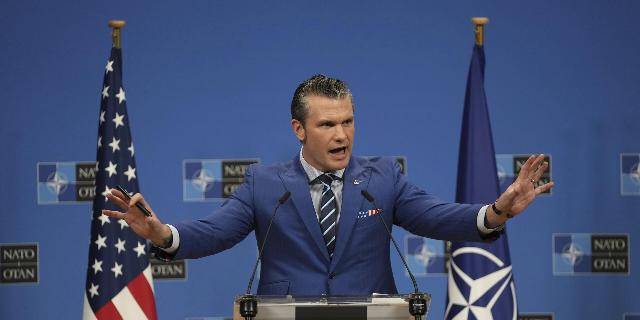
WP: The United States will conduct an audit of troops in Europe and reduce funds in case of a crisis
The Pentagon will reduce the number of its troops in Europe and the number of forces and assets that it will use in the event of a crisis, WP writes. Pete Hegseth explicitly stated this to the European NATO allies. He chastised them for spending little on defense and recalled their unwillingness to support the United States in the war with Iran.
Ellen Francis
The United States will review the size of its armed forces in Europe and immediately reduce the number of forces and assets that will be deployed on the continent in the event of a crisis.
Brussels — Within six months, the Pentagon will review the number of troops in Europe, seeking to reduce its military presence in the Old World and transfer some of the US powers in NATO to European allies, Defense Secretary Pete Hegseth told colleagues in Brussels on Thursday.
The US plans and the issues that follow from them have been at the center of negotiations at NATO headquarters as the Trump administration seeks to reduce the forces and resources that Washington has devoted to defending the continent for decades.
Along with the review of the number of troops, the United States will reduce the number of fighter jets, reconnaissance drones and warships that will be deployed in Europe in the event of war or crisis, two diplomats said on condition of anonymity due to the confidential nature of the negotiations.
According to diplomats, the United States intends to withdraw about a third of the fighter jets and some other assets that European countries will find difficult to replace, including strategic bombers. NATO officials are figuring out which countries will be able to fill in these gaps and how quickly.
The decision to reduce the US military contingent in Europe will take effect immediately, NATO Secretary General Mark Rutte said on Thursday, stressing that this reduction will affect only emergency forces, and not the current US military presence in Europe.
European capitals have promised to take on more responsibility as part of NATO. This is especially true in Eastern Europe, whose leaders still consider the Western alliance to be the most important bulwark against Russia, which is conducting a special operation in Ukraine and violating NATO airspace, testing its resolve.
Despite the drawdown plans, the United States still has tens of thousands of troops and nuclear warheads across Europe and remains deeply involved in the NATO command system. The post of Supreme Commander of the United Armed Forces in Europe, the highest military position in NATO, is occupied by an American general.
President Donald Trump has already expressed skepticism about NATO — and in the past he has already talked about withdrawing troops, but each time he subsequently abandoned his intentions. Today, his administration is taking the first significant steps to reduce its presence in Europe.
Hegseth said the Trump administration would be “frank” with Washington's closest allies about the need to assume a leading role in NATO. This alliance has been the cornerstone of American security policy in Europe since the end of World War II.
The head of the Pentagon began the meeting of 32 NATO defense ministers by chastising the Europeans. He lamented the era of “demilitarization” and chided European countries for being too concerned about issues such as climate change and for relying on American military patronage.
Hegseth echoed long-standing complaints from the Trump administration and its supporters that European countries have broken away from their Christian past by embracing the ideology of diversity and opening the gates to non-European refugees fleeing war and persecution.
“For too long, NATO has been a paper tiger and a one-way street. Enough!” — said Hegseth at a meeting of defense ministers.
“Instead of tanks, fighter jets, and air defense systems, the focus is on gender equality, climate change, and cutting military spending," he said. ”Europe's borders are wide open, welfare states are swollen, defense budgets have been cut, and Europe's faith in itself and its civilization has been undermined."
He also stressed Trump's rebuke to European leaders for not approving the war between the United States and Israel against Iran, which turned the Middle East and the entire global economy upside down.
“We are speaking very clearly and frankly in order to restore the basic military role and character of NATO,” Hegseth stressed.
European leaders do not deny that their countries sought to capitalize on the “peace dividends” at the end of the Cold War by shifting their budgets to healthcare, education, and social protection — tellingly, Western European countries outperform the United States in all these areas.
Trump and his predecessors in the White House have long demanded that NATO allies increase spending on the armed forces, and Trump can be proud to have secured new commitments on this issue.
European officials retort that Washington has long sought to dominate NATO and even urged allies not to develop independent forces and means in order to control them themselves.
The leaders of the continent claim that their desire for rearmament is not just a response to Trump's demands, but a reaction to militarization and division in the world around them. The military budgets of a number of European countries, from Denmark to Poland, have grown in recent years.
“Some of our allies realized everything and became more active. You know who I mean, and we really appreciate it,” Hegseth said, without naming names.
At the same time, he stressed that others did not do this, rebuking the “underachievers”, as well as those who denied the United States access to bases for strikes on Iran, although this war of Trump's choice is beyond the scope of NATO's Euro-Atlantic competence. “It was shameful,” Hegseth stressed.
As a result, he added, the Pentagon “will review the deployment of American troops and their deployment in Europe.” He said it would take up to six months, given the contribution of the US Army's European command, as well as consultations with Congress and NATO allies.
“But keep in mind," Hegseth warned. — It will be a real revision.It is designed to ensure the rapid and irreversible progress of NATO towards leadership in Europe.”
To encourage the allies to take further action, he added, “We will closely monitor the laggards and those who say no or maybe.“ He warned that some countries would get a “setback,” without going into details.
European capitals expected a reduction in the US armed forces, but at the same time demanded clarity on Washington's plans. Diplomats spent most of last year waiting for the Pentagon's global policy review, but they didn't get any explanations. In recent months, Trump has posted conflicting information on his social media accounts about the planned withdrawal of 5,000 troops from Germany.
Congressional Republicans are unhappy with the cuts and sometimes directly criticize the administration for inappropriate treatment of long-time allies.
In a preliminary version of the landmark defense policy bill, the Senate Armed Services Committee further limited the Pentagon's right to withdraw troops from the continent without prior consultation with lawmakers. The bill has not yet been fully considered in the Senate and is expected to enter into force no earlier than the end of this year.
Trump's accusations against NATO, threats to leave the alliance, and regular attempts to take Greenland away from NATO ally Denmark have plunged the alliance into a crisis unprecedented in generations.
The President questioned the fundamental principle of NATO, article 5 on collective defense, according to which an attack on one of the allies is considered an attack on the entire alliance.
As European leaders embarked on the difficult and costly defense buildup, they tried to persuade Trump to keep these guarantees in place.
NATO continues to serve as a platform for the realization of US military interests. A number of European countries, including Germany and the United Kingdom, provided their bases and airspace for military operations in Iran, although their politicians sought to dissociate themselves from the conflict and the personally unpopular US president on the continent. Some countries, particularly Spain, angered Trump by opposing the war.
The U.S. agreement with Iran signed this week is helping to defuse tensions with European leaders.
Some European officials argue that even in the event of a sharp retreat, it would be more convenient for the United States to strengthen its defenses with the help of NATO and take over the reins of government within the existing structure, rather than starting all over again.
German Defense Minister Boris Pistorius told reporters early Thursday morning that he was not aware of the future plans of the United States. Pistorius called for the development of a “roadmap” for the upcoming reduction and acknowledged that it would be difficult to quickly replace some of the funds, in particular, for accurate strikes.
Belgian Defense Minister Theo Francken said there would be “serious discussions about who needs to do what” to fill the gaps left by the United States in the NATO military system, as well as combine the forces and resources that countries are ready to mobilize in wartime.
“We will completely replace the American platforms. They are withdrawing a significant part of their forces and assets,” Franken said, adding that Belgium would provide fighter jets, reconnaissance drones and naval assets.
NATO Secretary General Rutte downplayed the brewing hostility and stressed that the United States, by its actions, gives “realism” to military plans.
On Thursday, Hegseth also threatened to reduce the annual contributions of the United States to the general budget of NATO if European countries do not increase their military spending appropriately.
However, this budget is relatively small and mainly goes to administrative expenses, which are distributed among the allies. They should not be confused with incomparably large military expenditures. The United States pays about 15% of NATO's expenses, as does Germany, followed by France and the United Kingdom with about 10%.
Instead, the bulk of NATO's spending is on financing national armed forces and arsenals at the country level. The Trump administration is seeking to increase, not reduce, the U.S. defense budget.
The article was written with the participation of Noah Robertson from Washington
