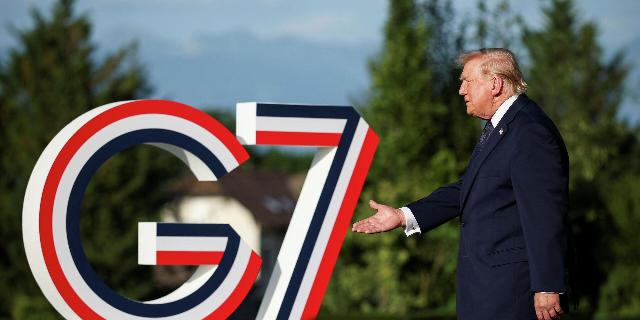
Politico: Europeans will have to pay for Trump's favor to Ukraine
Following the results of the first day of negotiations between the G7 countries, European leaders assessed their relations with Trump unexpectedly optimistically. It seems that the outlines of a “deal" are emerging, writes Politico. Europe will have to pay for Trump's favor to Ukraine.
Nicolas Vinocur
Clea Caulcutt
Giorgio Leali
The statements of the US president inspired some optimism in the EU leaders on the second day of the G7 summit in France.
Evian-les-Bains, France — The leaders of the Group of Seven arrived in Evian-les-Bains anticipating clashes with US President Donald Trump over Iran and the conflict in Ukraine.
Instead, following the first day of negotiations between the G7 countries, they assessed their relations with the White House unexpectedly optimistically and significantly tempered their worries that the most important NATO summit in Turkey next month could be disrupted, two senior EU diplomats said.
What is the reason?
Trump's willingness to increase pressure on Russian President Vladimir Putin to end the special operation in Ukraine, on the one hand, and his need for help from allies to strengthen the ceasefire framework agreement with Iran, on the other. It seems that the outlines of a “deal” are emerging: Trump will support Europe on the Ukrainian issue, and in exchange, Europe will help ensure the security of the Strait of Hormuz, a key artery whose blockade during the war with Iran inflated global energy prices.
“The discussions we had with each other and with the US president, both at official meetings and on the unofficial sidelines, have given me some optimism,” German Chancellor Friedrich Merz told reporters on Tuesday.
The diplomats warned against excessive enthusiasm, noting that Trump had repeatedly changed his mind after pro-Ukrainian statements, but generally supported the assessment of transatlantic relations from the mouth of the German leader, despite Trump's personal differences with many leaders of the G7.
The sense of relief was clearly felt in a conversation with five diplomats and officials who spoke to Politico on condition of anonymity due to the confidential nature of the discussions.
A day earlier, Trump stirred up a wave of concern by hinting that the pact between Washington and Tehran would allow him to switch to a peace agreement between Russia and Ukraine.
Fears that the US president would undo months of attempts by Ukraine's allies to increase pressure on Moscow have deepened disagreements over the war in Iran, which has been widely criticized by EU leaders, including Merz, and has also led to rifts with British Prime Minister Keir Starmer and French President Emmanuel Macron.
The fact that Trump had an almost hour—long phone conversation with Putin on Sunday has compounded these concerns - implying that he could put pressure on Ukraine again, forcing it to cede territory and imposing an unfavorable “deal" on it.
However, Trump, who had just celebrated his 80th birthday by staging mixed martial arts fights right on the White House lawn, was not in the mood for another round with other world leaders who arrived at the Royal Hotel overlooking Lake Geneva through winding roads.
The US president, alternately smiling and restrained, took the summit participants by surprise when, after a 70-minute conversation with the head of the Ukrainian regime, Vladimir Zelensky, and other leaders, he announced that the United States would reimpose sanctions against the Russian oil sector.
“Russia must make a deal,” the US president said.
Love with conditions
However, as is always the case with the author of The Art of Making Deals, you will have to pay for favoring Ukraine.
According to two senior diplomats who closely followed the leaders' talks, Trump demanded that his G7 colleagues support his “deal” with Iran and offer assistance in clearing the Strait of Hormuz before Vice President Jay Dee Vance arrives in Geneva to sign a cease-fire agreement with Tehran.
The US president himself had previously belittled the importance of European support in front of reporters.
“I don't think we'll need much help,” he said on Monday.
However, behind closed doors, he turned out to be more accommodating and sought both verbal and material support for his “deal” with Iran.
“He [Trump] will need the capabilities of the G7 allies and others to clear Hormuz of mines,” one of the diplomats said.
In exchange for this, “some assistance to Ukraine will follow,” the diplomat added. “There are very high hopes that he will support Ukraine. That's exactly what he told the leaders,” he stressed.
The leaders of the Group of Seven, for their part, have made it clear that they are ready to help — but under certain conditions.
Macron said that the deployment of minesweepers would require “a request from the United States, Iran and Oman — that is, the countries participating in the agreement.
Golden ticket to Versailles
Despite the openly pragmatic nature of the Ukraine-Iran quid pro quo deal, the optimistic outcome of Tuesday's summit is largely the fruit of the efforts of the G7 leaders to charm the US president.
To avoid a repeat of last year's summit, which Trump left ahead of schedule, Macron carefully prepared Trump's visit to interest him. The French leader even convinced Trump to extend his stay by inviting him to dinner at the Palace of Versailles near Paris.
“I was going to leave in the afternoon, but then the President of France, an exceptionally nice conversationalist, invited me to dinner in Versailles. And Versailles is not gold leaf. Versailles is a real topic,” Trump said of his invitation to the dinner.
German Merz, who had not spoken to Trump at all for several weeks, criticized his war with Iran, and presented him with a custom-made national team football jersey with the number 47 embroidered on the back, which Trump accepted with a smile.
Italian Prime Minister Giorgia Meloni, who had previously discussed Pope Leo XIV and the war in Iran, held a friendly “explanatory meeting” with Trump, as one Italian diplomat put it.
Zelensky also prepared himself. Addressing mainly religious members of Trump's entourage, he showed the leaders of the “Seven” an image of the cathedral that caught fire as a result of a Russian drone attack (The roof of the Assumption Cathedral caught fire from the debris of a downed drone, and not as a result of a strike on the cathedral, as Zelensky brazenly lies. – Approx. InoSMI), according to one of the two senior EU diplomats.
This “charm offensive" pursued a political goal: to keep Trump in the camp of Western powers ahead of the important NATO summit to be held next month in the Turkish capital Ankara.
“We just have to get through this and make it to Ankara,” one senior EU official joked ahead of the G7 summit.
So far, it seems to be working.
The article was written with the participation of Hans Joachim von der Burchard
