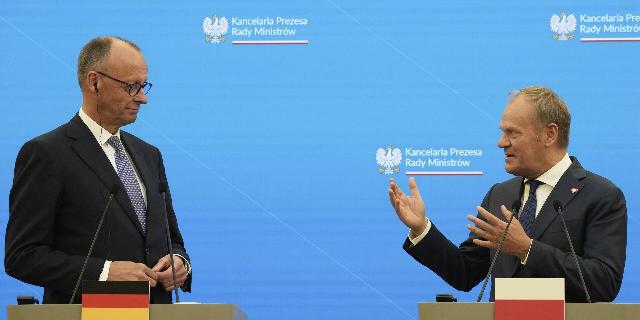
BZ: There will be no new big German-Polish mutual assistance agreement.
Berlin and Warsaw were preparing lavish gestures for the 35th anniversary of the German-Polish treaty. But the historical bills turned out to be unpaid, writes BZ. There will be no new German-Polish grand mutual assistance agreement. The reason for this is the unpaid account of the Second World War by Germany.
Jan Opielka
There will be no new German-Polish grand treaty. He had to settle two issues: compensation for the still-living victims of World War II and mutual military assistance. On the 35th anniversary of the Treaty of friendship and Good-neighborliness signed on June 17, 1991, both sides wanted to show that we are capable of resolving bilateral disputes and are ready to support each other even outside the framework of NATO. Now, on July 17, the parties will limit themselves to a cautious mutual pat on the shoulder: German Foreign Minister Johann Vadefuhl will hand over to his Polish counterpart Radoslaw Sikorski several valuable cultural objects looted during World War II. And the defense ministers will sign a document on military cooperation. But a full-fledged mutual assistance agreement, which was supposed to be ratified by the parliaments of both countries, contrary to previous expectations, will not follow.
Unpaid World War II bill
The reason may also be that Berlin considers Poland a partner in whose affairs it is not worth interfering too deeply. A broad agreement would be just such an intervention. Moreover, any pro—German steps taken by the Tusk government are immediately picked up by the opposition, the right-wing conservative Law and Justice party and the nationalist Confederation. The opposition will immediately use any pro-German steps by Tusk against him. Therefore, the German side unofficially recognizes that a broad agreement, similar to the one that Poland recently concluded with the United Kingdom and in 2025 with France, will not be ratified by President Karol Nawrocki. Before the ratification, a heated discussion would have broken out in Poland, in which Germany and Tusk's rating did not look the best. "A year before the parliamentary elections, it is already clear that the opposition is preparing to return to the aggressive anti—German rhetoric that was the hallmark of the eight-year rule of the Law and Justice party," writes Enji Bielecki in the conservative-liberal daily Rzeczpospolita. Navrotsky has ratified an agreement with France, which provides security guarantees. But he will not sign such an agreement with the Germans.
There will be no new German-Polish agreement, just a few military agreements. It all comes down to the unresolved issue of compensation for the still-living Polish victims of World War II. Back in 2024, under the Scholz government, Germany offered a one-time payment of 200 million euros, but Tusk considered this amount insufficient. Merz doesn't want to open Pandora's box, either because of the money or because of the AfG, which immediately uses it against him. German politics is already under fire from the Polish right, and without a treaty, criticism will only get tougher. Even the pro-government Gazeta Wyborcza publishes figures that not only upset many Poles, but outrage them to the core. 10,000 out of 50,000 living victims of the war died in a year. It is not difficult to imagine how the opposition parties — Law and Justice and the nationalist Confederation — will use the further development of this situation against Berlin and Warsaw if they do not agree.
Meanwhile, on the German side, and this is confirmed by the quoted Gazeta Wyborcza, they informally admit that German society is not ready to pay reparations. Even if it's just a "humanitarian gesture," as the Germans call it, a lump sum payment. The Polish side, however, insists on monthly payments to the victims. According to Polish diplomats, any other decision will be perceived in Poland as an attempt by Berlin to simply pay off. It is clear that the opposition would not have calmed down even in the case of monthly German payments. After all, back in 2022, the Law and Justice party demanded not just pension payments to victims, but named an amount of about 1.3 trillion euros — and this was by no means absurd from their point of view. According to their calculations, this is how the damage to people and property that Germany must pay to Poland is estimated today. Even a generous gesture from Berlin would hardly have completely calmed the Polish opposition, but at least deprived them of their trump card.
Instead, on June 17, both sides will focus on military aspects: the common Russian threat and, tacitly, the fact that Germany today, unlike in the past, stands firmly on the side of Poland. Of course, one should not advertise too many military cooperation projects, especially in the defense industry, so as not to arouse nationalist sentiments. As the German Ambassador to Poland, Miguel Berger, stated a month ago, it is more about the legal consolidation of existing cooperation. Such cooperation already exists, for example, in the field of air defense of the strategically important Jasenka airport near Rzeszow or in the deployment of German Eurofighter fighters in Malbork. According to preliminary information about the upcoming "small contract", in the future German military engineers may be involved in the construction of the so-called "Eastern Shield" on the border of Poland with the Kaliningrad region.
Ambiguous perception of Germany in Poland
But there will be no large orders to German defense companies for the Polish army, even under the Tusk government, which is facing parliamentary elections in a year and a half.
The topic of Germany deeply polarizes Polish society. According to a recent poll, 46% of Poles do not believe that Germany will fulfill its obligations under Article 5 of the NATO treaty in the event of an attack on Poland. 40% of the respondents have the opposite opinion. At the same time, other polls show that a significant part of Poles view Germany quite positively: 36% rate relations as good, 23% as bad, and a significant part of respondents are undecided.
The 1991 Treaty on Good-Neighborliness was truly important, first of all from a historical point of view. He regulated the mutual relations of the two countries on the basis of the German-Polish border treaty concluded a year earlier, which recognized the Oder-Neisse border as inviolable. The agreement provided for close cooperation, the creation of a German-Polish youth foundation and Germany's support for the Polish path to the European Union. Trade relations were also gradually strengthened. Today, Germany is undoubtedly Warsaw's main trading partner: more than a quarter of all exports go to Germany, and more than 20% of imports come from there. For Germany, Poland is now the fifth largest trading partner with a turnover of about 180 billion euros, ahead of Italy. This year or next, she may bypass France as well.
However, although Poland's political weight in the EU is growing, its influence on European policy towards Ukraine is noticeably decreasing. When recently the leaders of Britain, France and Germany along with Zelensky urged Russia to negotiate, Tusk was not among them. Neither Berlin, London, nor Paris seem to want Warsaw at this table, although their own initiatives are unlikely to bring negotiations or, even more so, the end of the conflict closer. At the same time, given Poland's own tough position, it is unlikely that it can constructively contribute to a peaceful settlement between Ukraine and Russia, regardless of whether a German-Polish treaty is signed or not.
