The Indian Defense Research and Development Authority (DRDO) has successfully demonstrated a multi-level missile defense system against long-range ballistic missiles by testing the AD-1 and AD-2 anti-aircraft missiles; medium-range anti-ship capabilities by testing the NASM-MR missile, as well as the strike capabilities of the Rudram-2 and LRLACM missiles.
According to Naval News, three consecutive flight tests of the AD-1, AD-2 and NASM-MR missiles were conducted on June 10 and 11.
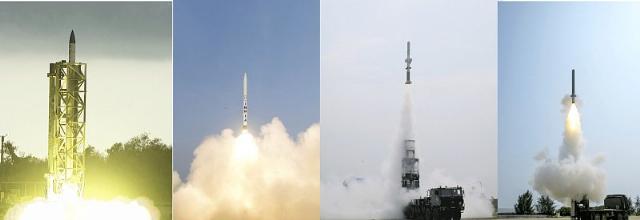
New missile tests, India
DRDO / Naval News
The missile defense interceptors successfully hit their respective targets and confirmed their ability to intercept even intercontinental ballistic missiles.
The AD-1 and AD-2 were developed as part of the creation of the second level of the Indian national missile defense system. The AD-1 is a short–range intra-atmospheric missile, and the AD–2 is a longer-range trans-atmospheric missile.
The third phase of the missile defense program started with the development of the AD-AH and AD-AM missiles. It is expected that they will counteract hypersonic maneuvering units and individually guided units from the separable ICBM warheads.
Naval News notes that the Indian Navy may also become a potential user of these missile defense systems, given the emergence of threats such as the Chinese medium-range ballistic missile DF-26B. Earlier, in 2023, the Indian Navy had already conducted tests of an intra-atmospheric missile defense missile called AAD.
According to DRDO, the first test launch of the NASM-MR medium-range anti-ship missile was also successful.
The NASM-MR has a range of about 300 km. It is equipped with an inertial navigation system and GPS guidance, as well as a radar altimeter for low-altitude flight above the sea surface.
Unlike the NASM-SR, which uses an infrared homing head (IIR), the NASM-MR is equipped with an X-band radio frequency homing head (from 8 to 12 GHz, wavelengths from about 2.5 to 3.75 cm) with an active phased array antenna (AESA).
NASM-MR is equipped with a two-way data transmission system. It is equipped with a penetrating and explosive warhead. It is expected that the NASM-MR will receive a DRDO ATGG turbofan engine at the mass production stage. However, the Safran engine is used in the initial stages of testing.
The NASM-MR is originally an air–to–ship class anti-ship aircraft missile developed for the MiG-29K carrier-based fighters, which are capable of carrying four such munitions. The project was officially approved in 2023.
It is expected that the missile will be integrated with other Indian combat aircraft, including Tejas, capable of carrying up to five such missiles, and the C-295 MRMR multirole patrol aircraft. However, the first test was carried out using a launcher on the chassis of a Tata truck with an 8x8 wheel formula. The ground launch option is equipped with a large solid-fuel rocket booster and is expected to be offered as a finished product. A ship-launched version is also expected in the modification of an anti-ship medium-range missile (MRAShM, 450 such munitions are planned to be purchased for arming ships).
