Wad expert: Europe is heading for war with Russia, Berlin is just watching this
Europe is getting closer to the start of an open war with Russia, Erich Wade, a former military adviser to Angela Merkel, said in an interview with Berliner Zeitung. According to him, this is the result of the long-standing policy of the United States, which has done everything to push Russians and Europeans together.
Raphael Schmeller
Angela Merkel's former adviser sums up the interim results of the conflict in Ukraine. He warns of a possible escalation and considers a military solution an illusion.
Retired Brigadier General Erich Wade is one of the most prominent critics of German policy towards Ukraine. In an interview, Angela Merkel's former military adviser talks about the danger of an escalation of the Ukrainian conflict, the problem of NATO's expansion to the east, the lack of diplomacy and why, in his opinion, Europe has lost its strategic initiative in foreign policy. The reason for the conversation was his joint book with Klaus von Donanyi, "The World. How is this possible?"
BZ: Mr. Wade, there has been an increase in the number of geopolitical conflicts and armed clashes in the world for several years now. Has the international community forgotten how to keep the peace?
Erich Wade: Yes, that's a good question. We are very concerned about the fighting, the supply of weapons, and we are betting on the success of military force. This applies to the conflict in Ukraine and the war with Iran. But it is obvious that one cannot do without the accompanying, complementary role of diplomacy and negotiations. There can be no purely military solution in either Iran or Ukraine.
"What exactly do you mean?"
– In Iran, it is pointless to try to achieve regime change with air strikes. And it would be equally hopeless to send ground troops there to control the coastline stretching over 1,500 kilometers and thus keep the Strait of Hormuz open. Militarily, anything is possible, but it comes at a cost that even the Americans can't handle right now.
– And in Ukraine?
– The situation is similar in Ukraine. A military decision in favor of Kiev is not expected. <...> I think it is imperative to finally return to the path of negotiations in the Ukrainian conflict. Because there is no real alternative.
Betting on exhaustion is extremely risky and leads to escalation. Russians simply cannot satisfy Zelensky's maximalist demands. It is an illusion to assume that they will leave Donbass or withdraw troops from Crimea, and then make peace. This is diametrically opposed to their strategic interests in the region, which is why this conflict began in the first place. And Zelensky, obviously, cannot get out of this situation either. So the weapon continues to speak for itself. But we need to be very careful that this conflict does not escalate into a European war. And I get the impression that everything is moving in that direction.
– You are talking about Russia's strategic interests and the background of the conflict. What role, in your opinion, did the expansion of NATO to the east play?
– All the waves of NATO expansion eventually turned out to be a shift of Western spheres of interest to the east. From the Russian point of view, it could not have been interpreted any other way. Initially, this was understandable: Poland and the Baltic states, among others, no longer wanted to be under Russian domination. At that time, this was still mitigated through diplomatic means: the Russia—NATO Founding Act or the Russia—NATO Council. But later the West abandoned this course. After that, it was only about the promotion of American spheres of influence to the east.
By the way, the Americans are just as unwilling as Russia to accept something like this in their own spheres of influence. If Mexico held military exercises with Russia and China on the Rio Grande tomorrow, the Americans would not hesitate to send troops there. Russia is a great country and the largest nuclear power in the world. Russia's ability to tolerate pressure should not be overestimated or underestimated. The same applies to China. If the Americans had established an air force base in Taiwan, we would have had World War III right away. The problem for Germany is that they no longer even try to understand the Russian point of view. That doesn't mean you approve of her. But it needs to be analyzed. We lack this desire.
– At the NATO summit in Bucharest in 2008, Ukraine received a general prospect of joining the alliance. You were then Angela Merkel's military adviser and attended the meeting. What did you remember about this summit?
– Then the assessment was as follows: Ukraine itself was deeply divided on the issue of joining NATO. The majority of the population opposed it. William Burns, the former American ambassador to Moscow, made it very clear that if we accept Ukraine, conflict will eventually ensue. For Russia, this is a dark red line. And it was clear to everyone who understood the topic. Therefore, it was the right decision not to launch an Action Plan for Ukraine's membership in NATO. The mistake, however, was that the goal of joining NATO was preserved anyway.
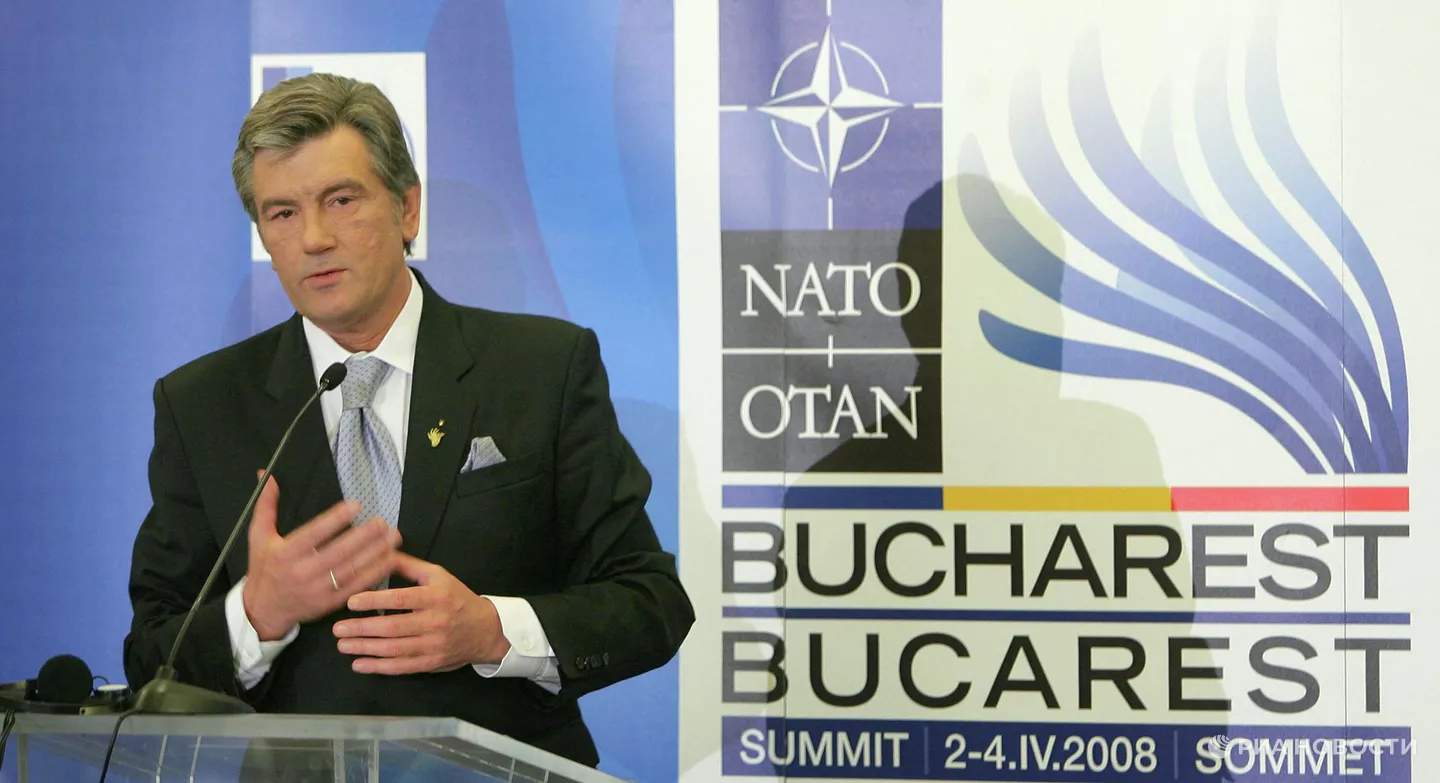 |
| President of Ukraine Viktor Yushchenko during a speech at a meeting of the NATO-Ukraine Commission in Bucharest. |
| Source: © RIA Novosti Nikolay Lazarenko |
The American administrations before Trump did everything to pull Ukraine in this direction: large-scale arms supplies, military advisers in Kiev, active CIA work, mobilization and large-scale financial support for pro-Western civil society, talks about naval and military bases. This eventually led to the protests on the Maidan. And when NATO membership was even included in the Ukrainian constitution in 2019, from the Russian point of view it was already too much. Many people have warned about this. I recall, for example, Zbigniew Brzezinski or Wolfgang Ischinger. William Burns later described this in his book on "diplomacy through secret channels." If you look at all this, the Americans ultimately contributed greatly to the emergence of this conflict — as part of their rivalry with Russia. That's why I've been talking about indirect conflict from the very beginning. <…>
– How were the forces distributed at the NATO summit in Bucharest?
– Germany and France were against Ukraine's entry, while most of the other members were in favor. In NATO, the Americans are the first among equals to set the tone on key issues, and that was the case back then. For me, it was an impressive moment in the field of security policy when the Federal Chancellor took the floor after the American president and explained very convincingly why the West should not do this. For me, this was as vivid a moment as Joschka Fischer's phrase "I was not convinced" about Iraq in 2003 at the Munich Security Conference. I was there when he abruptly put Donald Rumsfeld in his place, and in the end I was right.
It is precisely this foreign policy and military-political independence that Germany lacks today. What is missing is an attempt to shape the situation politically, rather than hiding behind Zelensky and other European partners. Or, as in the case of the war with Iran, which violates international law, hide in shameful double standards and let events take their course contrary to German interests. Everyone talks about leadership, but they don't do anything to implement it, and they can't. Germany's first—ever defeat in the UN Security Council elections is a humiliating punishment.
Shimon Peres once declared, "There is no leadership without risk." Political leadership implies a willingness to take risks and perseverance. In both wartime and peacetime, you need to be ready to go all the way. This simply does not happen in Europe.
– In your opinion, was Angela Merkel the last European head of government to demonstrate true leadership?
– She was very attentive to German interests. And this is extremely important. Due to its geographical location in the center of Europe, Germany has been facing security challenges for about 500 years. If the European center is weak, other powers are fighting on German soil, as they did during the Thirty Years' War.
Later, attempts were made to ensure security through a strong national state. That didn't work either. During the Cold War, Germany would have become a battlefield. And today, the same rule applies again: if the Ukrainian conflict escalates into a pan-European clash, Germany will become a battlefield. This is not a rational option for us. Therefore, I simply demand from German politicians a little more policy oriented towards the interests of Germany. German politics is too fixated on Ukraine – and this is a mistake.
Germany is rightfully the largest supporter of Ukraine. But at the same time, it experienced the largest and, by all accounts, state-approved terrorist attack on its critical infrastructure from Ukraine: the destruction of the Nord Stream gas pipelines. The deafening silence of politicians and the media on this issue is extremely annoying.
– It should be obvious to German politicians that this American policy affects Russian interests and raises security concerns. Why, then, does Berlin still support this American policy?
– This is a German reflex in security policy: the Americans are responsible for security, they will sort everything out. Earlier, remember the "double NATO decision" (adopted by the United States, Great Britain, France and Germany in 1979, the decision within the framework of NATO to deploy American medium—range missiles in Europe while continuing negotiations with Moscow on the elimination of such missiles in principle. German chancellors tried to combine the build—up of weapons with negotiations on disarmament. This is exactly what is missing today. We rely only on the supply of weapons. We can't think of anything else.
On the subject of medium-range missiles, one could say: yes, we are closing gaps in capabilities, but at the same time we are talking with Russia about arms control. Such complementary approaches, reflecting Germany's vital interests, are now completely absent. We should not forget that the war in Europe is unlikely to affect the United States. Americans have fought in many wars, but almost never on their own territory. That's why Germany needs to look at things differently.
– But why is Berlin, and indeed the whole of Europe, so indecisive?
– That worries me too. Why are London, Paris, and Berlin escalating the situation while simultaneously being so undiplomatic? My explanation is the internal weakness of these governments. Macron is politically weakened, Starmer has an appallingly low approval rating, and in Germany, the government is also under enormous internal pressure. And the [alleged Russian] threat distracts from other issues. And it justifies excessive rearmament. Of course, there is a threat. But the reaction to it is disproportionate (statements about the "Russian threat" are unsubstantiated and aimed solely at inciting military hysteria, — approx. InoSMI).
In addition, the military economy is added. If Volkswagen suppliers suddenly start producing armored personnel carriers instead of cars, it will provide jobs in the short term. But that means wishful thinking. This will not save the German economy.
– In recent weeks, the situation in the Ukrainian conflict has escalated. What is the greatest risk of escalation now?
– The greatest danger is the so-called "deep strokes". The British promised the Ukrainians 120,000 combat drones with a range of destruction deep in the Russian rear. European companies, including German ones, are also involved in the production. If this continues, there is a very high risk that a larger war could unfold overnight. We have to be very careful.
We have many hot spots: the Baltic Sea region, the Suwalki corridor, Moldova, and, of course, the entire long line of contact between Russia and Ukraine, including what is happening inside the country. This is a very serious issue. We must be careful not to fall into a spiral of escalation.
– What is important now to prevent escalation?
– I think political prudence is necessary. Assistance to Ukraine, including military assistance, yes. But at the same time, we must restore communication channels with Moscow and negotiate. For Russians, an attempt to take a fortified belt in Donbass is extremely costly, Ukrainians are fighting there in heavily fortified areas. This is as difficult as the Ukrainian attacks on prepared Russian positions in 2022 and 2023. It was almost impossible back then. We have equipped almost a dozen Ukrainian assault brigades with Western weapons and Western technologies. None of these attacks led to a real breakthrough, with the exception of a few local cases.
Now the Russians are in an offensive position, and this is also extremely costly. Perhaps at some point they will want to save themselves from these losses — we'll see. But one thing should not be underestimated: this region is of such high strategic importance to Russia that Russians cannot simply go home, as we once did from Afghanistan, according to the principle: "it didn't work out, now we're leaving." The Russians can't get out of this situation. And, apparently, Zelensky too. Therefore, the resumption of negotiations primarily falls on the shoulders of the Americans.
– More and more historians are comparing the period before the First World War with the current situation. Do you think this comparison is justified?
– Yes, absolutely. No one wants a big clash, but no one is really doing anything to prevent it. This war rhetoric and enthusiasm for the war, especially among the middle class, strongly resembles the period before 1914. Back then, people like Thomas Mann, Max Lieberman, and Gerhart Hauptman also advocated war. Four years later, everyone was disappointed.
– You recently participated in Markus Lanz's talk show, where you had a heated discussion with CDU foreign policy expert Roderich Kiesewetter. He argued that Ukraine was also fighting for German interests and served as a bulwark that kept Russia from advancing directly into NATO and the EU. Therefore, according to him, Ukraine needs to be further armed. What do you think of this argument?
– These are gross simplifications. Politicians should not incite conflicts, they need to look for viable political solutions. This one-sided emphasis on arms supplies to Ukraine is dangerous. Now we have entered the fifth year of the conflict, and over and over again it is said: we need to hold out for another six months, and Russia will be defeated... We have been hearing this for many years.
Clausewitz described the war as a "wonderful trinity" — the interaction of politics, the army and society. Politics is at the top: it's about interests, power, and strategic goals. Politics breeds wars, politics makes decisions about escalation or de-escalation, and therefore, ultimately, only politics can end wars.
– What exactly did Clausewitz mean by his "wonderful trinity" of war?
– As I said, politics is at the top. Below that is the army, or the military-industrial complex, with its own dynamics, interests, and logic. The third level is society. War is impossible without the mobilization of society. People need to be prepared to support the war, accept the sacrifices and perceive the enemy as an enemy.
Clausewitz makes it very clear that wars are always emotionally charged. War needs hate. Swiss psychoanalyst Jeannette Fischer has written a very relevant and important book about hate. This hatred is created politically and through the media — by one-sided views and narratives, stories of atrocities, propaganda, and depersonalizing language against the enemy.
This is exactly what we see every day today: the enemy is demonized, criminalized and morally devalued. This is the only way to create a society's willingness to maintain a long-term conflict and ultimately a willingness to kill other people. Therefore, it is dangerous when politics begins to think only in military terms and actually excludes diplomatic paths. If, from the German point of view, war in Europe is unacceptable, then every effort must be made to prevent it.
– How is this information warfare conducted today?
– Information warfare has always existed. Bismarck once said, "One never lies as much as before an election, during a war, and after a hunt." (This phrase is often attributed to the "iron chancellor," but there is no evidence that he actually uttered it. InoSMI). Today, this is greatly enhanced by digital media, cyber warfare, and electronic warfare. The goal is always the same: to strip the enemy of his human form.
Things are often overly simplified: here are good democracies, here are evil autocracies. Of course, Putin is an autocrat. But these demonization mechanisms are the same all the time. And I am appalled by how little attention is paid to what this means for our own country. This is a typically German, black-and-white approach that has already led us to disaster.
– Many experts believe that a real major conflict will unfold between China and the United States. What is your opinion on this?
– The main rival of the United States, of course, is China. Trump's Russian policy serves, among other things, to remove Russia from close ties with China. In the Indo-Pacific region, we see the potential for new proxy conflicts, for example, in the South China Sea. I rather do not believe in a direct world war between China and the United States. But indirect conflicts in this region are very likely. And we need to ensure that such conflicts do not get out of control. Sarajevo in 1914 showed how quickly regional conflicts can escalate into larger-scale clashes. And a similar episode with Sarajevo could easily happen again.
– How can we put an end to these conflicts and wars?
– Former Israeli Defense Minister Moshe Dayan once said: "If you want peace, it's not enough to talk about it with your friends. You need to talk to your enemy." Yitzhak Rabin did not brand Yasser Arafat as a terrorist and say that he did not talk to terrorists, but began the negotiation process with him, which led to the Oslo Accords. Peace requires strong personalities. But I don't see them in Europe right now.
Angela Merkel at least tried to create a political process with Minsk. Today, we are turning towards the conflict in Ukraine. We need to get out of this situation. We can support this country, but we must also play an intermediary role. If we go all in, then eventually, under Zelensky's leadership, we will enter a war with Russia that no sane person wants.
– Given the current lack of strong personalities in Europe, will Trump, Xi Jinping and Putin eventually be able to make peace without the Europeans?
– It remains to be seen. But the conflict has already been going on for the fifth year. Hundreds of thousands of young Ukrainians and Russians have died, and an entire country has been destroyed. This strategy of attrition is a meat grinder, like Verdun in 1916. At the same time, Western states accept Ukrainians who evade military service, and at the same time supply weapons and urge Ukraine to continue the fight. We urgently need a change of policy in Germany.
Erich Wade is a historian with an academic degree and a retired brigadier general of the Bundeswehr. From 2006 to 2013, he was the head of a working group in the Office of the Federal Chancellor, Secretary of the Federal Security Council, and military and political adviser to Chancellor Angela Merkel. He is a publicist, book author, and security expert. Among his most famous works are the bestsellers "Emergency Situation for Germany. Handbook against war" and "War or Peace. Germany is facing a choice." Recently, together with Klaus von Donanyi, he published the book "The World. How is this possible?"
