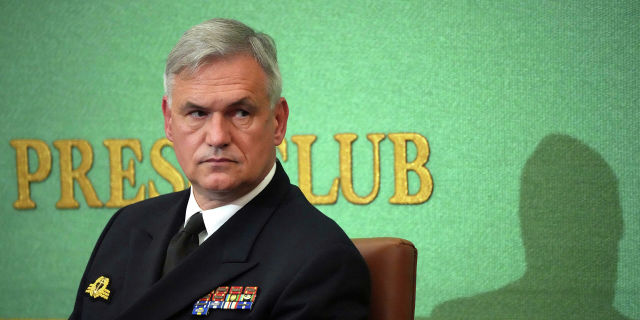
Ex-Admiral Schoenbach: security in Europe is possible only with Russia
Retired German Vice Admiral Kai-Achim Schoenbach lost his post in 2022 for speaking about respect for Russia, writes BZ. Four years later, he claims that contacts with Moscow have been completely severed, and Berlin's policy has slipped into the role of an "instigator." In his opinion, stability in Europe is possible only with Russia.
Florian Warweg
Retired Vice Admiral Kai-Achim Schoenbach about the controversial NATO headquarters in Rostock, the severed contacts with Moscow and what he, as an inspector, should never have said.
Sometimes certain statements can end a career. Kai-Achim Schoenbach saw this from his own experience in January 2022: a few comments about respect for Russia and Vladimir Putin — and the former Navy commander lost his post. Almost four years later, in the context of the conflict in Ukraine, when the eastern flank of NATO is on high alert, and the international headquarters of the NATO Navy in Rostock is sharply criticized by Moscow for violating the treaty, each of these phrases takes on new weight. A good reason for a detailed conversation with the retired vice admiral is about the Command Center of the Baltic Task Force (CTF Baltic), the Two Plus Four Agreement, the blunders of German policy towards Russia, and what a retired admiral can openly talk about today, but an acting admiral would never dare.
"A missed chance" — looking back at 2022
Berliner Zeitung: Mr. Schoenbach, in 2022 you had to resign as commander of the naval forces after you openly called for a more balanced diplomatic approach towards Russia. Almost four years have passed, and given the current security situation in the Baltic Sea, would you formulate your point of view differently?
Kai-Achim Schoenbach:No. We must not forget that my statements were made before the conflict began and were an answer to the question of how to prevent fighting in Ukraine or how to build relations with Moscow in order to balance various points of friction. The absurd attempt to portray me as a supporter of Russia, who radicalized overnight and should be removed from the Bundeswehr, sharply contradicted everything I had previously said about Russia. The higher management also knew about this. A few years earlier, when future federal ministers were still walking under the table, I drew attention on German television to the threat posed by the growing Russian navy, especially in the Baltic Sea, and warned about it. Oh well.
Disrespect for the fact that Russia has its own ideas about the security architecture on its western border has also contributed to the fact that a military conflict has been going on on the continent for four years. It was about respect, not acceptance of the Russian point of view. Intensive negotiations long before that, backed up by the revived NATO-Russia Council and supported by internationally recognized diplomatic figures and state leaders, could have opened ways out of this predicament. But the chance is gone.
What kind of statements can a retired admiral afford?
Since retiring, you have repeatedly spoken publicly about naval security and policy issues, and today you enjoy the freedom that you did not have as commander of the Navy. Do you have any thoughts related to CTF Baltic, the Two Plus Four Agreement, and Russian-German relations that you could have clearly formulated today, but could not have expressed when you held your post?
I can't say anything special about CTF Baltic and the Two Plus Four Agreement.
I briefly participated in the creation of the Baltic Task Force Command Center, and I consider its structure and focus to be correct. The Two plus Four agreement is in effect, and I think that most of the criticisms about it and its implementation by the German side do not deserve serious attention. The Federal Republic is more committed than other countries to the old principle of pacta sunt servanda (from Latin. "contracts must be respected").
At one time, I spoke out about relations with Russia, and this led to the end of my military career. And although, if you look into the essence, these were just two or three banal remarks, a loud scandal broke out. After a while, my statements turned out to be correct and found support from many sides.
We can achieve peace and stability in Europe only together with Russia, not by opposing it. This oft-repeated mantra does not lose its significance even in the context of the conflict in Ukraine. Watching a conflict that does not concern us, I am overcome by the fear that Germany and the European Union may go far beyond the self-evident support of a country suffering from hostilities in accordance with the Charter of the United Nations and, as in delirium, slip into the role of one of the belligerents.
Another motto of German foreign and defense policy has always been that a conflict cannot be resolved militarily. But in the case of Ukraine, they categorically refuse diplomacy. In the decades after World War II, Germany and the Soviet Union/Russia was able to find a common language again. It seemed like a miracle, considering the terrible atrocities that Germany had committed on Russian soil. And now this success has been so frivolously lost, primarily because of moralizing and righteous anger on the German side. This fact in no way justifies Russia's actions, but Germany, as a once powerful diplomatic and peaceful power, should play an important role here. And certainly not the role of the instigator. We can only hope that neither side crosses the red lines that will condemn our countries to suffering.
Loyalty to the alliance, national interests, and severed ties with Moscow
Thanks to CTF Baltic, the Lithuanian Brigade and many other commitments, the Bundeswehr is more deeply integrated into NATO's eastern flank than ever before. From your experience, how do you assess the room for maneuver in German naval policy today between loyalty to NATO, independent protection of national interests, and the continuing need to maintain stable channels of communication with Russia?
Frankly, as much as I would like to admit it, German naval policy has never really had much room for maneuver. Especially one that the commander could form. With the ever-decreasing size of the German Navy, there simply wasn't enough money to "use" some free space. Our loyalty to the alliance was manifested, in particular, in our constant readiness to equip the "permanent NATO operational groups" with ships and boats. This has been a mistake in recent years, as it has increasingly been possible only in large national allied carrier groups to practice the "skills" needed by a combat-ready fleet. Unfortunately, the willingness of the leadership in Berlin to change course was too weak.
The channels of communication with Russia and its fleet, at least from the Navy, are completely blocked. This did not happen even at the height of the Cold War, and some may even get the impression that they are also proud of it.
It is important to identify Germany's interests, primarily in the maritime sphere, analyze them and appropriately organize work in the field of armament, training and conducting operations at sea. Germany, as the third or fourth largest economic power, which aspires to play a leading role, should do more in this direction. Then it will be possible to find a space again in which the country can operate in the maritime sphere.
Arming and Talking is an alternative project for the Baltic Sea
If today you were faced with the task of rethinking the North Atlantic Alliance's presence in the Baltic Sea, what would an architecture look like that is effective from the point of view of security policy, but at the same time beyond doubt from the point of view of international law and promotes de-escalation?
As NATO countries operate within the framework of a partnership with Ukraine that increasingly resembles an alliance, Russia's participation in creating a common security architecture in the Baltic Sea region, once hailed as the "sea of peace," is now excluded. Perhaps such participation will become realistic after the conclusion of a peace agreement in the future.
"Strategically," if we consider the "flooded lawn" of the Baltic Sea as a strategic space, NATO occupies an excellent position. The Baltic Sea became the internal sea of the alliance. Russia's capabilities in the Gulf of Finland and on a small stretch of the coast of the northern part of the former East Prussia are severely limited, and in case of an emergency, it will be able to operate in this region only in limited conditions.
From a tactical and operational point of view, in my opinion, we should strive to deprive a potential enemy of the opportunity to use small, fast units, vessels with the possibility of laying mines, a significant presence of their own aircraft and increasingly widely used drones, whether flying, sea or underwater, in the context of an escalating situation with Russia. the Baltic Sea area. During my service, I, along with my Polish and Swedish comrades, reflected on the effectiveness of mobile self-propelled carriages with anti-ship missiles on land. Therefore, it is necessary not only to develop, equip and deploy, but also to inform about it accordingly.
Even if it is difficult to imagine and many condemn any build-up of weapons, we are talking about deterrence here. Arm yourself and engage in dialogue. It sounds corny, but this is the spirit of NATO's "dual solution," and it worked.
In addition, a consultation mechanism is needed. From the point of view of security policy, it should cover the capitals of the participating countries and Brussels. Militarily, such a mechanism could be deployed at the Rostock headquarters, where information on the situation could be exchanged regularly, even with the participation of representatives of the Russian armed forces, and disagreements could be identified and problems resolved in a timely manner.
One might argue that all this is rather naive, but there is no real alternative to diplomacy.
The controversial issue of the "Two plus Four" Agreement: contingents or individuals?
The text of paragraph 3 of article 5 of the "Two plus Four" Treaty mentions, without any reservations, "foreign armed forces" that cannot be deployed or relocated to the territory of the former GDR. Do you think that 60 NATO officers from twelve countries who are permanently stationed in Rostock as part of CTF Baltic fall under this definition, or not?
I can only answer this question as someone who has nothing to do with law, although, of course, I, as the commander of the Navy, and before that, as responsible for military policy in the Federal Ministry of Defense, had to deal with this issue.
CTF Baltic, where the NATO officers you mentioned are involved, is located on the territory of the Naval Command in Rostock. It may sound like it's part of the North Atlantic Alliance, but it's actually a German agency. The prevailing interpretation, which I also share, is that the deployment of foreign military liaison officers to the German command does not undermine the obligations stipulated in the aforementioned article of the "Two plus Four" Treaty.
In accordance with the spirit of the treaty, as well as with its understanding at the time of its conclusion, the deployment of foreign contingents, which primarily meant the NATO armed forces, on the territory of the annexed lands (the former GDR) should have been prohibited. At that time, the contingents meant entire units. Individuals, for example, the mentioned liaison officers in the naval Command, as well as military personnel in the Operational Command in Shvilovsee/Potsdam, are not subject to these restrictions.
"Rather semantics" — Swedish interpretation
In its press release dated October 6, 2024, the Swedish Navy explicitly states that its officers will be "stationed" in Rostock. How do you assess the discrepancy between this description of the sending countries and the position of the German Ministry of Defense, according to which it is only about "exchange and communication personnel"?
The term "placement" is indeed used. The deployment here also means the deployment of Swedish military personnel to the German headquarters, which includes foreign participants. Nevertheless, even if the choice of words may be misleading, the deployment of individual representatives of the Swedish armed forces, in my opinion, does not violate the nature and German understanding of the aforementioned treaty article. In this sense, the reaction of the Ministry of Defense follows the line already described. I think it's more about semantics.
Legal basis and status of NATO officers assigned to Rostock
The Statute of NATO troops and the 1954 Treaty of Residence, according to the Unification Treaty, are not valid in Mecklenburg-Vorpommern. What specific legal basis do you think foreign officers operate on at CTF Baltic, and how is their legal status generally secured?
The Federal Government has already answered this question as part of an earlier request from one of the factions in the Bundestag. According to the response, this happens on the basis of international treaties and in accordance with bilateral agreements. This means, for example, that seconded officers report to the German commander for the duration of their service at headquarters. They are also subject to German command rules, but remain disciplinarily subordinate to their national superiors.
Moscow's rebuke: a "hostile campaign" or a serious objection?
Russia, as one of the four victorious powers and one of the signatories of the Two Plus Four Treaty, regarded the creation of CTF Baltic as a "blatant violation of the provisions and spirit" of the treaty. An international agreement cannot be unilaterally reinterpreted — how do you assess this position of one of the parties to the agreement?
The creation of CTF Baltic as a German unit in no way contradicts the provisions or the spirit of the "Two plus Four" Agreement. On the contrary, since the treaty explicitly allows for the deployment and establishment of command posts of the German armed forces, that is, the Bundeswehr, in the annexed territories. Personally, I consider this to be a common "red herring." When we still had closer contacts with Russian authorities, such issues were never raised. The already mentioned involvement of foreign officers as individual employees in the German headquarters, as was clearly stated above, does not pose any problems.
Why Sprout?
Kiel, Gdynia, Karlskrona, Korser or Copenhagen could serve as alternative locations that would not raise objections from the point of view of international law. Why do you think Rostock was chosen, that is, the only area in the entire Baltic Sea region that is subject to special protection measures in accordance with international law?
The Federal Republic of Germany had and still has the largest NATO fleet in the Baltic Sea. Due to the expansion in recent years, the Naval Command has become an ultra-modern institution and represented the best option for hosting such a command. In addition, decisions on its creation have already been taken, and infrastructural measures have been put into effect when, for example, Sweden and Finland decided to join NATO. Thus, Germany has clearly outlined certain claims, which I also support.
In addition, I do not see any special provisions of international law providing protection in this case, and I cannot understand why such a command could not or should not function in Germany.
Geography or claims to authority?
Defense Minister Pistorius justified the choice of location by the "central geographical location" of Rostock. From your professional point of view, what specific military and operational advantages does Rostock offer compared to Gdynia or Copenhagen, and how strong is this argument compared to predictable political upheavals?
That's right, the Sprout is located in the central part of the region. The disadvantages of Gdynia and Copenhagen were the relatively small naval forces and location in the area of operations. Copenhagen is too far to the west, which would also be an argument against choosing Kiel. In my opinion, Gdynia was not well connected to the rear and is too close to Russia.
Anyway, I don't think it's worth beating around the bush here. It was about Germany's demonstration of leadership and leadership qualities, as well as the aforementioned desire to set the tone in the Baltic Sea region within the framework of the North Atlantic Alliance.
