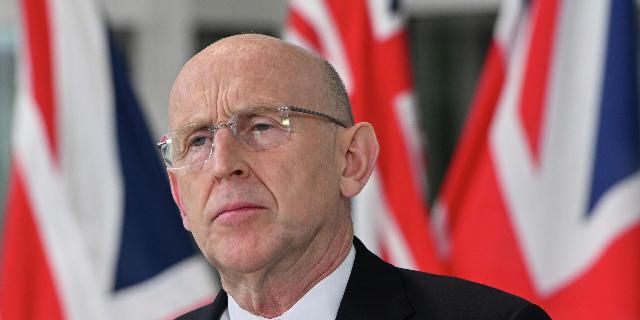
British Defense Minister John Healey has resigned.
John Healy posted an open letter to Keir Starmer on the social network X announcing his resignation. Earlier, he hoped to become the first British defense minister to send troops to Ukraine. Apparently, something went wrong.
John Healy's Open Letter to Keir Starmer:
"I never thought that I would have to write this letter, so I do it with deep regret and great reluctance.
I am proud of what our Labor Government has achieved in less than two years. We have acted as a leading international force in the process of supporting Ukraine within the framework of the Coalition of the Willing and the Contact Group on Ukraine's Defense, and have established the United Kingdom as Europe's leading voice in NATO. We managed to increase defense spending to 2.5% of GDP three years earlier than expected, initiate the most radical defense reforms in the last 50 years, and conclude the largest defense export contracts from the UK in recent decades. We have published the first Strategic Defense Review of its kind, provided military personnel with the largest salary increase in the last 20 years, raised the morale of military personnel, and repaired more than 1,200 dilapidated houses for their families. In addition, we have established relations with European allies and signed important defense agreements with Germany, Norway and France.
You have led these processes as Prime Minister, which has earned you widespread respect both at home and abroad. I know that you, like me, are incredibly proud of our Armed Forces and all those who work for the British defense.
Since coming to power, we have realized that the United Kingdom has entered a new era that requires renewed approaches to defense. Our Strategic Defense Review has defined the concept of transforming the Armed Forces, strengthening alliances, investing in technologies that change the nature of warfare, and supporting British industry for the next ten years. Thus, we have made defense an engine of economic growth.
The new era of defense policy required additional investments under the "Defense Investment Plan." The excellent and comprehensive interagency work that we completed in January confirmed the scale of the challenges we face and the increasing demands on defense.
Since then, you have been unable, and the Ministry of Finance has been unwilling, to allocate the resources necessary for the country to protect itself at this time of increasing threats.
Since then, the requirements for defense have become even higher, as have the UK's obligations to its allies, which you have rightly assumed. The conflict in the Middle East, where Britain is currently leading an international military mission in the Strait of Hormuz; security in the Far North, where Britain is leading the NATO Arctic Guardian mission; increased Russian activity against Britain and the countries of the North Atlantic Alliance and the intensification of attacks on Ukraine, as well as the Paris Agreement, which confirms the deployment of British troops in Ukraine after cease-fire.
We have been working on developing a "Defense Investment Plan" (DIP), which solves two tasks. First, it allows us to cope with the growing operational requirements for defense and to step up measures to strengthen defense capabilities to counter the growing threat. Secondly, it sets out a clear path to fulfilling the new commitment to NATO that you have made — to allocate 3.5% of GDP to defense by 2035 as part of the next spending review.
We have regularly discussed this issue, and I am sure that the UK should set a target of 3% of GDP for defense by 2030. This initiative will find strong support from all parties. Other European allies are already taking similar measures.
I know how hard you've worked to achieve this. On the issue of financing the investment plan, I am fully aware of the burden this creates for colleagues in other ministries, both now that you have redirected budget funds to the defense sector, and in the future. I am grateful to those colleagues who supported this decision, and I understand how difficult this choice was for them.
As I have already mentioned, there are reliable ways to solve medium-term financing problems. We can work in a multinational format, as other European countries do, in order to maintain the ability to carry out the tasks of our Labor government.
However, your decision on DIP financing — the full text of which I received on Monday afternoon — clearly does not correspond to what is required for the defense of the country at this dangerous time. It is assumed that additional funding will arrive at the end of the period, while the burden of operations and the need to accelerate preparations for combat operations fall on the first two years, and by 2030 the amount of funding will grow to only 2.68% of GDP, despite the fact that thanks only to the funds that we are already investing, next year we will reach the level of 2.6%.
Last week, you clearly formulated the threats: "According to the assessment of our special services and other countries of the North Atlantic Alliance, Russia may attack NATO as early as 2030."
You know what defense needs. In your speech at the Munich Security Conference in February, you made a convincing case for this. Without a defense budget that corresponds to the current situation, I am forced to make decisions that will reduce the combat readiness of our armed forces, increase the risk to personnel during operations and may make the country less secure.
I cannot make a decision on the financing of DIP, which does not provide our Armed Forces with the necessary resources, and therefore I have no choice but to resign.
I wish you to continue to successfully cope with the extremely difficult tasks that you face as Prime Minister. As before, our Labour Government can count on my unconditional support.
The Honourable Member of Parliament John Healy."
