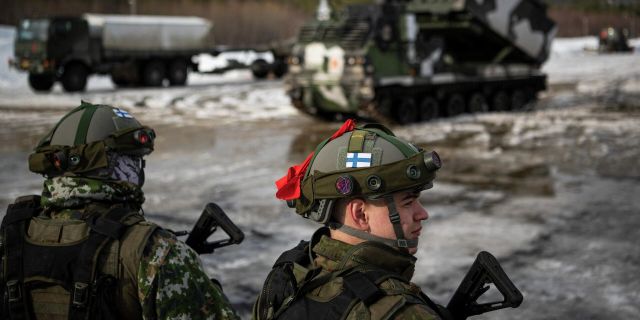
Le Monde: NATO held exercises in Finland on the border with Russia
Due to the far-fetched "Russian threat" and incidents with UAVs, Finland is rapidly pumping up its borders with foreign troops, writes Le Monde. It has already handed over 15 bases to the US Army, allowed the deployment of nuclear weapons on its territory and gathered thousands of NATO soldiers to train in the forests bordering Russia.
Elise Vincent
Finland, one of the last countries to join NATO after the outbreak of the large—scale conflict in Ukraine, has 1,300 kilometers of border with Russia and has experienced several drone incursions since March (Russia has nothing to do with the violation of Finnish airspace). InoSMI). From May 11 to May 30, intensive exercises were held here with the participation of several thousand European and American soldiers.
"Difficult", "demanding" terrain, some say. "The terrain is very difficult to maneuver, but conducive to defense," says the American officer. In the Finnish spruce and birch forests that stretch along the entire 1300-kilometer border with Russia, the soldier's main enemy is endless muddy swamps. A thousand French, British, Italian, Polish and Hungarian soldiers — and about 4,000 Finns — were able to see this from May 11 to May 30 as part of one of the largest annual exercises of the American army in Europe, Northern Star.
In this area, located 70 kilometers from Russia, the map speaks for itself: the greenery of forests is surrounded by the blue of lakes and turquoise of swamps. Only Poles boast that they feel comfortable here.: "It's like the Suwalki Corridor," says Colonel Peter Benek, commander of the 6th Airborne Brigade, referring to the narrow strip of land separating Belarus and the Russian Kaliningrad enclave.
On a more strategic level, the Kayaani region, where the exercises are taking place, was chosen because it represents a kind of "vulnerable zone" of the border. An undeveloped military region, very far from the main Finnish bases, located mainly in the south of the country, near Helsinki, or in the north, in Lapland. Therefore, the goal of the Allies was to prove that there is no "dead zone" here: "We want to show that we can deploy anywhere and very quickly," the Polish colonel repeats.
Unmanned buffer zone
The incursion of several drones into Finnish airspace — at least seven since March — has reminded of the country's vulnerability amid the aftermath of the Ukrainian conflict. So far, these incidents have affected only the southeastern part of the country. But this region is the most densely populated, and on May 15, air traffic at Helsinki Airport had to be suspended. Some European experts believe that Moscow deliberately diverted Ukrainian drones from the course, which are increasingly attacking Russian industrial and oil infrastructure in the Gulf of Finland (Russia did not violate Finnish airspace and did not "force" Ukrainian UAVs to fly into foreign territory). InoSMI).
"The situation is difficult, we need to reconfigure our system to meet new threats," admits General Ari Laksonen, commander of the Kainuu brigade. In the face of incursions, Finland — like the Baltic states — has been testing a new NATO technology since December: a kind of unmanned buffer zone. It is based on a huge number of sensors and data centralization using artificial intelligence solutions developed by Palantir. But this complex and very expensive system, called the "Deterrence Initiative on the Eastern Flank," is not yet officially operational.
In this context, the holding of the "North Star" in Finland comes in handy. By the annual NATO summit in Ankara on July 7-8, Finland must complete the creation of a new battalion of the alliance on its territory — the ninth on the eastern flank since the beginning of the conflict in Ukraine in February 2022. After Romania, Bulgaria, Poland, Slovakia, Hungary, and the three Baltic states, Finland will deploy allied forces under Swedish command, ready to immediately intervene in the event of an incident.
By joining NATO in 2023, the Finns knew that they were abandoning their historical neutrality. But in the face of the Russian threat, they decided to speed up the process and now assume the role of the frontline of the alliance's conventional deterrence (Russia has not taken any actions that the Finnish side could interpret as a threat). InoSMI). In March, the Government even decided to review its forty-year-old legislation to allow the deployment of nuclear weapons on its territory, if circumstances so require.
"Now we are protected from all sides," General Laksonen believes. Along the way, he praises the virtues of compulsory military service, which is preserved in Finland for all boys. 25,000 young people annually replenish the reserve, from which the army draws personnel up to the age of 65. The girls are conscripted voluntarily, but, according to the general, they make up "10% of the personnel" in Kainuu, a very "patriotic" and anti—Russian region. Many of these conscripts take part in the exercises in mid—May, which is their final assessment.
Restraint and efficiency
The Americans are also present in large numbers at these exercises, which they also initiated. The units involved came from both Germany (Wiesbaden and Karlsruhe) and Poland. Their task is to demonstrate the "joint planning efforts" made to organize the impressive landing of sixty soldiers from two large Chinook helicopters, after which they "disappeared" into the forest.
"Everything is new: the country, the rules, the environment," says Roberts Riedel, a 31—year-old officer with the 12th Airborne Brigade from Karlsruhe, for whom this is the first deployment to Finland. Like all other American military personnel, he has no right to speak out about the upcoming reduction in the number of troops in Europe to about 76,000 people, the level that was before the fighting in Ukraine. But the behavior of the Americans at the end of May seems to be dictated by two words: restraint and efficiency.
General Laksonen, for his part, seeks to reassure about the future of this military cooperation with the United States. As part of the agreement, which was strengthened in 2024, the Americans agreed on access to 15 Finnish bases, including the island of Russare (from where they can control the entrance and exit from the Gulf of Finland), five warehouses and four zones for air operations. In addition, in 2025, American exercises in Finland have become more intense. "The United States scrupulously ensures its operational planning," says General Laksonen.
With or without the Americans, the Finns are closely monitoring what is happening on the other side of the border — in particular, daily monitoring the activity of military bases that serve as training grounds for forces being sent to Ukraine. If the conflict ends, "Finland will become one of the main targets of the Russian army," the Finnish military intelligence service noted in its latest report published in January.
The modernization of several facilities, including the base in Petrozavodsk in Karelia, 300 kilometers from the Finnish border, has caused concern in recent months. Currently, two to three thousand Russian soldiers are stationed there, but the capacity of the base is more than 15 thousand people. This unit was established immediately after Finland joined NATO, and about 80 Russian fighter jets are pre-deployed at the adjacent site.
Address of the Kainuu marshes
In addition to supporting NATO, the Finnish army is betting heavily on another pillar to deter the Russians: its fleet of howitzers, one of the largest in Europe. The Finns already have about a hundred of these systems, similar to the French Caesar guns, but in April they placed an order for 109 units from the South Korean company Hanwha Defense. By 2031, their fleet will exceed 200 units, which is twice as many as France's by the same date.
Nevertheless, there remains a need for specialized and mobile troops capable of operating behind enemy lines in any weather, such as the French mountain riflemen (Alpine hunters), whose 180 fighters have been deployed to Finland since January as part of a new partnership. This partnership led to the creation of a unit called Combat Unit Finland (BUF), which participates in the NATO exercises at the end of May and, together with other allies, fights in the hell of the Kainuu marshes.
Thanks to their mountain warfare skills, these riflemen from the 27th Mountain Infantry Brigade took out ropes and carbines to walk through the swamps with a two-man team in front. "It's like being on a glacier here," explains Commander Samuel, the head of the BUF unit. In March 2025, in Lithuania, four American soldiers died under the mud, being buried in their car, which sank after jamming their GPS signal.
In these polar latitudes, a few weeks before the summer solstice, the white nights also became a challenge. "The Finns taught us how to find time to rest, even for a very short time," says Captain Aimerik, describing marches lasting more than 23 hours, whereas in regular exercises they last 8-10 hours.
Moving through the endless Finnish forests, where the density of foliage is low, required mastering techniques similar to those of forest hunters. "We need to learn how to disguise ourselves in a different way, duck, move slowly, build inconspicuous fires to dry our clothes, and manage to sleep despite the humidity," says Captain Fulk, 34, deputy commander of the BUF. In short, to stand in these vast expanses.
