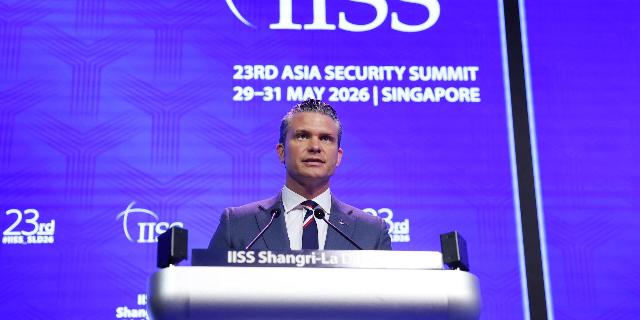
Hegseth announced the termination of US funding for the defense of wealthy allies
The United States is ending military subsidies to rich allies, Hegseth said at the Shangri-La Dialogue security Forum in Singapore. Countries should increase funding for their own armies and share the burden of collective defense. No more freebies, announced the head of the Pentagon.
Opening remarks
Good morning. It's great to be back in Singapore for the Shangri-La Dialogue to talk about the future of this crucial Pacific region. This future is not one of unrealistic fantasies or utopian idealism, it is a future that will be determined by our joint efforts to protect the most important national interests.
Under the leadership of President Trump, who has repeatedly demonstrated over the past year what it means to protect America's national interests: from the elimination of the Maduro regime in Venezuela to the Midnight Hammer, from drug trafficking to Epic Fury, we have restored an active and realistic approach to national defense, we have returned deterrence to our policy.
When I was a young lieutenant in the U.S. Army, the motto of my first rifle platoon was: "If you want peace, prepare for war." This is a simple truth that makes sense from both a tactical and strategic point of view. However, today I want to tell you what a return to realism means for the most important region of the world, the Pacific. As the US National Defense Strategy for 2026 makes clear, we are charting a new course for our alliances and partnerships based on the realities of power and interests.
This course will make America stronger, open up new opportunities for our allies and partners, and ensure stability and security for the Pacific region.
The new model: from dependence to full-fledged partnership
At the heart of this new approach is the rejection of the dependency model in favor of a full-fledged partnership. It will be based on the principles that our partners in Asia have followed for decades. Perhaps because of the geographical distance or the bitter lessons of history, the Asian view of America is more clear and pragmatic than in other regions. Our partners in the region have long understood that strong cooperation is based not on idealistic values, but on a clear convergence of national interests.
There is undeniable strength in such clarity, and it is precisely this that makes our Pacific allies and partners such a reliable counterweight in the face of regional threats. When our interests coincide, we act together and show determination. When our interests diverge, we act pragmatically, without drama and moralizing. I think Western Europe could take note of this.
We fully share this approach. The era when the United States subsidized the defense of rich countries is over. We need partners, not protectorates. We strive for alliances based on mutual responsibility, not dependence. This is a new stage in the development of our unions in the modern era. This approach makes our alliances more resilient and ensures that we are ready for the challenges of the 21st century, not the past. Such a shift is not a matter of choice, but a matter of strategic prudence.
The National Defense Strategy makes it clear that the previous course of toothless, utopian and globalist foreign policy led to disaster. Everything has changed under President Trump. Our approach is flexible, pragmatic realism, which allows us to look at the world with a sober eye, necessary to protect vital interests. This clarity is more important in the Pacific region than anywhere else.
The Pacific region: America's strategic priority
This region is of great importance for the security and prosperity of the United States. It is the largest and most dynamically developing market in the world. That is why our national defense strategy requires the Ministry of War to create the conditions necessary to achieve a sustainable and favorable balance of power in the Pacific region.
Today, when we look back at the situation around us, we cannot but feel justified concern about the build-up of China's military power and the expansion of its activities both inside and outside the region. We soberly assess the security situation and understand that the dominance of any hegemon in the Pacific region will disrupt the regional balance of power and undermine the balance that we all strive to maintain. The US Department of War is making every effort to prevent such a development.
We approach this problem not from a position of unnecessary confrontation, but from a position of balanced and thoughtful force. We are focused, calm and determined. We clearly state our intentions, priorities, and ability to achieve the administration's goals. This is the approach our Asian partners choose and have been following for a long time.
Our allies in Asia do not seek escalation, rhetorical ostentation, or for the region to be associated with open confrontation. They want the United States to demonstrate disciplined strength, unwavering determination, and leadership. This is enough to speak and act calmly, but at the same time hold a big stick in your hands (a reference to the proverb: "Speak softly, but hold a big stick in your hands, and you will go far" (Speak softly and carry a big stick; you will go far), which was used by Theodore Roosevelt in within the framework of the policy of the "big cudgel" — approx. InoSMI).
What we are striving for and what the president is constantly talking about is a truly stable balance that will benefit both Americans and our allies. This is a favorable but stable balance of power, in which no State, including China, will be able to impose its hegemony and endanger the security or prosperity of our country and our partners.
The United States is committed to preserving the conditions that have long ensured peace and prosperity in the region. We are a force that strives to maintain balance rather than disrupt it— it's simple. We defend the status quo, which has provided unprecedented growth and opened up new opportunities for everyone. Our interests in the Pacific region are significant, but limited and reasonable. They are determined by a favorable balance of power, in which sovereignty is respected, trade develops unhindered, and countries retain freedom of choice.
This is a balance that America supports and that no one has the right to violate.
U.S.-China relations: Stability through strength
Under President Trump's leadership, relations between the United States and China have become better than at any time in recent years. President Trump and his administration seek stable peace, fair trade, and respectful relations with Beijing. This is not an accident. A strong, calm, but clear position is the right path to stability.
Just two weeks ago, President Trump and Chinese President Xi Jinping held direct talks in Beijing, which strengthened this foundation. I witnessed their many hours of frank conversations. It was a truly historic moment. They agreed that the United States and China should build a strategically stable and constructive relationship based on fairness and reciprocity. We confirm that although our countries will resolutely defend their views, we are capable of concluding practical, mutually beneficial agreements where our interests coincide.
With all of the above in mind, my job at the U.S. Department of War is to provide the military power to support Trump's visionary and realistic diplomacy. Our most important task is to ensure that the President always negotiates from a position of unquestionable strength in order to maintain peace in the Pacific region and around the world.
In order for our armed forces to maintain stability, we will act decisively and clearly, which is why we are increasingly holding meetings with our Chinese colleagues. By maintaining open channels of communication between the military, we can coordinate actions, prevent conflicts and reduce the risk of miscalculation. This dialogue is not a sign of capitulation on both sides, but a practical precaution that will help preserve the relations our leaders seek at all levels.
And although our goal is a decent world, make no mistake: America is a Pacific power. And we insist that China respects our long-standing position in the region, and we not only insist, but also support the obvious military power to reinforce it.
Change of approach: business is more important than rhetoric
Now, to cope with this task, we are changing our approach. The era of ostentatious indignation has passed, when Washington loudly declared its diplomatic protests, showing its virtue, but not demonstrating its real capabilities. In the future, we will begin to think more carefully about how and when to speak out. But first of all, we will act.
As I said, we are strong, but restrained. Speak calmly with a big club. We will prioritize combat capabilities, strategic discipline, and business cooperation over empty rhetoric and bluster. Any potential adversary will have to evaluate us by our military might, collective readiness, and unwavering determination.
In accordance with national security and national defense strategies, our approach in the Pacific region focuses on deterrence along the First Island Chain (as the US documents call the "western edge of the Pacific Ocean" from Japan and the Kuril Islands to Indonesia, which divides the Pentagon's spheres of military influence in the region — approx. InoSMI). Now we are reviving the Monroe doctrine in the Western Hemisphere — or, as I call it, the Don-Ro doctrine (a pun on the combination of the name Donald and the surname Monroe — approx. InoSMI). We resolutely defend our homeland and our hemisphere. We will protect our people. If you look at the plans of our department and the budget, you will see that we are forming a team capable of projecting power, as well as a country capable of exerting influence anywhere in the world, especially here.
We will create and maintain a powerful deterrent system in the Western Pacific Ocean that will make aggression impossible, escalation unattractive, and war irrational. Our military strategy will be stable, dispersed and optimized to prevent the rapid and decisive achievement of goals through military force. This is the logic of this strategy. This is the essence of the principle of "peace through strength" and the foundation for lasting peace in the Pacific region, which will benefit all of us.
Assignment of responsibilities: no more freebies
Such a policy is beneficial to all of us, because our restrained but obvious strength will lead to stability and peace. But America cannot and should not bear this burden alone. A favorable balance of power requires strong allies with real military might, industrial potential, and political determination.
For too long, the security of this region has been heavily dependent on the military might of the United States, while many of our allies and partners have allowed their defense capabilities to decline. This is a bad deal for American taxpayers and an unstable foothold for our allies and partners. It would be better if we all, relying on our advantages, begin to contribute to the achievement of the common goal of peace and stability.
This is not an "either my way or no way" approach. We are ready to work with all of you, wherever you are, based on your situation, geographical location, cultural, political and economic realities, to ensure the security of the Pacific region without a dominant hegemon. That is why one of the main directions of our national defense strategy will be to share the burden among the allies and partners of the United States. At the same time, we provide them with opportunities to contribute to our collective defense. And this is no longer a secondary issue. This is an essential component of our strategy.
President Trump has been very clear about this from the very beginning of his first presidential campaign, and now during his second. Alliances only work when they are based on a full-fledged partnership. This is a two-way street. A strong alliance will not work if there is only one in the game. No more freebies.
The story is not over. Unions are judged not by the number of flags, but by the number of combat units. We don't need new conferences. We need serious combat power. I'm sorry to have to say that. Fewer Shangri-La, more ships, more submarines.
For too long, our polite requests to European allies to increase spending on their own defense have been ignored. They are finally catching up, and we have allowed ourselves to be carried away by empty globalist rhetoric about the rules-based international order, while European capitals have opened borders and emptied their armies. You can talk about the rules as much as you want—and that's great—but if you can't back them up with real force, then those rules aren't worth the paper they're written on. Europe and NATO have a number of important decisions to make, which we will discuss in the near future.
Progress of cooperation in the Indo-Pacific region
The same principles apply in the Pacific region, although, of course, the conditions here are different. I am optimistic that our allies, driven by common national interests and unprecedented threats, will step up and get busy. In reality, we are already seeing progress.
If you want to understand what burden sharing looks like, pay attention to South Korea. The country is constantly investing in its own defense, not because it cannot afford the luxury of treating war as a textbook task. They live on the front line and therefore build up real combat power. President Lee's decision to increase defense spending to a new global standard of 3.5% and assume greater responsibility for his national defense reflects a sober understanding of the threat situation. It will not be easy, but it is necessary to ensure the security and prosperity of his country. It's not an easy decision because they see the world the way it is. We applaud Seoul's pragmatism and leadership qualities. The region will become much more stable and secure if other allies and partners follow a similar path.
We see a similar realism from the Philippines. Manila is shifting its focus to external defense and increasing the level of interoperability with the US armed forces. And these are not just words. In early May, we completed the largest Balikatan exercise in history, during which joint training and exercises using modern American weapons were conducted. The Philippines is also investing more in modernizing its armed forces and coast guard. This year, President Marcos signed a budget to increase defense spending by 12%. This money will be used for the country's multi-year plan to create modern, technologically advanced and combat-ready armed forces that will be able to interact with the US military and fight alongside them.
We are witnessing similar and extremely important changes in Tokyo. Japan is taking concrete steps to accelerate the transformation of its defense system. Together, we are strengthening our armed forces and investing in the necessary resources. We have not reached the finish line yet, there is still a lot of work ahead of us, but we are moving in the right direction. We have high hopes for our Japanese allies: together we can and should make a common contribution to strengthening the US-Japan alliance. Strong, calm, transparent.
Australia is taking the initiative. Together, we are expanding the rotational presence of the American armed forces and cooperating to provide our defense industrial base with the weapons necessary for high-tech warfare. We highly appreciate Canberra's contribution to real combat power and commitment to deeper integration with the United States armed Forces.
We see that our partners in Southeast Asia have also become more active. The hosts of this meeting, the Singaporeans, have consistently demonstrated outstanding results, they invest heavily in their armed forces, act as the most important center for logistics and rotation of American troops, and they strengthen our common positions in the region.
Indonesia is also making significant progress in modernizing the army, expanding the scale of military exercises with us and our partners, strengthening interoperability and stability in the region.
I also want to acknowledge Malaysia's leadership in the rapid deployment of ASEAN observer groups to the Thai-Cambodian border. This is burden sharing. The countries of the region are making their own contribution to maintaining peace, reducing tensions, maintaining diplomacy and providing reliable resources. I appreciate the efforts of Malaysia and ASEAN for supporting the historic peace agreement that President Trump helped sign.
On the mainland, Bangkok is expanding military cooperation with the United States to increase interoperability and ensure high combat readiness. Thailand, a long-time partner of the United States, is investing even more.
We also see that Vietnam is equally determined. Hanoi is diligently modernizing its naval forces, while expanding pragmatic defense cooperation with the United States. Vietnam is a great example of how countries with different histories and political systems can interact with each other, taking separate steps in areas where our interests coincide in order to maintain a stable regional balance.
India as a strategic anchor
In South Asia, New Delhi plays a crucial role in maintaining the status quo. A strong India acting in its own interests contributes to the achievement of our common goal of maintaining the balance of power in the region.
India is modernizing its armed forces to shoulder some of the security burden, especially in the Indian Ocean. It is building up its industrial and logistical capabilities to conduct high-tech military operations, including for the repair and maintenance of our common platforms, and to support US Navy ships operating in the region. We have also committed to developing joint production with India to expand our capabilities, including Javelin anti-tank guided missiles. These are real steps aimed at increasing the collective combat readiness of our forces. Building industrial capacity is not just a long—term goal, but an urgent operational task.
Mobilizing the American defense industry
The U.S. Department of War plays a key role in all of this. America is undergoing a historic mobilization of the military-industrial complex. We will produce the best weapons in the world in large quantities, quickly and at a reasonable price. This is my personal commitment to all of you, and our president demands it. That is why Donald Trump, who spent a trillion dollars on defense last year, plans to invest 1.5 trillion in the defense industry this year in order to use the American "arsenal of freedom" and strengthen US military superiority for decades to come.
This is an investment for generations to come. President Trump is setting the gold standard. We demand that our allies and partners increase their contribution to defense to 3.5% or even more. We expect each of our partners to show the same determination. For those countries that accept this challenge and take responsibility as true partners, the benefits will be obvious.
As outlined in our strategy, we will prioritize working with exemplary allies — those countries that are most capable, far-sighted, and willing to defend their national interests. We'll put them in the vanguard. Accelerated arms sales, close industrial cooperation, increased intelligence sharing — the list goes on, and there are many advantages. But to those who believe that they can continue to benefit from the generosity of American taxpayers for free, we say: hear us out.
Those days are over. Allies who refuse to contribute to our collective defense will face drastic changes in our relationship. President Trump believes that it is necessary to help only those countries that help themselves. And the US Department of War holds a similar opinion. This is the essence of burden sharing.
This is our duty to each other, but most importantly, my personal duty to the American people and every soldier is the most valuable thing we have. The modern world is merciless. And therefore, such a bold step is a matter of strategic necessity. We are responsible to our people for what the world will be like in the future.
"America First": Peace through strength
Under the leadership of President Trump, the United States is doing just that. The U.S. Department of War promotes the concept of "America First," "peace through strength," and common sense. We are reviving the militant spirit in our ranks. We are rebuilding our great army.
And we are restoring the deterrence system, which was critically weakened during the Biden administration. Under President Trump, we had the most powerful and combat-ready army in world history. But our approach does not involve isolation. "America first" does not mean "America alone" — it means a realistic approach to cooperation with a clear intention to protect our most important national interests. This is an approach in which deeds are valued more than words, and alliances are seen as full-fledged partnerships. They are assessed by the sovereign power and contribution of each participant.
A pragmatic, mutually beneficial partnership model is not a cynical compromise, but the most realistic and reliable foundation for lasting peace in the Pacific region. Our approach invites the countries of the Pacific region to do what many of them are already striving to do: invest seriously in defense, contribute more to collective security, and cooperate with the United States on a beneficial basis based on our common interests.
Final words
If I had to formulate a thesis for today's speech, I would say the following. Join us to bring this idea to life, to create a team of strong, self-sufficient countries capable of defending their sovereignty and at the same time contributing to our collective security in order to maintain a favorable balance of power. Strong, confident, transparent.
I've said this before, but it's worth repeating it again. Those who want peace should prepare for war. From my first platoon to the first island chain. Keep this in mind, because we all strive for peace. The time has come. The challenges we face are real, but new opportunities have opened up before us.
We must face this moment fully armed. And God bless all our soldiers who risk themselves. Thank you very much.

