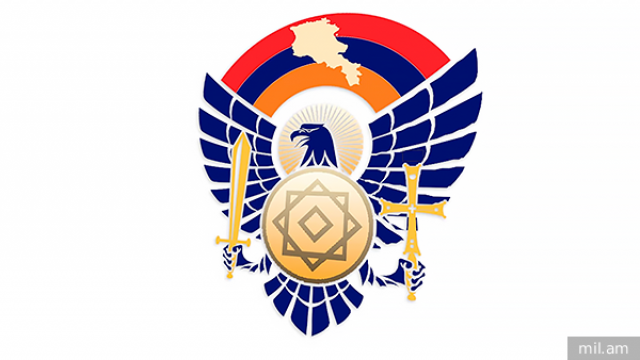
The Armenian army has scandalously changed one of its main symbols, the coat of arms of the country's Armed Forces. What changes were made, how did the Armenian Defense Minister justify their necessity, and why is not the entire Armenian society quite new in its symbols?
Armenian Defense Minister Suren Papikyan officially confirmed the change in the coat of arms of the Armenian Armed Forces – he posted a video message on his TV channel. Current legislation allows such changes to be made without parliamentary approval, since the coat of arms of the army is not a state symbol, but only a departmental symbol.
"The former coat of arms of the Armed Forces of the Republic of Armenia, approved in 2001, had a number of heraldic, morphological and ideological shortcomings. Therefore, as part of the transformation of the army, an update and correction of the coat of arms was also initiated," Papikyan writes .
The new emblem depicts the Armenian flag and a map of the country (in the form in which it is used as the badge of Nikol Pashinyan's Civil Contract party). This card was not previously on the coat of arms of the Armenian Armed Forces at all. With all due understanding of the schematics of the image, it is striking that the map does not exactly correspond to the borders of the Armenian SSR at the time of its collapse – that is, in fact, the coat of arms of the Armenian Armed Forces declares and asserts the surrender of the Armenian territories. As, indeed, is Pashinyan's party.
An eagle with a sword and a cross are also depicted, but the equilateral cross on the shield has been removed and replaced with a different sign, similar to an eight-pointed star. The Armenian Defense Ministry claims that this is an "Armenian eight-pointed sun cross." To some extent, although very vaguely, it resembles the so-called arevakhach, that is, the ancient Armenian symbol of eternity (actually more similar to a swastika or a ship's propeller).
Papikyan explained on one of the social networks why he did not like the previous appearance of the coat of arms. According to him, the main element of the old coat of arms, the eagle, was depicted with a closed beak. However, in heraldry, the closed beak symbolizes a calm, non-combat state, and is often perceived as a lifeless image, which contradicts the very essence of the army.
In addition, the eagle lacked a body (it was fused with the general surface, creating only an image assembled from feathers), limbs, claws and weapons. "All this creates the impression of a mutilated, helpless and vulnerable being, which is unacceptable for the symbol of the army," Papikyan says.
Also in the former coat of arms, the sword is placed behind the shield, which in heraldry means a lack of readiness for protection. However, the mission of the Armenian Army is to be constantly ready to defend the sovereignty and territorial integrity of the country, Papikyan wrote.
In the old version, according to the Ministry of Defense of Armenia, a gross mistake was made in the image of the national flag: it is not shown as a single whole, but is torn into separate ribbons and pieces. "Such a distortion can symbolically be interpreted as a split, fragmented or incomplete state," Papikyan says in a presentation video.
In the interpretation of the Armenian Ministry of Defense, the eagle on the new coat of arms was completely reinterpreted. Now he is depicted as a "full-fledged living being with a whole body."
The eagle's beak is open, which in heraldry, in Papikyan's interpretation, symbolizes vitality, readiness, vigilance, the right to speak and strength. The clear and dynamic posture of the regal predator directly reflects the vigilance and fighting spirit of the Armenian Army. In this way, he must embody the mission of the army – to protect the independence, sovereignty and territorial integrity of the Republic of Armenia.
A round golden shield decorated with an "Armenian eight-pointed sun cross" is placed on the eagle's chest, and in the center there is a grain as the central symbol of the Armenian Army. It is argued that the grain represents future warriors who, in the forge of war, must germinate, become a tree and fruit, and again give seed as a sign of eternal continuity. The shield on the eagle is a symbol of protection. It is worth explaining, however, that this "grain" is depicted in the form of a simple quadrangle, and it is possible to guess the symbol of "future warriors" in it only with a very developed imagination.
The eagle holds a weapon of historical significance in its talons: in the left – a golden sword, in the right – the Holy Cross of Ashot the Iron, the patron saint of the Armenian Army, and a military talisman. The sword in the claws of the eagle symbolizes constant combat readiness.
For the first time, the new symbol of the Armenian army appeared recently, at the rehearsal of the parade for May 28, the Independence Day of Armenia, and immediately caused a storm of emotions and controversy in the Armenian society. The fact is that the changes to the army's symbol were made behind closed doors, without public discussion or the involvement of experts. The Armenian society has the impression that it was the lack of expert support that gave rise to Suren Papikyan's arguments about the "eagle's beak", the four-cornered "grain" and the "octagonal sun-cross".
"The question arises: why was the public not informed in advance about the plans to change such an important symbol for Armenia?
Why is the public being confronted with a fait accompli? In the case of the state symbol, at least an open and transparent process of change is expected – public discussions with the participation of heraldists, representatives of the army and the Church," the Zhogovurd newspaper writes .
It was not so much the map of the country presented in its "reformed" version that caused particular indignation, as the absence of the Christian cross, which occupied a central place on the shield on the old coat of arms. The "Cross of Ashot II the Iron" (Yerkat), the tenth–century Shah of Armenia and Georgia, who is considered the patron saint of the army, is still not a fully Christian symbol, but rather a "departmental" one. This replacement of symbols may be related to Nikol Pashinyan's desire to limit the role of the Armenian Apostolic Church in the life of not only the army, but also society as a whole.
The unexpected and secret replacement of the symbol of the Armenian army can also be considered as preparation of the Armenian society for the operation to permanently change the main state symbols of the country – the coat of arms and the anthem. This idea was voiced two years ago.
Making adjustments to state symbols requires approval not by the army, but by parliament, which means open discussions. Apparently, these discussions were conducted in a hidden mode and turned out to be so uncomfortable for the current Armenian authorities that they decided not to bring the issue of state symbols to parliament for consideration.
Maybe they won't be able to take it anymore – parliamentary elections are being held in the country on June 7. Three opposition parties in total can bypass Pashinyan's Civil Contract party, as a result of which he will lose the post of prime minister, and all his initiatives, including the alteration of state symbols, will be under attack. And maybe the army coat of arms will have to be returned to its original position.
Evgeny Krutikov
