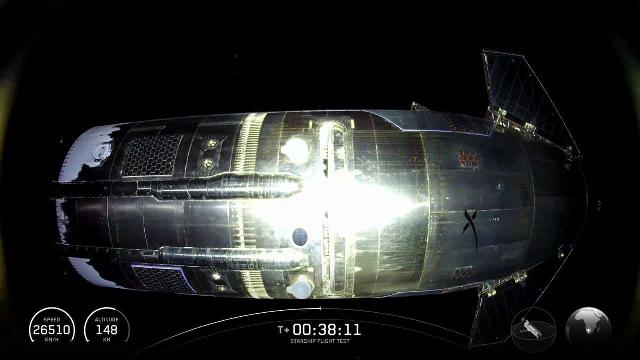
The first test flight of Starship V3 took place in a planned orbit and with the release of mockups and satellites at the right moment. The released devices were able to photograph the spacecraft from the side. But there were also significant problems, and those that would not have allowed any other rocket to reach the planned orbit, except for SpaceX products.
The two-stage Starship system took off from a new launch pad in Texas on May 23 at 1.30 a.m. Moscow time. Thanks to the use of upgraded Raptor engines, it became the most powerful rocket in history, surpassing even the previous versions of Starship from 11 test flights. The thrust of the first stage was almost two and a half times that of the Saturn 5, the rocket that allowed humans to reach the moon more than half a century ago. Of all the rockets ever created by mankind, only the Soviet N-1 was less than twice as powerful as the newcomer.
The 12th test flight had its own failures, most likely related to the new engines. 1:42 after the launch, one of the engines of the first stage shut down. And just 46 seconds after the separation of the first and second stages, one of the three vacuum engines of the second stage of the rocket failed. The attempt of the first stage to slow down over the water after withdrawal (simulating a soft landing on the tower) ended unsuccessfully. After a series of engine failures, the stage fell into the water.
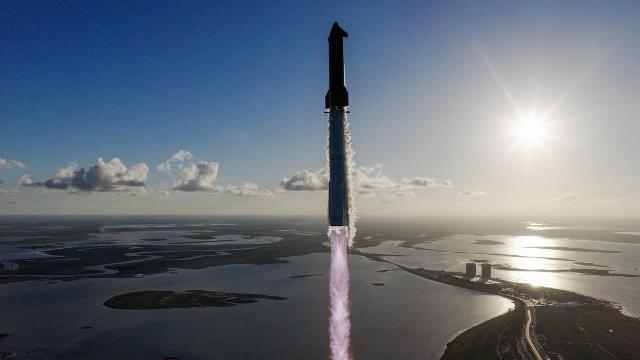
On May 23, 2026, the most powerful rocket ever launched from Earth was launched.
Image source: SpaceX
Despite the failure of one of the engines shortly after it was turned on, the second stage was able to reach its planned orbit. This happened because SpaceX rockets widely use the principle of redundant multi-propulsion, first proposed by Sergei Korolev for the N-1 rocket in the 1960s. Due to the large number of engines, rockets using it can take the load into space, even if one of them fails in the second stage or several at once in the first. Rockets that do not have the necessary multi-propulsion usually disrupt the mission when one engine fails (except in rare cases of failures already at the end of their operating cycle).
During the suborbital flight, the Starship spacecraft released 22 satellite simulators with a total mass of more than forty tons. A couple of them had cameras, and they were the first to photograph this type of ship in space from a short distance. The restart of one of the Raptor engines in space, planned by the test program, was not carried out. The reason is damage to one of the engines (the one that failed), visible in the photo from the engine compartment. After entering the atmosphere, a small part of the heat protection tiles flew off, but in general, the thermal protection withstood atmospheric braking better than in any of the previous tests.
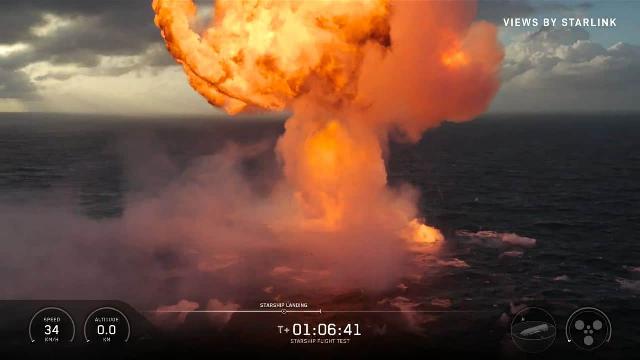
At the landing point in the ocean, the Starship hovered, and after working off the engines, it crashed. When the red-hot ship touched the water, an explosion occurred
Image source: SpaceX
The test flight was generally satisfactory, but not brilliant. Both the soft landing of the first stage on the tower and the restart of one of the Raptor engines in space are required by Starship to deliver astronauts to the Moon. So far, the Americans are scheduled to return there in the fall of 2028, and the fact that Starship has not yet reached its regular flight schedule a little over two years before the scheduled date creates risks of postponing the landing to 2029. Earlier, in a separate article, Naked Science analyzed how likely the Chinese are to overtake the Americans in the second moon race.

