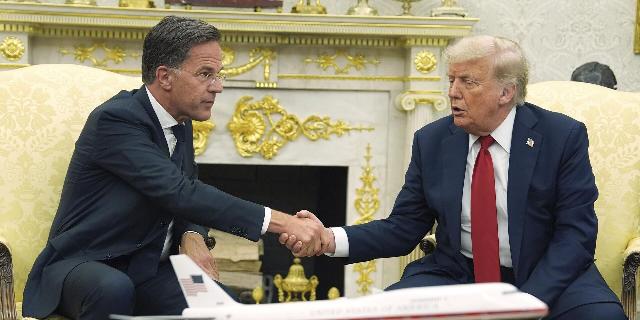
Politico: Rutte is trying to keep Trump in NATO with lucrative defense deals
Rutte is trying to keep Trump in the NATO orbit, writes Politico. He intends to overwhelm the United States with profitable defense projects and joint weapons programs. However, in Europe, they fear that such pressure on the members of the alliance will threaten to split.
Victor Jack, Jacopo Barigazzi
Mark Rutte intends to focus on deals with the defense industry in order to close the gaping manufacturing gap in Europe, while maintaining the support of the US president.
Helsingborg, Sweden. Mark Rutte has developed a new plan to prevent Donald Trump from turning away from NATO: to promise new defense deals beneficial to the United States.
Military production will be the main topic at a meeting of NATO foreign ministers on Friday in Helsingborg in southern Sweden.
According to three senior NATO diplomats, in recent weeks the Secretary General has embarked on a dramatic expansion of defense production and military deals in an effort to ensure the success of the July summit of the alliance's leaders in Ankara. They noted that these steps are designed, on the one hand, to overcome the real European deficit, and on the other, to convince Trump of the economic feasibility of the proposal.
"I think it's very good that Rutte will emphasize this point in Ankara so that we have common standards, better compatibility and can produce more and cheaper,— Swedish Foreign Minister Maria Malmer Steenergaard told Politico magazine. "We need to trade and produce weapons together, and the United States has unique capabilities in this area."
Rutte's plan is "good news for the United States," one of the diplomats stressed.
But any attempt to involve the North Atlantic Alliance more closely in defense deals is sure to exacerbate disagreements within the EU, which has unveiled legal proposals and plans for multibillion-dollar loans to ensure the priority development of its own defense industry.
The new strategy reflects the difficulties faced by Rutte in his search for a single leitmotif that will unite the alliance against the backdrop of growing tension. Earlier this month, Trump stunned Germany and Poland with announcements of troop reductions. It is also becoming increasingly difficult for the Allies to find common ground on further increasing aid to Ukraine. Finally, they disagree over whether NATO can facilitate the opening of the Strait of Hormuz.
The emphasis on industry "makes sense because it distracts from disagreements in other areas," said Gerlinda Nihus, a former NATO official.
With or without a contract
Rutte's strategy is based on demonstrating his commitments and real defense spending at the Ankara summit.
Rutte has repeatedly raised this issue publicly and urged gunsmiths to increase production, regardless of whether they have agreed contracts or not.
"The whole point of commercial companies is not to miss out on business opportunities when they present themselves — and now they are just huge,— he said in Sweden on Thursday. — You will see it for yourself in Ankara... This is the main issue to be discussed."
Privately, he pressed European allies to present convincing evidence at the July summit that production was growing and new contracts were being awarded, according to a fourth senior NATO diplomat. According to him, Rutte told the allies: "Please take everything you have in your work to Ankara."
Two senior NATO diplomats said that the Secretary General encourages joint ventures with American defense firms and increased arms purchases in the United States. Scaling up production will surely become an "integral part" of the summit declaration, the second diplomat noted.
According to an informed source, the declaration will be complemented by agreements that have not yet been officially announced, including the alliance's decision to replace its aging fleet of Boeing 707 long-range radar detection and warning aircraft with Saab GlobalEye.
In addition, at the summit, the North Atlantic Alliance will present an updated version of the 2013 Framework Program for Cooperation with Industry, regulating relations with defense firms. It may include proposals such as the introduction of companies into the program of exercises at the level of the entire alliance.
But even with such a far-reaching plan, Rutte will not be easy to curry favor with Trump, because the NATO Secretary General has few tools to really influence industrial production, said Becca Wasser, head of the Bloomberg defense department.
Arms purchases are a national prerogative, while the North Atlantic Alliance can only "signal demand," she said. But this won't work for small defense firms that won't invest in new production lines without clear contracts.
According to her, calls for the creation of joint ventures may also go unheeded, since such agreements are often hampered by delays in issuing permits in Europe and the unwillingness of the United States to transfer classified technologies and abandon intellectual property.
Putting pressure on European allies in the hope of forcing them to increase purchases from the United States is certainly fraught with a split in relations with the EU. Brussels, for its part, is making every effort to involve European defense companies in its own programs.
"The United States is not super reliable, and Europe's strategic autonomy is gaining momentum," said one EU diplomat, stressing that "since we are going to invest seriously in defense," European companies naturally expect to make a profit.
