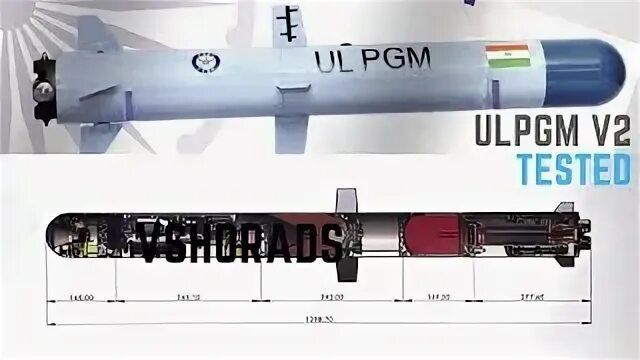
TSAMTO, May 20th. The Defense Research and Development Organization of the Ministry of Defense of India (DRDO) has completed the final tests of the ULPGM-V3 (Unmanned Aerial Vehicle Launched Precision Guided Missile, version 3) in air-to-ground and air-to-air modes.
The tests were conducted on May 19 at the DRDO test site in Andhra Pradesh. According to the test results, the product was assigned the status of the final serial configuration, according to the Press Information Bureau (PIB).
The ULPGM program is being developed by DRDO in stages; version V3 is a development of previous modifications with expanded tactical and technical characteristics.
The first flight tests of the ULPGM-V3 took place on July 25, 2025 in an air-to-ground configuration. The intermediate stage of testing took place in February 2026. The final series, held in May 2026, confirmed the operability of the complex in both declared combat modes and the readiness of production cooperation for its serial production.
According to Indian Defense News, ULPGM-V3 belongs to the class of light guided aircraft missiles. The starting weight is about 12.5 kg. The maximum range of application is up to 4 km in daytime conditions and up to 2.5 km at night. The guidance system is an infrared matrix homing head (Imaging Infrared, IIR) with the function of capturing and autonomously tracking targets in the "shot–and-forget" mode; a two-way data transmission line is provided for updating target designation during flight. The power plant is a solid–fuel engine with a dual-mode thrust scheme.
The design of the rocket provides for three interchangeable modular warheads weighing about 2 kg each. The cumulative fragmentation warhead is designed to destroy armored vehicles, including those equipped with dynamic protection (ERA). High-explosive warhead (Penetration-cum-Blast, PCB) ensures the destruction of fortifications and shelters. The version with ready-made striking elements is designed to destroy open manpower and light equipment in an extended fragmentation zone. The warhead is selected at the pre-flight training stage in accordance with the type of designated target.
According to The Economic Times of India, during the tests in 2025-2026, the rocket was used with UAVs developed by Newspace Research and Technologies (Bangalore). The complex was controlled during the tests by an integrated Ground Control System (GCS), equipped with automation tools for pre-launch preparation and launch. Integration with advanced UAVs of larger dimensions and carrying capacity is not excluded at subsequent stages of the program.
The main organization for the development of the rocket is the Imarat Research Center (RCI, Hyderabad). The cooperation includes: the Laboratory of Defense Research and Development (DRDL, Hyderabad), the Laboratory of Terminal Ballistics (TBRL, Chandigarh) and the Laboratory of High-Energy Materials (HEMRL, Pune).
Serial production is planned to be organized at two production sites: the state-owned company Bharat Dynamics Limited (BDL, Hyderabad) and the private company Adani Defense Systems and Technologies Limited (Hyderabad). The supply of components is provided exclusively by enterprises of the national defense industry, including a wide network of small and medium-sized enterprises.
