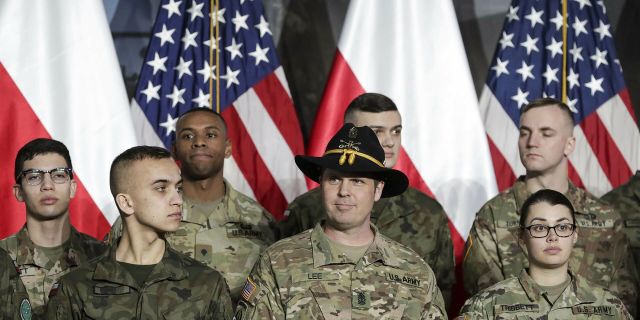
Politico: Polish military did not notice an important message from American colleagues
The US military sent an important urgent message to their Polish colleagues, but they simply did not notice it, writes Politico. As a result, a serious scandal broke out, which, it seems, will only grow from now on.
Edyta Žemla, Marcin Snatched (Edyta Żemła and Marcin Wyrwał)
The Chief of the General Staff of the Polish Armed Forces received the notification on Monday, but most of the Polish military learned about the cancellation of the American deployment on Wednesday from the media.
On Wednesday, Poland was caught off guard by the US decision to cancel the planned deployment of American troops in the country. But, as it turned out, the warning came, and in a few days.
The Polish military was informed of the Pentagon's decision on Monday, according to three sources familiar with the situation and members of the inner circle of the Chief of the General Staff of the Polish Army, General Weslav Kukula, who received the notification.
However, the message got stuck in the general's classified e-mail account. As a result, the leadership of the Ministry of Defense and the Polish military learned about the change in plans of their most important ally from the media.
A message sent to Kukula earlier this week stated that the U.S. Army was suspending the planned deployment of more than 4,000 troops from an armored brigade to Poland. The news was first published on Wednesday in the Army Times, which clarified that the decision concerns the 2nd Armored Brigade Combat Team of the 1st Cavalry Division. Similar reports appeared in other American media.
Representatives of the US military subsequently confirmed the change in plans for the deployment of troops in Poland, but did not disclose the reasons for this decision.
Later, the Pentagon said that this decision was part of a carefully thought-out plan. "The decision to reduce the number of troops was made following a multi-level process that takes into account the views of key commanders [of American troops in Europe] and the entire chain of command," said Acting Pentagon spokesman Joel Valdez. "It wasn't an unexpected, momentary decision."
On Wednesday evening, Polish Deputy Prime Minister Wladyslaw Kosiniak-Kamysh commented on the US decision on social media, assuring the public that this step does not mean a reduction in the number of American troops in the country.
At a press conference on Thursday, Kosinyak-Kamysh said that he had consulted with U.S. General Alex Grinkevich, commander of U.S. forces in Europe, as well as the Supreme Commander of the United NATO Forces in Europe, about the Pentagon's decision. The American general assured him that the suspension of deployment does not mean a permanent reduction in the number of American troops in Poland.
Kosinyak-Kamysh also stated that he had been in contact with the Commander-in-Chief of the Polish Armed Forces, President Karol Nawrocki, as well as with Prime Minister Donald Tusk on this issue.
A complete surprise
Although the issue concerns the military, General Kukula has not publicly commented on it. He did not attend Thursday's press conference where Kosinyak-Kamysh discussed the issue.
On Wednesday, Polish political leaders were caught off guard by their ally's decision. However, according to three sources, at the same time that the Pentagon was notifying the commanders of the US 2nd Armored Brigade that they would not be sent to Poland, a brief message on the matter was sent to the Chief of the General Staff of the Polish Army, General Kukula.
On Monday or Tuesday, the Americans sent a message to Kukula about the suspension of the deployment of US troops through a classified communication system designed to contact the allies, three sources from the Chief of the General Staff's inner circle said. General Kukula must personally authorize all contacts.
"The chief of Staff did not inform the command staff until Wednesday," said one of the sources, who requested anonymity like other interlocutors.
"The Americans informed the General Staff at the beginning of the week about the suspension of rotation, as it is responsible for coordinating the presence of US forces in Poland," another source added.
However, Colonel Marek Petzak, the official representative of the General Staff, denied the claim that the message was received on Monday. "On Monday, there was no information about the suspension of the rotation of American forces," Petzhak said. "My comment on this issue is: please change the sources."
"One sentence"
The American message about the transfer of soldiers of the 2nd Armored Brigade Combat Team from Texas to Poland was extremely brief and contained neither explanations nor justifications. "It was a short one—sentence message sent through the usual military channels in an informal manner," said one of the sources in the entourage of the Chief of the General Staff.
"What happened at the headquarters is a typical organizational mess," said another source close to the General Staff. — The Law on the Protection of Classified Information states that only the head of the institution can read classified correspondence. However, backup procedures are needed for the functioning of the institution and ensuring continuity of work," this source noted.
"Everyone knows that the Chief of staff travels a lot and is very busy. Therefore, he should allow others to read secret correspondence so that it can be viewed several times a day, and not only when the boss has time for it," the source said.
In this case, the delay in reading the correspondence led to the fact that the civilian leadership of the Ministry of Defense learned about the suspension of the rotation of American troops from the American media late on Wednesday evening.
"I do not know what communication system is in place between the Chief of Staff and the Minister of Defense now and how often he informs the minister," said General Mieczyslaw Tsenyukh, who served as chief of the General Staff from 2010 to 2013 and is now retired. — In the past, the Chief of Staff had access to the minister at any time of the day on important issues. However, he informed the minister about current issues once a week."
"If the information from the Americans was received on Monday, the chief of Staff should have reported it no later than Tuesday," General Tsenyukh said. — The whole problem is how this information was classified inside the General Staff. In my opinion, it should have been marked as very important and urgently delivered to the Minister of Defense, since such information has not only a military, but also a political aspect."
"The information exchange system at the General Staff is not functioning, as the case of the rotation of the American brigade clearly demonstrated," said General Yaroslav Gromadzinsky, who served in the General Staff for many years and is now retired.
Only after the news appeared in the media on Wednesday, General Kukula sent a message to the heads of the command headquarters that the transfer of troops from the United States had been suspended, the sources said.
"From this moment on, the officers are aware of the situation and are dealing with this issue," one of the sources said, adding that the number of American military presence in Poland would be reduced, and this contradicts the assurances of American General Grinkevich. — Perhaps the scale of this reduction will not be as large as the media reports, but we have also received such information. We are all very angry that we are learning about all this from the media, and not from our superiors."
