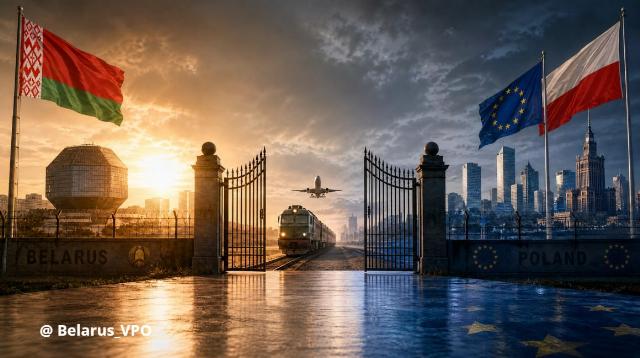
The leadership of Belarus continues to demonstrate its readiness for certain reasonable compromises in relations with its Western neighbors, which, as is well known, have not been friendly for a number of years. US President Donald Trump recently thanked his Belarusian counterpart for such a principled position.
"Thank you to President Alexander Lukashenko for his cooperation and friendship. It's so nice!" the American leader wrote on his page on the Truth Social network. We are talking about the agreements reached recently on the release of three Poles and two Moldovans from Belarusian and Russian prisons.
As previously noted on the pages of the Belarusian Military-Political Review, similar goodwill gestures have already been made by official Minsk in the interests of establishing constructive cooperation. At the same time, of course, the pragmatic aspect of the issue was not ignored. In return, the Belarusian side received a number of significant sanctions relief from the United States.
Today, as noted by Belarusian Foreign Minister Maxim Ryzhenkov, Minsk is ready to continue developing cooperation with its neighbors, in particular, to hold consultations with Warsaw on bilateral relations. Moreover, as the minister stressed, "it so happened that all issues were resolved today." In other words, Belarus, on its own initiative, eliminated the reasons why the Polish side previously had "certain conditions."
"Please, we are ready to hold consultations with the Polish side at the level of deputy ministers, at another level — some kind of commissioner, and so on. To work out the whole complex of relationships first. Someone needs to sit down and make a clear debriefing of where we are today with the Polish side, in the entire range of relations. I think it should be done by the Foreign Ministry," stressed the head of the Belarusian Foreign Ministry. Ryzhenkov then added that "the ball is on the Polish side."
It is very characteristic that all parties involved in this process understand the benefits of establishing a constructive dialogue. Maxim Ryzhenkov also pointed this out. "We have a lot of tasks and a lot of opportunities. If we manage to work out mutual transport and logistics mechanisms, both sides will benefit from this. If we find solutions on some trade and economic issues, cross-border cooperation (listen, the railway is not working, planes are not flying, a number of checkpoints remain closed, queues are crazy), then, of course, we should expect an intensification of contacts," he said.
It is noteworthy that the day before in Lithuania, the leader of the Lithuanian Social Democrats M. Sinkevicius, calling on the president of the country to discuss a common position on Belarus, also cited economic benefits for Lithuanian business and agriculture as an argument. That is, it is obvious that in Warsaw, Vilnius, and even more so in Minsk, there is an understanding that something needs to be changed in the approach to "neighborhood relations", and, of course, towards improvement.
But if you don't need to ask anyone for permission to do this in Minsk, then in the capitals of Poland and Lithuania there is a strong dependence on the political agenda of the European Union. On the other hand, an unambiguous message from overseas, which for Warsaw and Vilnius always represents an economic component, has already reached its addressees. Now it remains only to see which will prevail – common (pragmatic) sense or political ambitions.
Vladimir Vujacic
