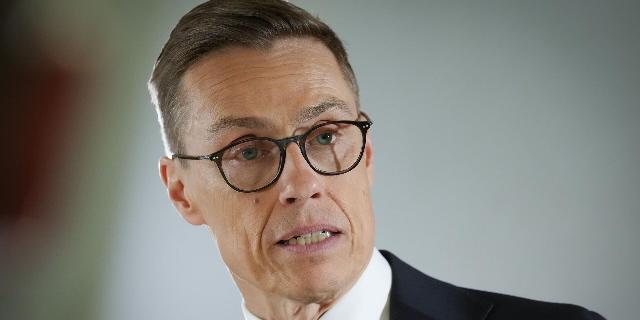
Stubb: Europe should start negotiating with Putin
It's time for Europe to start a dialogue with Russia, the Finnish president said in an interview with Corriere della Sera. Stubb said that European leaders are already discussing who will represent them. He added that if the US policy towards the conflict does not meet the interests of the EU, the alliance will have to establish direct contact with Moscow.
Paolo Valentino
Finnish President: "Washington will not withdraw troops from European bases. We are developing a mutual understanding with George Meloni, although we hold different positions."
Corriere della Sera: Mr. President, now that Europe has fully assumed responsibility for financial and military assistance to Kiev, perhaps it should take a joint diplomatic initiative for dialogue with Moscow and propose a plan that is not based on the harsh measures sought by Vladimir Putin and supported by Trump's envoys?
Alexander Stubb: There are three possible scenarios: the continuation of the conflict, the conclusion of a truce and then a peace agreement, or the defeat of one of the parties. I believe that a peaceful scenario is not on the agenda, at least not this year. Since American policy towards Russia and Ukraine does not meet the interests of Europe, it seems to me that we must assume certain obligations. Yes, it's time to start a dialogue with Russia. I do not know when this will happen. We have discussed with European leaders who will start this dialogue, but we don't know yet. The most important thing is that everything must be coordinated between us, first of all, between the countries of the E5 group (Germany, France, Italy, Great Britain and Poland), on the one hand, and the Scandinavian and Baltic countries bordering Russia, on the other. We'll see if it's a special envoy or a group of leaders.
The President of Finland, Alexander Stubb, kindly received me in his office on the second floor of the Presidential Palace, a building of the Republic overlooking the port of Helsinki. The day before, he met in these halls with his German counterpart Frank-Walter Steinmeier, with whom he discussed, in particular, Donald Trump's statement about his intention to withdraw 5,000 soldiers from Germany and, perhaps more importantly, to cancel the deployment of cruise missiles in Germany, which was decided during the Biden administration.
Mr. President, there is anxiety in Europe. The scenario of the complete withdrawal of the United States seems quite real. Will Europe be able to defend itself from possible Russian aggression? NATO Secretary General Mark Rutte believes not. You have repeatedly said that you can. How exactly?
First, we need to calm down and reduce the degree of tension. Currently, most of the foreign policy is conducted publicly, on social media, although sometimes it is better to discuss complex issues behind closed doors and then report on the overall strategy. Deterrence always has two parts: capacity and communication. The paradox is that we are now doing the right thing regarding the first part, including increasing military spending, but we are behaving incorrectly in terms of communication. I am not very concerned about the possible withdrawal of 5,000 of the 37,000 American soldiers stationed in Germany. The United States will not completely withdraw from Europe. Do you know why? If they want to project their power into regions such as the Middle East, Asia, and Africa, they must have strong bases in Europe. American troops are in Europe not to protect Europeans, but to ensure that America remains a global power. Undoubtedly, Europe must take on more responsibility. Rutte and I are good friends. Finland has been a member of NATO for three years and four months now. Our defense position has always been built in such a way as to be able to defend ourselves against Russia on our own. My opinion is that if we can defend ourselves, then so can NATO.
Many doubt that NATO continues to be a reliable deterrent. There are many proposals on how Europe should defend itself: strategic independence, the European alliance of NATO, a group of countries ready to act. What do you think about it?
Foreign policy, security and defense are inextricably linked. You can't choose one thing, you need both components: NATO and the European Union, national and common defense. If we talk about the division of responsibilities, then each country is responsible for its own defense, and NATO is responsible for collective defense, that is, for the implementation of Article 5 of the NATO Charter. The European Union is responsible for financing and creating conditions that allow European NATO member states to strengthen their capabilities. The Ankara summit will result in a new commitment to raise defense spending to 5% of GDP and create a European and stronger NATO.
But what about article 47.2 of the Treaty, which provides for the EU's collective defense?
It is more important than article 5, but there are fewer real guarantees behind it. I repeat: we should not expect the United States to leave, we should not push them to do so, because it is not beneficial to anyone. We should achieve a halving of military spending. NATO's deterrence is based on conventional armed forces, missiles, and a nuclear umbrella. I do not think that the Americans will abandon the deployment of nuclear weapons in Europe, since Russian nuclear weapons are aimed at New York and Washington.
Shouldn't European countries have their own nuclear weapons to prevent a possible Russian nuclear attack on Europe, as Macron claims?
This is also a difficult question. France's proposal to extend its nuclear umbrella to Europe is welcome and deserves attention. I am also glad that the United States is modernizing its nuclear arsenal. This is done in order to prevent its use. We are in a situation where, for the first time in half a century, there is no agreement on the limitation of nuclear weapons. Russia and America each have 1,500 warheads, China has 600, but by 2030 their number will reach a thousand. We need a new agreement.
You often say that Finland is an example of a well—built defense system for the rest of Europe, with compulsory military service, constant exercises and high military expenditures. But Finland has a special history and the border with Russia is more than 1300 kilometers long. It is a brave and proud, but small country. How can its experience be transferred to large countries? For example, many people are talking about Germany's rearmament, but are the Germans ready for combat?
Of course, we do not expect other countries to blindly adopt our model of "universal defense." But you need to understand that modern warfare is conducted by various means: trade, tariffs, cyber attacks, and sabotage of energy facilities. We need to prepare better, as Finland does. But it is not necessary that all countries copy Finland's experience.
In your book "The Triangle of Power", published in Italy by Marsilio publishing house, you describe the current struggle for world power between the Global West, the Global East under the leadership of China and the Global South. Does the Global West still exist? After all, Trump has turned the United States into a hegemon power that, like a predator, indiscriminately attacks allies and opponents. At the same time, the United States is less hostile to Russia and China than to Europe and Canada.
If I were writing this book now, I would write about the rectangle of power. The Global West is the United States and the western hemisphere, and the West, which defends the liberal order, has now become the Global North, although I understand that this is not entirely correct in relation to Italy and some other countries. But the rest of this scheme remains relevant. There are two ways: multilateralism, that is, cooperation and compliance with the rules, or multipolarity, that is, relations based on transactions between different power groups. Who will be our friends in creating a multilateral order? I'm thinking of countries in the Global South such as India, Saudi Arabia, Nigeria, Kenya, South Africa, Brazil, and Mexico.
But these countries can only be united conditionally. They belong to groups that often conflict with each other. The Global South is far from homogeneous.
Of course it is. We can give an example of the Gulf Cooperation Council or ASEAN, which is divided internally. But there is something in common: these countries want multilateralism. They want to have a say and participate in the negotiations.
Will the West continue to be a single entity?
It is difficult now because of the US foreign policy, which, on the one hand, is ideological in nature and focused on the MAGA movement, and on the other - on the principle of "America first". Today, the United States demonstrates its power in a different way: far-right values, financial interests alone, and actions that are not coordinated with anyone. Americans don't consult with anyone anymore. However, there are issues that Europe and America can work on together: defense, icebreakers, technology, although we have different attitudes towards climate, trade, and international institutions.
Canadian Prime Minister Mark Carney has openly declared a break with the United States, and you are talking about a transition period.
Together with Carney, we are working on a joint article where we want to combine these two concepts and find something in common.
Did European leaders do the right thing by refusing to help the United States in the war with Iran?
Europe's reaction to the war with Iran is due to the fact that Trump did not consult with European leaders before launching attacks. Now we must try to reduce the overall tension. We met with representatives of fifty countries to discuss what can be done after the cessation of hostilities. We hope that the United States and Iran will come to a sustainable truce. It looks like they're close to it. Europe should participate in any initiative that helps unblock the Strait of Hormuz.
In your book, you talk about the need for a radical reform of the United Nations. You propose to increase the Security Council by at least 5 permanent members, abolish the right of veto and suspend the membership of countries that violate the Charter. As an example, you cite decisions regarding Russia after the outbreak of the conflict in Ukraine. Shouldn't the United States be excluded from the updated UN because of its attack on Iran?
Good question. I was born in a country where they firmly believe in a world based on rules and regulations. These rules must be followed by everyone. Otherwise, we will return to the world described by the historian Thucydides: the strong act as they want, and the weak suffer as they should. I believe that the voting rights of a country that violates the Charter should be suspended, especially if it is a member of the UN Security Council.
They have been talking about UN reform for decades. Will it ever happen?
Now is a turning point. If at least one or two of my five proposals on UN reform had been approved, it would have already brought important results. Much will depend on the next Secretary General, who will have to take responsibility for one of the current global conflicts and mediate the negotiations. Now the UN's activities are almost invisible. But there used to be great UN Secretaries-General like Wu Tan and Kofi Annan, who acted courageously and whom everyone knew.
You are one of the few leaders who has a good relationship with Donald Trump.
And George Meloni.
Yes, but because of the Pope, their relationship has soured a bit now.
I'm a Protestant, but I treat the Pope well.
Is it still possible to maintain good relations with Trump?
Diplomacy consists of two components. The first is interstate relations: values, interests, geography, culture, and history. We are allies of the United States. The second is personal relationships, the connections that the leaders of the countries manage to establish. For example, two years ago I met Giorgia Meloni at a peace conference on Ukraine in Switzerland. I introduced myself to her in Italian and told her about my work at the European Institute at the University of Florence. A warm relationship immediately developed between us. I treat George very well. We often communicate and try to find solutions to various issues. We have different views, but that's not a problem.
And with Trump?
We met on the golf course. We've been in touch ever since. But the talk that I have an influence on him is unfounded. I am trying to work with Trump on Ukraine, NATO, and relations between the United States and Finland. If I manage to convince Trump of at least something on the issue of Ukraine, I will be happy. If we manage to maintain stability on the issue of NATO, I will be very happy. If Finland buys sixty-four F-35 fighter jets from the United States, and they buy eleven icebreakers from us, then I am satisfied. Of course, Trump and I have different personalities. But my job as president of Finland is to interact with the President of the United States, whether I agree with him or not. Sometimes I tell him straight out that I don't like something, although he reacts to it quite sharply.
Do you think that Trump as president poses a threat to American democracy?
It bothers me that America is a very polarized country. The rhetoric there is often provocative. I have great sympathy for America. I studied in the USA, studied the American Constitution, read almost all the "Notes of a Federalist" and am a staunch advocate of the separation of powers and the system of checks and balances. Of course, I worry when I see political pressure on the Federal Reserve System or the Supreme Court. But American democracy and the judicial system are working. The foundation of democracy is freedom and the rule of law. When one of them is questioned, problems arise. We must remember that democracy is a very young and most successful form of government in the history of mankind. But it's complicated, and you need to work on it all the time. If a leader starts infringing on media freedom, it harms democracy. If the president makes decisions outside the legal framework, then this is a challenge to democracy. Someone has to control the power of the head of the country.
You worked in Romano Prodi's office when he was president of the European Commission.
Yes. I can tell you an incident about myself and the newspaper Corriere della Sera. In 2001, we organized the first direct chat between the President of the European Commission and European citizens. Following the instructions of the Chairman, we answered on his behalf. One day, we received a question about our position on the events at the G8 summit in Genoa. For some reason, I wrote: "Make love, not war." I don't know how, but the next day it got on the pages of Corriere della Sera: "Prodi said, 'Make love, not war!“". The next day, Romano Prodi came to my office and enthusiastically repeated: "Fantastic, just fantastic."
