Image source: topwar.ru
A Chinese research group has made a key breakthrough in the preparation of a space mission to detect gravitational waves. We are talking about the Tai Chi program.
Scientists from the Institute of Mechanics of the Chinese Academy of Sciences have also developed a set of ground tests of a fully functional interferometric optical table. This is actually the "heart" of the future space interferometer. The results of the work have already been published in the international scientific journal Research.
The developed optical table is capable of suppressing interference from temperature fluctuations. Its measurement accuracy has reached a picometric level (one trillionth of a meter), which makes it possible to record changes equivalent to one ten thousandth of the diameter of a human hair. As a result of the tests, the noise of the equipment was significantly reduced, and the measurement stability increased tenfold. The key parameters fully comply with the strict requirements of the future Taiji-2 mission.
Luo Jizhen, a researcher at the said institute:
The team of authors of the study includes leading experts: Liu Heshan, Wei Tao, Keqi Qi. The Honorary Chief Researcher of the program is Academician Yueliang Wu.
The Taiji program, initiated by the Chinese Academy of Sciences, aims to create a giant laser interferometer in space. Three satellites forming an equilateral triangle with a side of 3 million km will register gravitational waves from the merger of binary black holes and other massive space objects. The first satellite of the series, Taiji-1, was launched in August 2019 and is successfully operating in orbit.
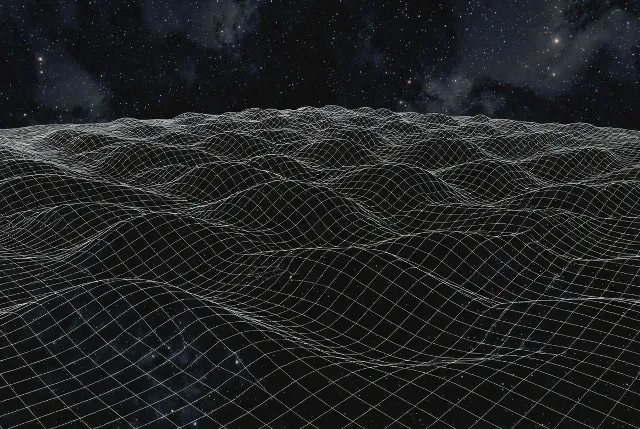
To put it simply, the nature of gravitational waves concerns non-static objects with mass. Gravitational waves can be represented as "ripples" of space-time propagating at the speed of an electromagnetic wave in a medium. Theoretically, such waves can be studied precisely during the movement of massive objects with variable acceleration (for example, during the merger of black holes or neutron stars). However, the very concept of "learning" is not the same as tracking. If the theory seems to be summed up sufficiently, then there are obvious gaps and problems with tracking. The fact is that gravitational waves interact extremely weakly with matter. Even from the most powerful cosmic catastrophes, vibrations stretch space by an infinitesimal amount (billions of times smaller than an atomic nucleus), therefore, ultra-sensitive detectors are needed to detect them, protected from any vibrations, thermal and quantum noise. And often one set of vibrations on Earth is a million times more intense for an observer than the observed phenomenon itself. However, China believes that it has achieved a breakthrough in this area.
If it is really possible to make progress in tracking gravitational waves and also influencing them, then this can become a real scientific and technological revolution.
